
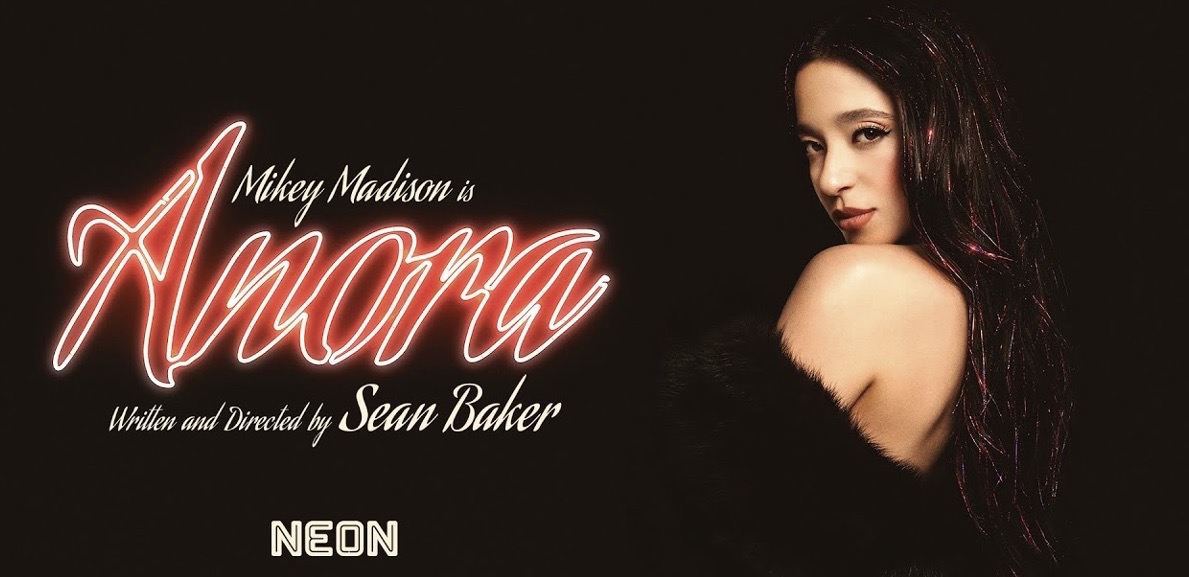
TW: Sex and Sexual Assault
Sean Baker’s tragic, romantic comedy-drama took the most recent Oscar’s ceremony by storm and clinched the best actress award Mikey Maddison, who plays the eponymous heroine. There’s no doubt that from the opening seconds of the film, Maddison grabs the audience by the throat and does not let them go, and I do think it is safe to say that she is key to the film’s success. I’ll admit, certain narrative points within the film did lose me, but it cannot be denied that the film had a lot of interesting points to raise about the sex industry, class, treatment of women and the fairytale narrative.
Let’s start with our heroine. I found the name ‘Anora’ to be intriguing and beautiful, it almost has a princess quality, probably due to its suffix, reminiscent of Disney heroines such as Cinderella, Tiana and Aurora, ex cetera. Already I am drawing links to Disney narratives! In Latin, ‘Anora’ translates to ‘honour.’ Although to me, the name seemed quite unique, Anora prefers to be known as ‘Ani.’
Immediately, Ani feels different – she crushes existing stereotypes with her heels. Ani is not a sex worker because she was trafficked, or forced, or destitute, unlike other fictional heroines such as Fantine. She is in her control; this is her choice. This is why we are drawn to her, she stands out, and her brassy Brooklyn accent is instantly distinct and recognisable. She also does not comply with the ‘hooker with a heart of gold,’ stereotype either, an example of this being Julia Roberts’ Vivian March from ‘Pretty Woman.’ Ani is brash and ballsy; we see her in the opening moments of the film wrapping men round her little finger with ease, and going for what she wants.
The film has received praise for its depiction of the sex industry, and for me, the film appeared to demystify and decriminalise it. Scenes of Ani dancing are intercut with scenes of her having a cigarette break with a friend, and eating her dinner out of a Tupperware box. The film is trying to say that the structure of her life is not that different to ours. The job she is doing is different, but then… my job is probably different to yours. She lives as we do. She works, she laughs with her friends, catches up on sleep, she parties. She is not discriminated against because of her personality, but only because of her job. This is evidenced by Vanya’s Russian, oligarchical family, who, without even meeting Ani, declare that their son has ‘shamed’ his ‘family by marrying someone like’ her. It feels like the film is asking us why. Why is she so discriminated against for her work? She is just a young woman making a living, which surely, many people of all genders and ages can relate to.
We see her go home in the morning, make up free in her beanie hat. It could be conceivable to think that dollars we see Ani receive, the dizzying bright lights, dresses and heels imply that she earns a lot of money. The film further normalises her by presenting her as a standard twenty-three-year-old in a flat share with her sister. All these plot points work to break the stereotypes that already exist around sex work, and sex workers themselves.
I think it’s important to remember from the start that Ani is only twenty-three. She is incredibly young. She does seems older, as Ivan points out, but this is probably due to her clothes and confidence. Her youth and girlishness are hinted at by the tinsel in her hair that shimmers throughout the film. Note the how the colours change. While she is in her abrupt wedded bliss with Vanya, it is a shocking pink.
The first half of the film does indeed play like a Disney fairytale. Ani is swept off her feet, has a world-wind romance and marries a wealthy suitor, Vanya. It is important to note that Ani does not see Vanya as a way to leave her sex work behind but work in general behind. Ani seeks freedom from the tedious, boring nature of work. Don’t we all? She is not looking to be saved from what others perceive to be a shameful profession. She is not ashamed of her work. I originally doubted if the relationship was genuine on Ani’s part, because we see her flatter her clients all the time. However, after remembering her age, I think it is conceivable. I think many twenty-three-year-olds would see Vanya’s lifestyle as an escape from the mundane. We also see this genuine nature reflected in her make up. Her look becomes more natural in the film, as we begin to peel back the layers of her character. She becomes more transparent and vulnerable, as her relationship with Vanya progresses. Both her and Vanya are swept up in the moment and make that age old mistake of ultimately mistaking lust for love.
The situation Ani finds herself in is very different to what she is used to in the nightclub, and just proves that the power dynamics in the nightclub are just a simulation. In the night club, women hold the cards, men hold the dollar bills. On the outside world, I Baker’s Brooklyn, women, especially of Ani’s age and class, do not have this power. This is proved throughout the film, as she is berated and manhandled by the men around her, first and foremost because they are men, but also because they possess greater wealth than her. Now, it is the nightclub that looks like a fantasy land, as in Baker’s real-world Brooklyn, a woman of Ani’s age and economic status is no match for the wealthy man.
Vanya’s poor treatment of Ani speaks to the wider theme of men’s treatment of women in the world. Vanya is spoiled, and sees Ani as a possession, he literally buys her as a plaything in his playground. He then discards her when told to by his family and replaces her with a co-worker. Vanya’s abandonment of Ani is incredibly traumatising for her as it leads to her encounter with his bodyguards.
Ani finds herself in a scary situation once Vanya’s family bodyguards come for him and try and force the two to divorce. Ani is bound and gagged, and in a disturbing image, bodyguard Igor pulls Ani on top of him, almost simulating a lap dance, but in this dance, Ani is not in control. She is forced into silence by the men around her, which seems like a broader thematic statement about the treatment of women. The blood red of the scarf used to gag Ani could refer to passion and sexuality but is also disturbing as it the colour of blood. It could therefore imply the potential violence that Ani could be subjected to in this situation. At the end of the film, Ani asserts her belief that, if given the chance, Igor would have raped her in this scene.
Igor brings the red scarf with him on their quest to find Vanya, offering it to Ani when she becomes cold. Ani wraps it around her neck. It seems like she is taking back control here, but her choice to wrap it around her neck simulates that of a hangman’s noose, implying the desperate, and perilous situation she has found herself in. The changing use of the scarf contributes to the wider question of control in the film. Is Ani ever in control? Or is she constantly controlled?
After realising she is no match for Vanya’s wealthy family, Ani agrees to leave Vanya for the sum of ten thousand dollars. This negotiation scene simultaneously gifts Ani with control but also takes it away. She wins, because she has the money, but she is still being bought, and controlled. This led me to wonder whether people would see Ani as a gold digger, but this presents an interesting discussion of gender. Would someone consider Ani a gold digger because she is a woman? What is the male equivalent of a gold digger? Although not explicitly gendered in its form, the phrase ‘gold digger,’ is almost exclusively associated with women, not men.
We close the film with a conversation between Ani and Igor. It is here Ani claims that Igor would have previously raped her. For her, it is inconceivable to think that someone would not want sex from her. Despite their difficult relationship at the beginning, Igor later shows kindness to Ani and defends her, proclaiming that she deserves an apology from Vanya. Some commentators claim that it is the relationship between Igor and Ani that would blossom into genuine romance. Whilst I would not personally say that their first meeting could be described as a meet-cute, they certainly start with the bickering and dislike, and then end in an intimacy.
We see Ani incredibly vulnerable at the end of the film with Igor, and when simulating sex with him, she takes control and places herself on top of him. Unlike Vanya, Igor does not break eye contact with her, and it presents the most intimate portrayal of intercourse in the film. Vanya would not look Ani in the eye during their furiously fast coital sessions. Ani’s relationship with sex is complicated, and I did wonder why she would want to engage in sex with Igor at this moment. Perhaps she needs comfort after what she has just experienced, or perhaps it is because she only encounters men who want sex from her. This is the only thing she knows. This thread, however, does not appear to empower Ani, and victimises her further, massively contrasting how we first saw her at the club in Brooklyn.
It is also tragic, as Ani finally has the space to process her trauma and breaks down in tears. There is also the realisation that despite this experience, nothing in her life has really changed. To the outsider, her life almost seems worse, as the last few frames of the film are less aesthetically pleasing and exciting than the opening of the film, Ani strutting across the club floor. Unlike the classic fairytale formula, Ani does not ascend to wealth, riches and happiness, but seems to fall much further as it all comes crashing down. Unfortunately, there is no happily ever after here. It appears that this film is very much a fairytale that is grounded in reality.
Thanks for reading!
 Khambay's Words, Words, Words