

The Bush Theatre’s newest show, written and directed by Mohamed Zain-Dada and Milli Bhatia respectively, follows four British Asians whose paths cross at a speed awareness course, set in the basement of a Birmingham-based hotel. A play with an all-Asian cast, writer and director slots well into the Bush Theatre’s rich history of giving a platform to underrepresented voices, and whilst veiled in comedy, ‘Speed’ successfully uses its intimate setting to tackle the wider themes of South Asian rage, trauma and identity. Fasten your seatbelts.

The main question Nikesh Patel’s Abz, as course facilitator, asks is what has made the three participants so angry? They are girl boss Faiza, nurse Harleen and delivery driver Samir. Although initially appearing as stock characters, the play successfully uses its setting to pile on the pressure and dig deeper into their respective psyches. Abz notes that they are ‘mirrors’ of each other. By that logic, the characters mirror us as well.
The action takes place on a central stage, adding to the interrogatory feel of the production – these four characters are under the microscope, surrounding by our prying eyes, rabbits in headlights. This also allows the audience to feel as if they are participating in the course, in the way that a traditional theatre set up would not. Throughout the 90-minute production, we see characters bend and break, resulting in an emotionally charged therapy session.
Spoilers to follow…
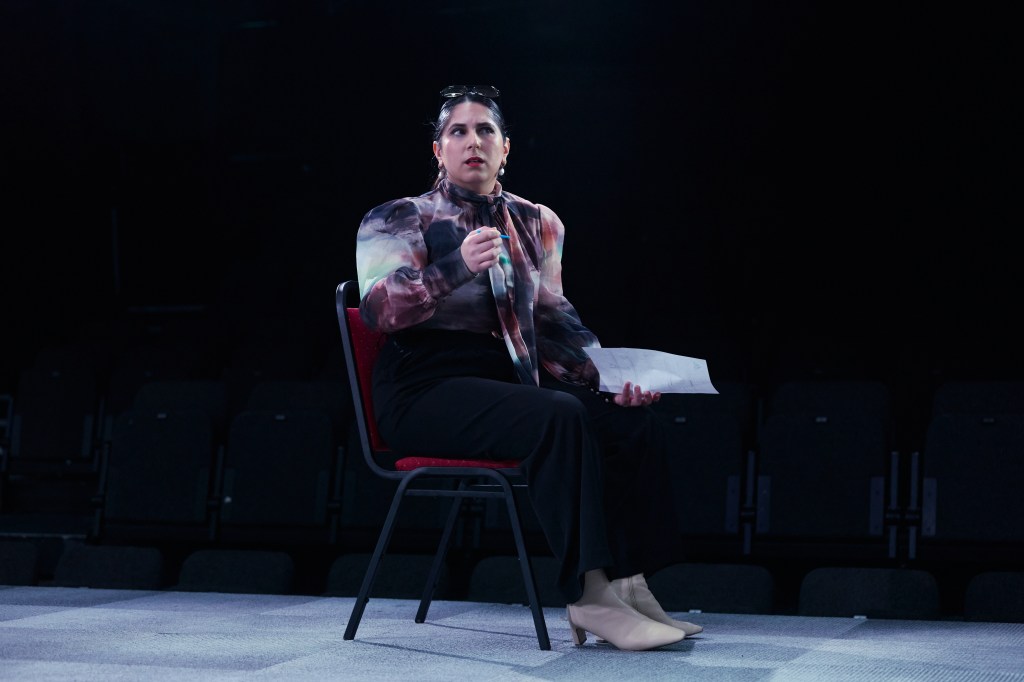
The characters’ varying acceptance of their Asian roots initially causes divides. Sabrina Sandhu and Arian Nik’s Harleen and Samir are in touch with their Asian identity, dropping words in Panjabi and Urdu. However, Shazia Nicholls’ brilliantly comedic Faiza is prouder of her St Albans heritage and is complemented when Samir opines that she ‘don’t look Pakistani.’ Her distinct departure from her Asian side, as we later discover, might have more practical reasoning. She details that one of her business ventures fell through because ‘the FSA don’t want brown women to succeed.’ Although this garnered laughs, it speaks to the wider theme of the struggles that women, specifically Asian women, face in the business-world. Faiza has had to fight to earn that BMW, and perhaps suppress her Asian-ness in the process. The idea that South Asian’s need to downplay our identities, and that they could be under threat, is revisited throughout the play.
The simple question of what has made Faiza, Samir and Harleen angry and end up on the course is fairly simple – the patriarchy, unfair and unsympathetic systems, and racial abuse. Faiza, Harleen and Samir stand by the actions that led them here, as do we, but Abz refuses to look at each of their stories holistically, instead concluding that the law, no matter the injustice that they faced, should be upheld.

Abz, coupled with the DVLA, is representative of a system of reform. RUNDI, a speed awareness course of Abz’ own devising is what is on trial here, as well as the three participants. He believes in meaningful engagement and the idea of ‘unlearning and rehabilitating.’ His maintenance of these ideals, as well as the distinctly British phrase of ‘keep calm and carry on’ means that he fails to consider each participants’ individual identities and experiences. We see this early on when he continually calls Harleen ‘Helene.’ I go by Harpal, or Harps, but have had Hearts, Harpy and Harpull to name a few botched examples of my name. The irony is that, while Abz encourages this meaningful engagement, he fails to properly engage with those in front of him, enforcing a ‘one size fits all’ system. It is throughout the course of the play that we see that this is wholly untrue, and if it does not work for these three, why would it work for wider society? This little microcosm, this mirror, is deftly used by Zain-Dada to make broader statements about British society.
A good example of this is the discussion about the race riots last year. The play does well to include this, as the situation last summer presented the greatest racial unrest I have experienced in my lifetime. I was advised by people in my high street to go home for my own safety. Whilst Harleen and Samir detail the racial abuse they witnessed and experienced, Faiza is silent and Abz maintains that, despite this horror, we should ‘take it on the chin,’ and keep calm and carry on. Sabrina Sandhu shines as Harleen here, her passion and controlled anger crackles under the surface and gives her enough confidence to silence comedy duo Samir and Faiza, and authoritarian Abz. Samir and Harleen ask why South Asians should be silent in the face of racial attacks, and calls out the very behaviours that many of us have over the past year.
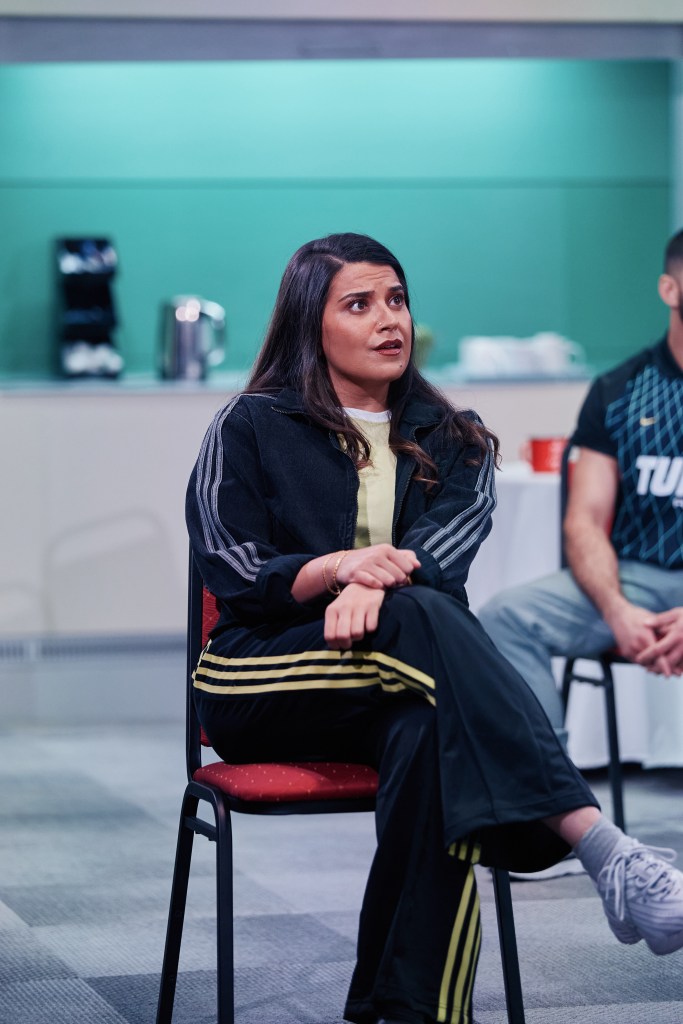
As the tension between the four bubbles over, ‘Speed’ puts its foot down veering into the thriller genre with the revelation that for all his high and mighty behaviour, Abz has not been honest. After some shouting and road rage, albeit without the car or road, the wheels fully come off and Abz is forced to admit that, after also being racially abused, he engaged in dangerous driving that had dire consequences. Unfortunately, this gear switch may not come as a surprise, Jessica Hung Han Yun’s lighting throughout the play foreshadows some sort of trauma. However, this revelation gives Patel the chance to show his range, and his quick switches from disciplinarian, desperation and devastation succeeds in making this plot point genuinely affecting.
Abz’ suppression of his Asian side, in response to his racist encounter, has manifested into internalised racism, hinted at throughout the play by his desire to save the participants from what he describes as their ‘base selves.’ His paternalistic attitude towards the participants echoes the very historical arguments that white supremacy and racism were founded upon. Although Faiza did indulge in some of the stereotypes that Abz perpetuated, referring to Samir as a typical ‘brown boy,’ her distancing from her Pakistani roots has not marred her judgment to the point at which she can be described as racist.
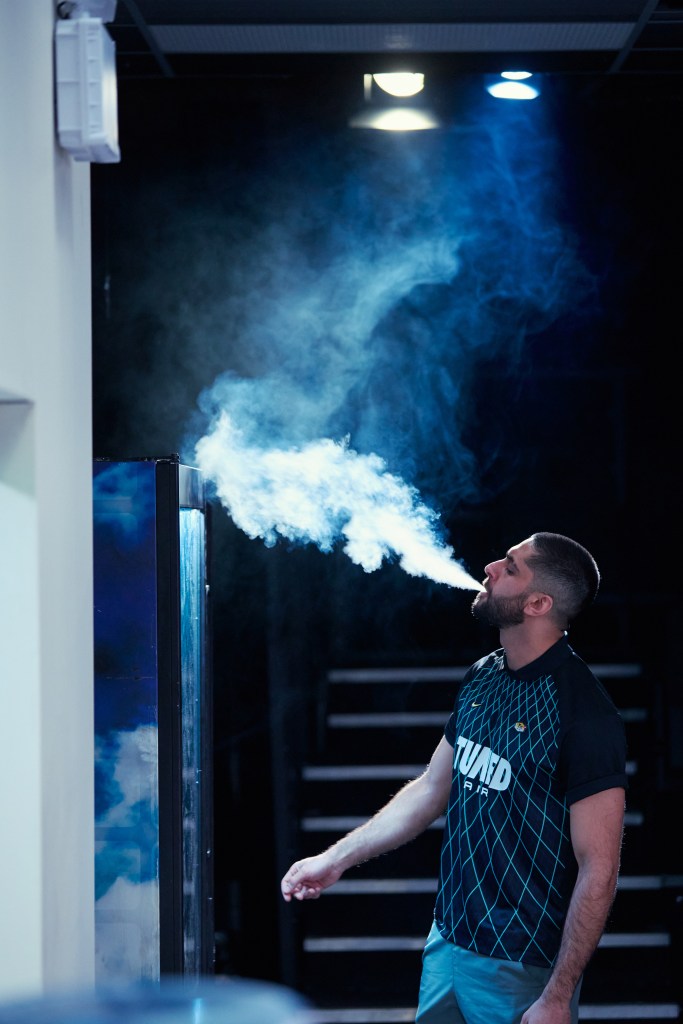
Due to Abz’ harsher treatment of Samir throughout the play, even going as far to refer to him as a ‘typical paki,’ it is fitting that the pair close the show. Although both men have bared their souls, a rarity for South Asian males, but a staple of Zain-Dada’s work, see ‘Blue Mist,’ Abz and Samir cannot come to an understanding. Both Abz and Samir, and by extension Patel and Nik, come full circle, shedding the stock characteristics established at the beginning, of the disciplinarian and the joker, to add real nuance to their characters in the closing moments. They are two sides of the same coin, their experiences of racial prejudice are similar, but their response, perhaps due to their differing age, and how they deal with their trauma are markedly different. The ending is not quite the ‘let’s unite against racism and celebrate our cultural heritage’ message that audiences might expect or hope for. ‘Speed’ poses bigger questions, asking what will become of South Asians if we do not unite and find strength in our shared experience, even if that experience involves the trauma of experiencing racial discrimination.
While Abz’ revelation may not be break-inducing, the play succeeds when it speeds towards the wider themes of South Asian rage, trauma and identity. The nuanced presentation that the plays characters and themes showcase makes for compelling, revealing, and relevant viewing, especially for members of the South Asian diaspora. It’s certainly a speed awareness course I will not forget.
4/5
Thank you for reading!
Speed is playing at the Bush Theatre until May 17th!
Tickets: https://www.bushtheatre.co.uk/event/speed/
Photography by Richard Laker
 Khambay's Words, Words, Words