

Countless students have pored over Henrik Ibsen’s stories and characters, myself included. Whilst his works were shocking and scandalous at the time of publication, ‘Ghosts’ was first performed in 1882, restaging Ibsen’s plays today runs the risk of losing the original shock factor. This is where Gary Owen and Rachel O’Riordan’s reimagining of the source material succeeds, it retains the scandal and adds to it. Whilst using the framework of Ibsen’s original piece, this production uses a contemporary lens to add greater dimensions to its characters, ensuring that they all, particularly the women, are explored in greater depth and have a piercing agency that previous adaptations missed.
The drama opens with Victoria Smurfit’s Helena Alving preparing to set up a charitable foundation in the name of her late husband Carl, but revelations about his past behaviour and the arrival of her son Oz threaten to unbury some dark family secrets. Although physically absent, Merle Hansel’s minimalist staging ensures that Carl is forever present, images of the back of a man’s head adorn the left and right walls of the set, presumably representative of the Alving patriarch that the family can never truly escape. The back glass wall is an innovative addition, the fog behind it constantly rolling forward – a fantastic reference to the slow unravelling of family secrets and a direct reference to the Nordic fjord in which the play is originally set. Due to Helena’s pure white athleisure outfit, it is her that is most clearly reflected in the glass, an image reading as if she is almost talking to herself… or her personal ghosts in the fog.

Smurfit’s Helena is the powerhouse that anchors and drives the play. Smurfit showcases a deft versatility in portraying Helena’s many faces, as the victim, the controller, the dominating mother but also the vulnerable woman, sometimes in the same stroke. Whilst, like the original, Helena scrambles to keep her husband’s past indiscretions a secret from her son, Helena is gifted a life of her own, notably a past in which she did wield power, and in the present, without her husband she is emboldened. She constantly delights in doing things her late husband would have ‘hated.’ We learn more about her past through her relationship with Rhashan Stone’s lawyer Andersen, this productions’ response to the hypocritical Pastor Manders. Her flirtatious hold over him is far more subtle in Ibsen’s text, but works here to make Helena a fully developed human being, and ramps up the sexual tension early on in the piece. Ibsen’s Helen would be clutching her pearls.
In a quick chat, director Gary Owen described to me that the choice to make Helena more rounded just ‘made sense,’ as otherwise the audience might struggle to relate to and understand her. He’s bang on, and her humorous snipes make her instantly likeable and attention-grabbing, her later vulnerability elicits immediate sympathy. It is here that the contemporary lens really elevates the character, as in the original text, Helena is more of a passive narrator in her own story – here she is imbued with greater agency and character which is strengthened by the backstory Owen has crafted for her.

Callum Scott Howells’ comically self-absorbed Oz is an actor in this version, not a painter, and joyously undercuts some of the shows more serious moments with a dangerous humour, whilst poking fun at the acting elite in the process. His connection with Patricia Allison’s Reggie seems much more a meeting of equal minds than in the original. Simisola Majekodunmi’s lighting follows Oz’s various bursts of enlightenment, a stylistic note seemingly lifted from the original text – Ibsen always took care to mention stoves and candles in his stage directions. Oz and Reggie proceed to sleep together, again, marking another explicit update to Ibsen’s original, in which the incest is only hinted at, never coming to physical fruition. This addition serves to heighten the stakes and keep the audience gripped, as affirmed by their gasps, as they anticipated a scandalous fallout.
While Ibsen’s original piece emphasises that it is the sins of the father that threaten the family, physically represented by Oz’s syphilis, this production jettisons the references to venereal disease and points the finger at Helena. The sin is not just paternal, but also maternal building to the overarching theme that it is inter-generational sin and trauma that threatens the Alving line, not an inherited disease. Ideas around inherited trauma will certainly resonate with viewers today.
The play also goes into depth about Helena’s trauma in a moving monologue, with Andersen describing Helena’s treatment by Carl as coercive control. Such a concept did not exist in the minds of Victorian theatregoers, but this exploration reflects society’s developments in recognising such toxic relationships and aftercare for its victims, as highlighted by the #MeToo movement. It is moments like this that the contemporary lens of the show really pays off.
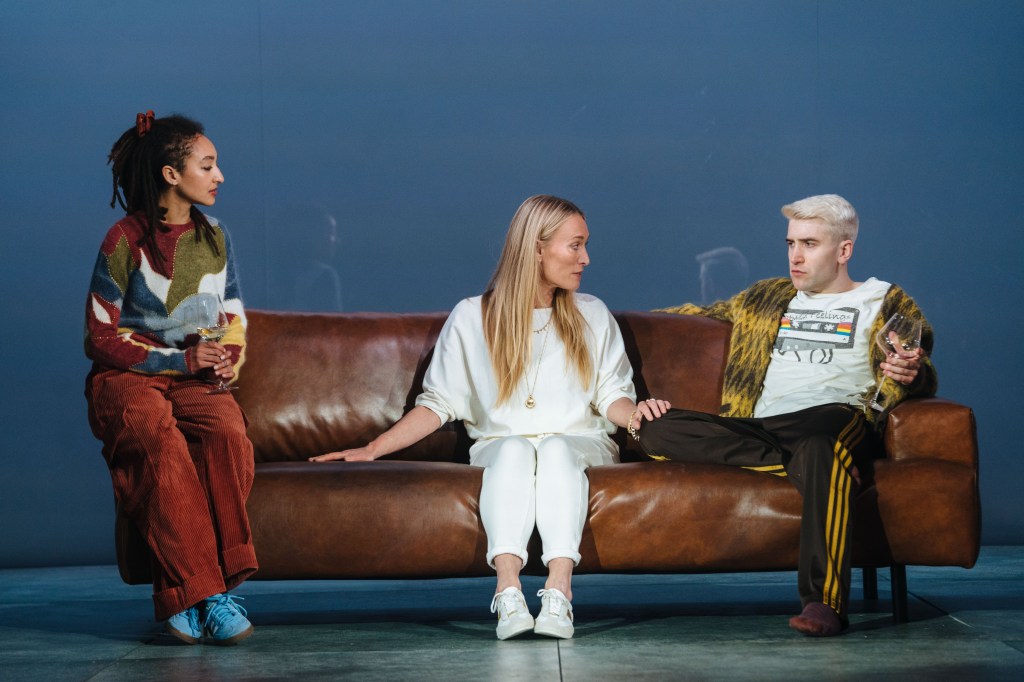
The first act ends with Helena revealing to Oz and Reggie that they are half siblings, the plot point that ends Ibsen’s original play. Owen’s choice to place it here allows for a greater exploration of the fallout of this revelation in the slower, second act, and finally gives Reggie the chance to have her say, in a commanding turn by Allison. Ibsen does not give his Regina this opportunity, as in his work, at the realisation that Oz is her half-brother, she bolts out the door, and out of the play, never to be seen again. The play boils down to a confronting conversation about the blurred lines of consent, enabler, victim and controller between mother and son, as they thrash out whether they can ever survive this inherited trauma and be free of it. Smurfit and Scott Howells anchor these big ideas whilst O’ Riordan’s direction ensures that these closing discussions are gripping and affecting, and it is here that Scott Howells’ Oz really shines, his characters journey gathers speed as he swaps the comedy for tragedy.
By going for more explicit discussions of sex, coercive control and trauma, this production adds greater layers and depths to Ibsen’s classic story and characters, digging deeper into the heart of ‘Ghosts’ and laying it bare for all the audience to see, whilst raising pertinent questions about human nature along the way.
5/5
Thanks for reading!
‘Ghosts’ is playing at the Lyric Hammersmith until 10th May!
Photography by Helen Murray
 Khambay's Words, Words, Words