
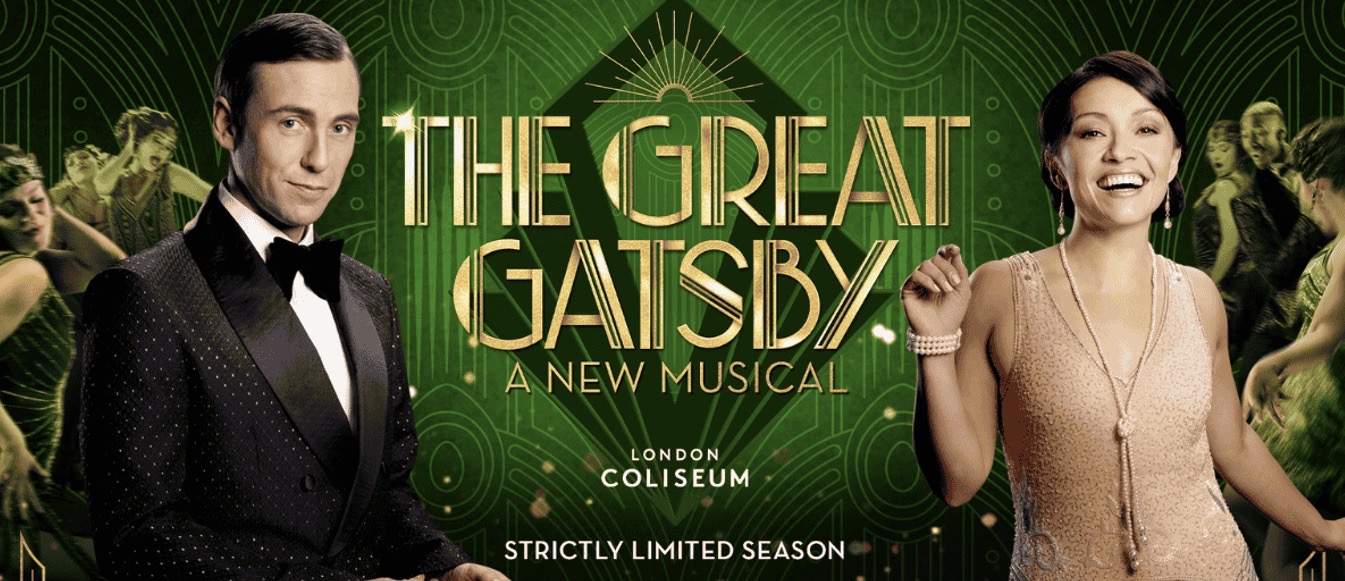
The West End’s latest offering, ‘The Great Gatsby,’ officially launched last Thursday with what has been described as the press night to end all press nights. I was lucky enough to attend and can safely say that this statement is pretty bang on. Based on the successful Broadway show, which itself is based on F. Scott Fitzgerald’s 1925 novel, the story details the class divides, greed and materialism of America in the 1920s. Specifically, the story revolves around the enigmatic and extravagant Jay Gatsby, as told to the audience through the eyes of narrator Nick Carraway. Although I feel the musical could have done with fleshing out some of its characters a little more, ultimately it succeeds in breathing new life into the classic novel and puts forward a star-studded spectacle which is more than worthy of a spot on London’s famed West End.

Visually the production is faultless. Linda Cho’s opulent costumes reflect the style of 1920s America and there are probably hundreds – the wardrobe department deserve a pat on the back and perhaps a lie down after this run has finished. Dominique Kelley’s choreography is incredibly impressive, particularly the extended tap dance sequence. Paul Tate dePoo III’s scenic and projection design was particularly innovative, blending physical sets with computer-generated imagery. When I entered the theatre to take my seat, I was very early, and the theatre was empty. The image of the bay was projected onto front of the stage, the infamous green light glinting, the sounds of the sea lapping on the shore could be heard. This immediate calm, especially after the buzz of the red carpet, gave me goosebumps. Normally in the West End there may be music, but usually we just sit waiting in front of a blank curtain or empty stage. The addition of the CGI made the whole show incredibly immersive, and gave the production a much bigger scale, mirroring that of Gatsby’s infamous parties.
The show capitalises on the vibrant, vitality of 1920’s America that the novel promises and takes the opportunity to inject new life into its story and characters. I am sure we would all like to frequent one of Gatsby’s famous parties, and having the novel splashed all over the West End stage in London’s biggest theatre is surely the best, and only, way to do it. Being, quite literally, bathed in the famed green light was also an exhilarating moment and is a fine example of Cory Pattak’s atmospheric work. The music was catchy too, and allowed for a greater exploration of Scott Fitzgerald’s iconic characters.
Speaking of them, they are famous for being rather unlikeable. Gatsby’s undying hope warrants some sympathy, but others, like Daisy Buchanan, whom her own cousin describes as ‘careless’ seem beyond redemption. My studying of literature leaves no doubt in my mind that the novel acts as an important social commentary on 1920s America, but not one that I have ever personally enjoyed. This is where the musical does the novel a favour – it makes the characters more relatable, and therefore more accessible to a broader audience.
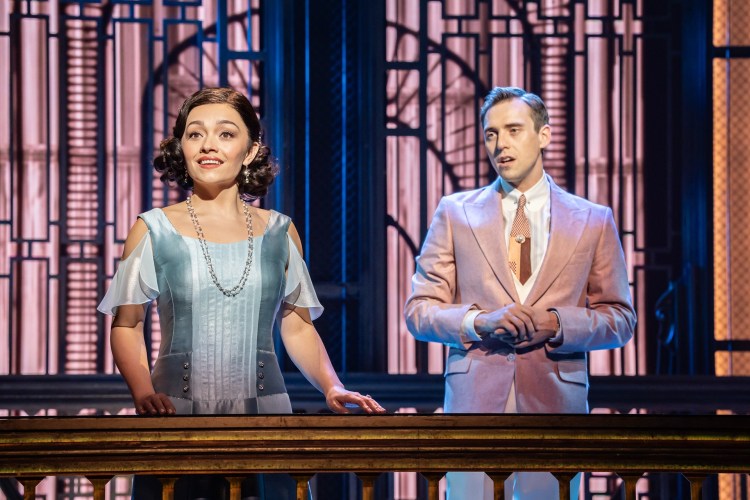
The addition of musical numbers soliloquizes each character’s thoughts and feelings, making for more intimate characterisation, something which was notably missing from Baz Luhrmann’s 2013 film, and perhaps the novel, as primarily we only get Nick’s point of view. Let’s take Daisy for example. It is clear in the novel that she is shallow, and materialistic. She has some affection for Gatsby but not enough to leave her horrid husband Tom and trade in her lavish lifestyle. The musical adds greater depth to their romance through some pretty impressive power ballads. Daisy is given several, both sprung directly from her quotations in the novel about roses and girls being fools, the latter of which makes her more sympathetic. She is restricted by her sex and social convention – all of which is discussed in Scott Fitzgerald’s original work. This particular song takes place after Gatsby’s funeral. In the novel, following Gatsby’s death, Daisy and Tom flee with no word. This song, and preceding conversation with Nick acts almost as an epilogue. Daisy’s song with Gatsby at the close of the first act, ‘Save Me Too,’ also makes their desire for each other believable, especially given Jamie Muscato and Frances Mayli McCann’s strong vocals.
What is interesting about this it that some critics have stated that the musical’s softening of Daisy misses the entire point of the novel. While this is true in some ways, Daisy is famously careless, I would argue that, for a West End show, this characterisation might not make for the most emotionally satisfying experience. This switch veers the iteration of the story into tragedy territory, Gatsby meets a tragic end, which I found to be much more moving, and emotionally involving, than the original.

Many characters really benefit from the inclusion of musical numbers, especially Corbin Bleu’s Nick Carraway. In Scott Fitzgerald’s novel he is a subdued observer, but his musical numbers in the show give him an extra warmth and humour. His song ‘The Met’ in which he is horrified by Tom’s hedonistic behaviour and wishes he had been taken to the Metropolitan Museum of Art as promised, drew laughs from the audience. Bleu portrays Nick as a sweetly naïve everyman, a much more relatable, and likeable, audience surrogate than his written counterpart.
Another character that benefits from the musical numbers is Jordan Baker, played to sardonic and comic perfection by Amber Davies. Her characterisation mirrors that of the novel, she is cool and sharp, and quick to criticise social convention. She is the archetypal ‘new woman’ of the ‘20s, and provides a good foil for Daisy. A standout performance in my opinion, Davies’ sass coupled with Bleu’s bumbling charm make for a sweet pairing, that is strong enough to rival that of the show’s title couple. Her song ‘New Money’ is my personal favourite, and I bet that the wide-legged pants that Davies sports in it will be a sellout this summer.

Myrtle Wilson’s three musical numbers add multiple dimensions to her character. In the novel and Baz Luhrmann’s film Myrtle barely gets a look in, but in Rachel Tucker’s capable hands her presence and demise drew visceral reactions from the audience.
However, I do have some characterisation critiques. Gatsby’s past, which Luhrmann goes into through a flashback sequence, does not feel like it is given enough exploration in this adaptation. It is very explicit that ‘it is all for’ Daisy, but his rising through the ranks is not quite as fleshed out. Also, although John Owen-Jones’ has some catchy tunes as Meyer Wolfsheim, he is not quite there long enough to compete with the impressions made by the other characters.
I would like to take a second to talk about the diverse cast. Both Bleu and Mayli McCann hail from ethnic minority backgrounds, which should be celebrated. Their presence suggests that wealth and beauty do not just have one Caucasian form, and as a young Asian creative, a definite minority in this industry, their presence does not go unnoticed.
Despite some minor characterisation quibbles, ‘The Great Gatsby’ does exactly what a West End show should, it presents dazzling spectacle, some of the best musical talent out there and delivers a toe tapping soundtrack that will stay with you for hours afterwards. While it might not satisfy some of the literary purists out there, I have no doubt that it will satisfy London theatregoers this summer, which, especially in this format, is the point. It is the West End after all, old sports!
4/5
Thanks for reading!
‘The Great Gatsby’ is playing at the London Coliseum until the 7th of September!
Photography by Johan Persson
 Khambay's Words, Words, Words