

The Tara Theatre in Earlsfield is known for crafting compelling work that explores the world through a South Asian lens. It’s latest production, ‘Permission,’ written Hunia Chawla and directed by Neetu Singh, follows the friendship of Hanna and Minza, two young women from Karachi whose lives take them in different directions. Anisa Butt’s Hanna travels to attend university in the UK, while Rea Malhotra Mukhtyar’s Minza stays in Karachi. The show touches on a multitude of prevalent issues such as freedom, protest, liberation and of course, permission. The play provides so much food for thought that I worry it almost buckles under its own weight, running at a short seventy minutes.
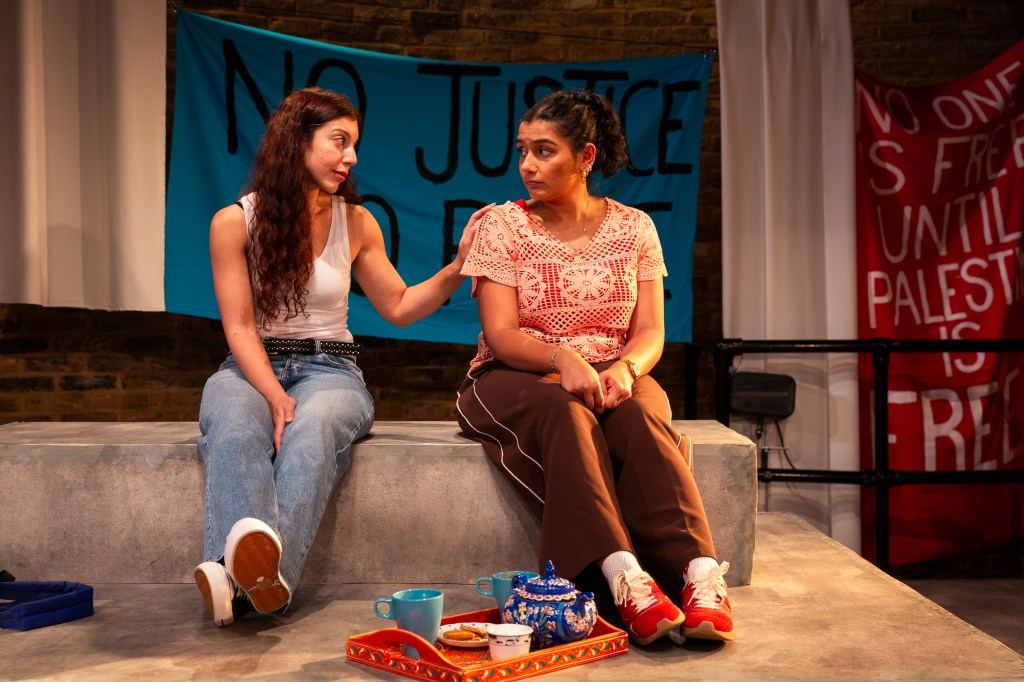
Hanna’s and Minza’s friendship is the heart of the show, and their chemistry and humour make them highly watchable. We open with Hanna trying to keep her boyfriend secret from her parents, and it is clear that in Karachi, women do not always have full autonomy. Hanna suppresses her sexuality, cannot leave the house alone, and her and Minza both dream of liberation. But how to achieve it is the question. Hanna believes that she will find this liberation when moving to the UK for university, and it is here that the play really engages with the uniqueness of the immigrant experience.
Traditionally, the Muslim woman is portrayed as oppressed, and saved by the liberating attitudes of the West, but Chawla’s writing is far too smart and nuanced for that. Yes, Hanna finds freedom to a degree, she can walk in the street unchaperoned, but ultimately is a fish out of water. Her world comes to a stop when compromising photos of her are released online, and sent to her family. She is ashamed, and the audience probably think that her traditional parents will disown her. Minza disbelieves this, but Hanna’s fear, and exposure to perceived westernised values by flatmate Anushe, also played by Mukhtyar, makes Hanna question whether owes her parents anything at all. These are two very different ends of the spectrum, and Anushe’s assertions directly conflict the traditional relationship between Asian child and parent. Parental approval is important to Hana, and Asian culture, and Anushe’s liberal thinking is shocking to Hanna’s traditional family values. This is just one of the many examples of nuance within the production.
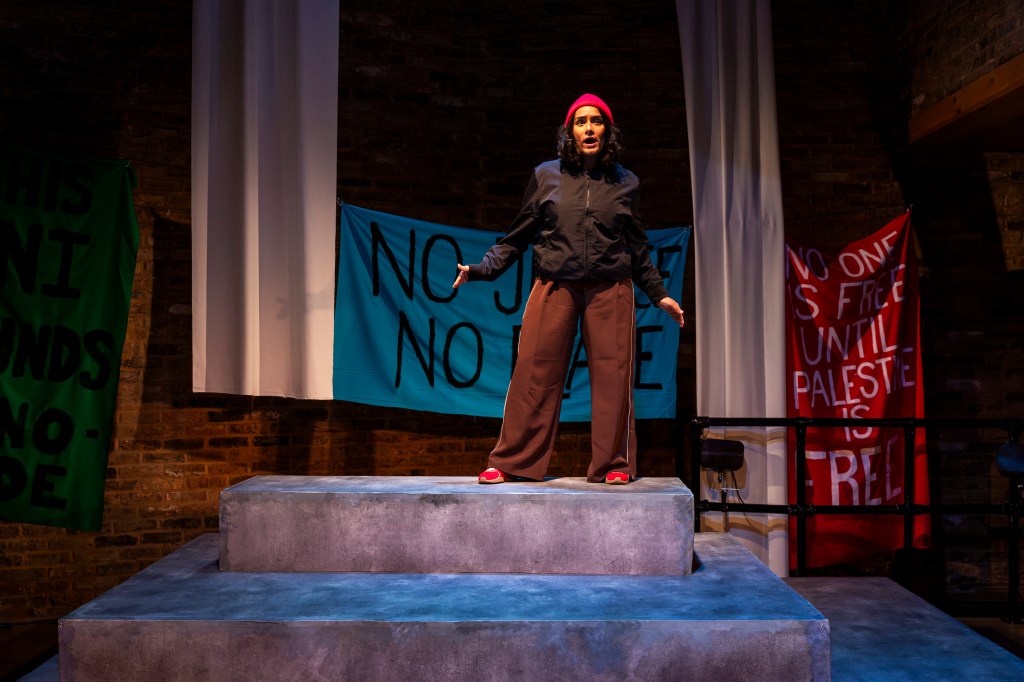
Ultimately, the West is not the ideal that Hanna envisaged, as when attending a protest, she is caught, her visa is revoked, and she is sent back to Karachi. In the UK, she does not have the same level of autonomy as Anushe does, because she is on a student visa. Hanna’s father also welcomes her home, showing her compassion, not disdain. Stereotypes do not seem to exist in this space. Minza has grown more confident in her fight for liberation, maintaining that, action is action. Whilst sometimes it cannot be radical, they can only do what they can do, based on their surroundings. Hanna initially dismisses Minza’s Aurat Marches, prompting Minza to remind her that, in the context of Karachi, a group of women marching to demand liberation is just as powerful as a bunch of students taking over the students’ union in the UK. Both are pushing the boundaries as much as their surroundings allow. It depends on the context, and depends on the person.
So, it is not necessarily the happy ending audiences might have hoped for, it does not provide any answers, but then again, most things in life do not operate as most shows do, with a distinct beginning, middle and end. And most things are not black and white. The play is a realistic snapshot of an important time in these women’s lives. It is pessimistically realistic, but also hopeful.

With such a short runtime, I wonder if the play could have benefited from a greater length to unpack its many themes. I am also divided on its stylistic choices. The two women do interact with men, in the form of several voiceovers. It is not something that I have experienced before, and while it does work to keep the focus on the two women as the centre of their own story, it is hard not to shake the idea that they are both just talking to thin air. I am also unsure whether the audience interaction works, as it takes you out of Hanna’s world, particularly at a point where she is supposed to feel isolated and lost. It does provide comedy to lighten the scene, but so does Hanna’s interaction with Anushe.
Maybe to conclude we should look back at the show’s title. Do we ever have permission to fully do anything? To live freely? To fight for liberation? If so, at what cost? Like life itself, the play offers enough food for thought to keep you full for weeks, but just like Hanna and Minza’s fight for liberation, it could all benefit from having a little more time.
4/5
Thanks for reading!
‘Permission’ is playing at the Tara Theatre until the 7th of June!
Photography by Adam Razvi
 Khambay's Words, Words, Words