
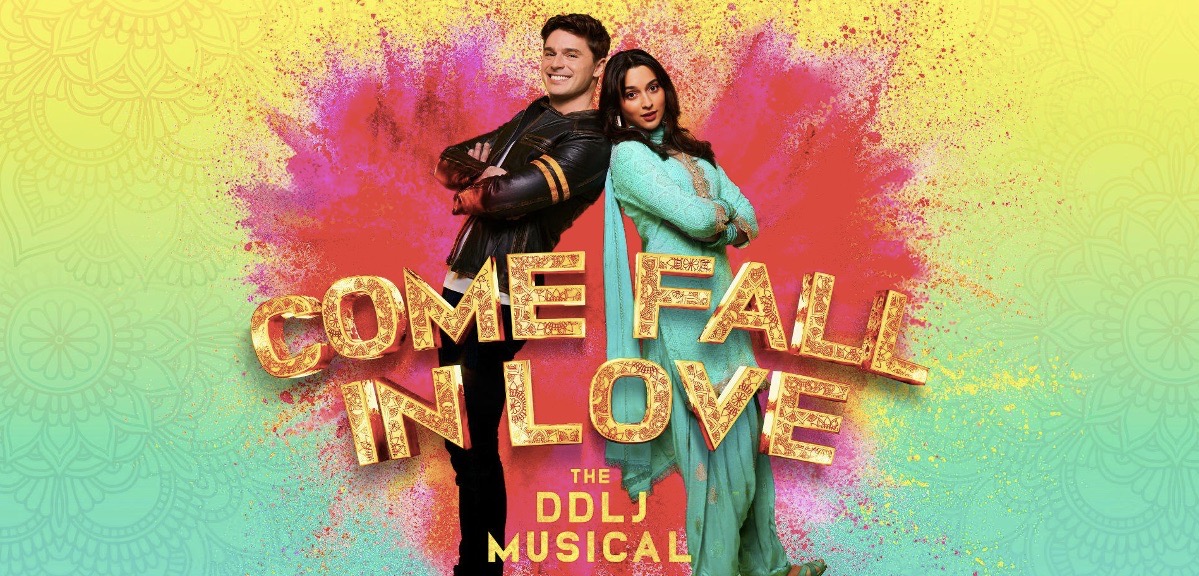
East meets west in ‘Come Fall in Love – the DDLJ Musical’ which is playing at the Manchester Opera House. Based on Aditya Chopra’s 1995 classic ‘Dilwale Dulhania Le Jayenge’ the story follows British Indian born Simran (Jena Pandya) and Roger (formerly Raj, played by Ashley Day) as they embark on a trip around Europe and an unexpected whirlwind romance. However, these lovers have a thorn in their side – Simran is promised Kuljit (Kinshuk Sen) in Panjab, India. It captures the heart and spirit of the original, and boasts an extremely talented cast, colourful costumes and impressive choreography that draws from a range of genres. Although, the show could do with a little bit more depth when dealing with the nuances of Indian culture at times, the show asks you to come and fall in love, and overall, it is pretty difficult not to.

Early on we are introduced to Simran, who has just graduated from Oxford. Although her cleverness sometimes could lean into know it all, Pandya does an excellent job of making her likeable and relatable, whilst communicating her internal struggles particularly in her song ‘Twice as Good.’ Simran recalls how her father Baldev (Irvine Iqbal) told her in her youth that to gain the same opportunities as her Caucasian peers, she must be just that. Twice as good. It is an obstacle that many ethnic minorities face.
Unlike the film, Simran already has her tickets to Europe, her trip has been agreed, and the audience does not learn about her impending arranged marriage until the latter half of Act One. In the film, Simran uses this marriage as leverage to gain her father’s permission to go on the trip, leading to a heartfelt conversation between father and daughter about love, family and culture, which communicates the depth, and love, of their relationship. This might have helped the audience empathise with Baldev and his struggles more, and not just see him as the man forcing his daughter into marriage, which is how Roger’s family see him. With the omission of this conversation, the audience may not fully understand the cultural implications of arranged marriage, and to be honest, Roger does not either, as Simran never really explains them to him. This is an example of where the east half of the show needs to be bolstered a touch. The famous scene of Simran running on the train with Roger’s help drew cheers from the audience, as did all callbacks to the original film, be them dialogue or instrumental.

Simran and Roger’s trip boasts some impressive staging and set design, which continually reflects the country the two are in, setting the scene for one of the longer, and more memorable dance numbers, ‘Come Fall in Love.’ Pandya has a difficult job keeping up with Day’s boundless energy, who risks drawing the audience in more with his money and partying ways, whilst Simran geeks out over Voltaire in the corner. However, their scenes in Switzerland put them on more equal footing, and Simran’s drunk state that spawns the song ‘Better Get Right’ allows Pandya to add some comedic flair to the beloved heroine. The first act does feel a tad slower than the second, but serves as important build up for the long awaited jump to the mustard fields of Panjab.
Act Two opened with quite a magical moment. The Mool Mantar, a Sikh prayer, is played into the auditorium, over the image of the Golden Temple which is projected onto the stage. It was quite breathtaking, having been to Amritsar myself, but I worry that without proper reference to the importance of this to Simran and her family, it may not have had quite as big an impact on the whole audience as it did me.

The vibrant second half picked up the pace and exposed the audience to a multitude of dances, like Bhangra and Giddha, and it was joyous, and comedic, to see Roger fully embrace Simran’s culture. What I am more mixed on though, is Roger’s mother Minky’s (Kara Lane) burlesque-esque number and romance with Kuljit, something that I felt detracted from the main love story unnecessarily. The inclusion of ‘Mehndi Laga Ke Rakhna’ from the original film also felt like a massive cultural moment, one that was enjoyed by all.
As the second half dances to a close, Roger proves that he has taken the time to learn about Indian culture, and recounts to Simran that seva, an idea that was mentioned throughout the show, is the Sikh concept of selfless love and charity. It is moments like this where the east meets west formula really works, putting both sides of the globe on equal footing, and showing the meeting of two different cultures. I will admit, seeing one of the scariest fathers in Bollywood history sing and dance was something to get used to, but Baldev’s cry of ‘jao Simran jao’ still feels as visceral and impactful as the first time I saw it on film. The productions’ closing number ‘Holi Hai’ was brilliantly energetic and is the best thing to take as a lasting impression.

Overall, my cultural criticisms do not detract from the joy of what we are seeing in front of us – the meeting of two cultures, and ultimately a celebration of love. Especially given the current racial climate a show that celebrates the coming together of an Indian woman and Caucasian man is the kind of equality and understanding that we should all be championing. The joy felt in the auditorium was palpable, and it is rare to see so many people of colour in the theatre… you could definitely hear them! Myself included! If an audience can be so delighted by a show that showcases Indian culture, then surely, by and large, this is truly something to fall in love with.
Jao Simran Jao!
4/5
Thanks for reading!
‘Come Fall in Love – The DDLJ Musical’ is playing at the Manchester Opera House until the 21st of June!
Tickets are available from: https://www.atgtickets.com/shows/come-fall-in-love/opera-house-manchester/
 Khambay's Words, Words, Words