
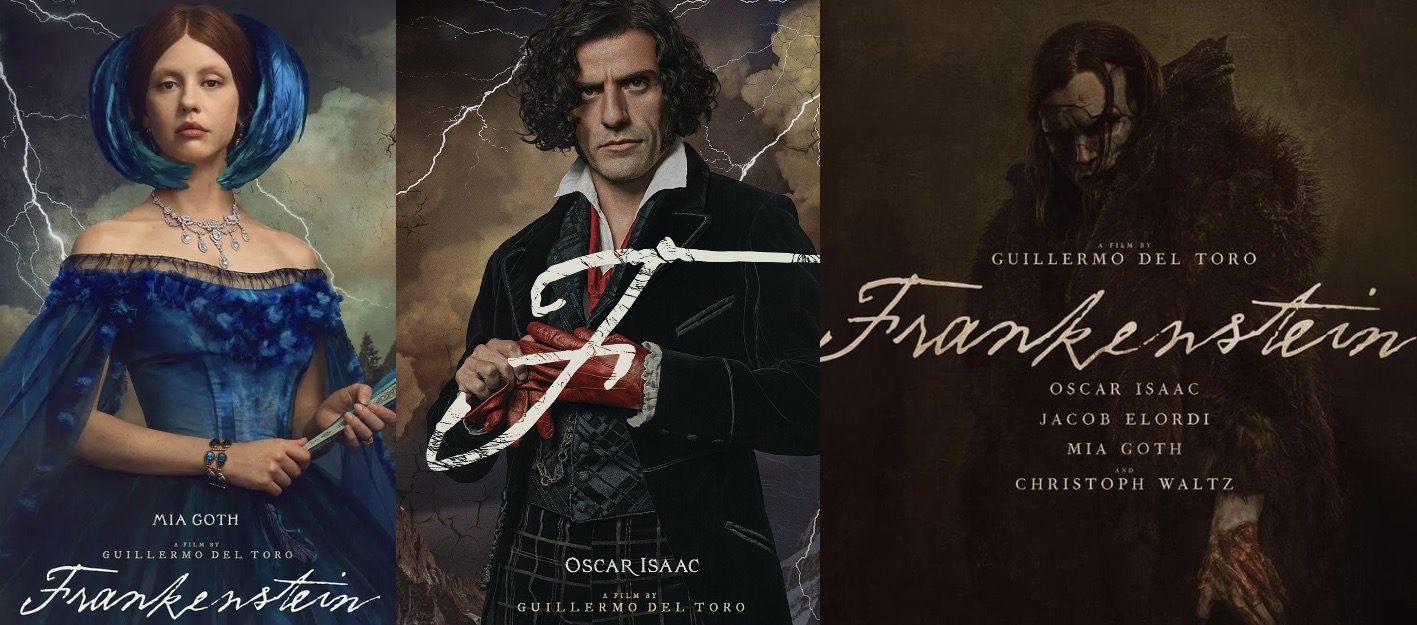
Mary Shelley’s ‘Frankenstein’ is probably one of the most famous British novels – if not THE most famous in Gothic circles. Personally, I’ve always been more team ‘Dracula,’ so I was very interested to see what Guillermo Del Toro’s take had in store for the iconic story. Safe to say, the film has received rave reviews, cementing Del Toro’s position as a connoisseur of all things Gothic. Broadly, I enjoyed the film – I believe it capitalised on the best aspects of the novel whilst also providing the audience with some impeccable and innovative symbolism. Let’s take a look!
So, although there are some character changes to the plot, the film broadly follows the structure of the novel and opens with Victor, Oscar Isaac, and the Creature’s cat and mouse chase in the North Pole. Before we see the face of the Creature, played by Jacob Elordi, we see his tall shadow, and hear his bellow. We also see him behave violently towards the Royal Danish Navy in his quest for Victor, which dehumanises him from the off, initially scaring the audience. Del Toro knows though, that when recounting the Creature’s story, that monstrous image will dissipate in favour of audience sympathy and understanding.
Victor’s backstory is slightly altered from the original text, instead of being Swiss, he is French. Del Toro plays on the classic Gothic trope of the aristocratic dying family, and presents Victor as having a strong attachment to his mother, played by Mia Goth, who also plays his sister in law to be, Elizabeth. In the original text, it is Victor who is set to marry Elizabeth… but more on her later.
Young Victor always wears white, a symbol of purity and childhood innocence, in contrast to his mother, who always wears red. In this context the colour red it may not represent promiscuity, there is no implication of sexual impropriety, but this colouring may indicate her passion for Victor, and his for her. The fact that she is also played by Goth foreshadows Victor’s later romantic attraction to Elizabeth, and if we play that backwards, Del Toro could be implying that Victor had an Oedipal-esque attraction to his own mother.
Victor’s father however demonstrates early to him the correlation between the body and violence. Whilst tutoring him in anatomy, Victor’s father canes him if he makes a mistake. Victor is also raised with a keen understanding of labour and birth, beginning his obsession with the creation of life. This is further exacerbated by the death of his mother, who dies during childbirth. As well as leaving an emotional mark, Victor’s mother cups his face with her bloody hands as a way of saying goodbye to him. At her funeral, Victor recounts that he considered his mother to be a ‘part of my very self’ and that part of his life has now been ‘extinguished.’ This has a very ‘Wuthering Heights’ feel to it – Victor opines that his mother was one half of him, and with her death, a fire within him as died. It is in his adult life that he seeks to reignite that fire by attempting to create life to better understand her death. Del Toro implies that Victor’s desire to create life in reality is his quest to resurrect his mother.
We can see through his costume that Victor always carries his mother with him, as, in adulthood, he is shown to be sporting a red necktie, her trademark colour. The presence of the red around his neck suggests his unbreakable tie to his mother, and that he is shackled by his vow to ‘conquer’ death in her name. The colour of red recurs throughout the film, most notably in the electrical currents Victor uses to animate individual limbs and the Creature itself. Again, this is a connection to his mother, almost as if she is present when he is trying to complete his experiments.
Victor’s mother is established as the reason that he exists, not just biologically, but as the object of his mission to create life. Red, therefore, becomes the colour throughout the film that communicates the force of life, as previously mentioned in the form of the electrical current.
Victor, throughout his lfie, has dreams and visions of a luring red angel, perhaps one of life, or one of death – ‘forces’ that Victor vows to have ‘command’ over. At this moment we are jolted back to the present day with a shot of the Creature bursting out of the ice, implying a rebirth and resurrection, and that Victor did ultimately succeed in this goal.
Going back in time, we are introduced to Elizabeth. When Victor first spots Elizabeth’s umbrella in the crowd, he is drawn to her, as he was drawn to his Mother, and even tries to simulate a form of non physical intimacy with Elizabeth by posing as a priest at her confession. Much like Victor, she is drawn to and connected to nature, something that is also communicated in her clothing.
Elizabeth’s costumes have drawn much attention on social media and with good reason. She has a feathered headdress, and the prints of her dress have been inspired by natural patterns and colourings. In terms of colour, when we say lay people on screen, they wear darker tones, but higher classes, particularly women, wear brighter colours – which help to communicate subtext and move the story forward. She is also seen wearing a red crucifix, the colour of red again hinting towards Victor’s mother, affirming that he is drawn to both women. When Victor confesses his love to Elizabeth, she is shown to be wearing a red dress, and in a shot where the camera is placed behind her, we get a glimpse of her intricate laced corset which could be seen to resemble a human spine – again emphasising her connection and affinity to nature.
Elizabeth and Victor’s responses to the Creature are ironically similar and different at the same time. When animating the Creature Victor’s hoists him up to resemble a crucified Jesus, as well as Da Vinci’s anatomical drawings. Victor and the Creature’s first encounter takes place in his bedroom, whilst both are in a state of undress. The drapes of Victor’s bed are red, and whilst being bathed in sunlight, they embrace and Victor removes the Creature’s bandages. The intimacy does border on homoeroticism, but also links to the idea of mother and child. The Creature’s bandages could be a direct reference to the bandages found outside Jesus’ tomb following his resurrection.
Elizabeth chooses to visit the Creature at night, and we see her in her nightgown, hair open and holding a candle as she walks through the dimly lit hallways. This gothic image is reminiscent of proto-Gothic figure of Lady Macbeth, and Elizabeth’s candle implies that it is her light that will overcome the darkness that hangs over Victor and the Creature. Her long, red hair resembles the paintings of the pre-Raphaelite era, the vivid colour of which contrasts with the muted tones and paleness of the Creature. In the Elizabeth era, long, untied hair was a mark of madness and sexual discordancy, which here may perhaps reference Elizabeth’s confused feelings towards Victor and the Creature. She exhibits a maternal instinct and is more empathetic towards the Creature than Victor, implying that she is a Madonna-like figure to the Creature, who himself has been hinted to resemble Jesus. The Creature is the embodiment of the natural world, something which we have already established that Elizabeth is fascinated by.
Victor then attempts to burn the tower with the Creature locked inside, invoking the image of Prometheus, something Mary Shelley referenced in the original text, which she subtitled as ‘The Modern Prometheus.’ Prometheus was the Titan who created humanity, and in defiance, stole fire from the Gods. Zeus punished him by chaining him to a rock, where an eagle would eat his liver daily. His pain only ended when Heracles killed said eagle. The image of the chained Creature surrounded by fire evokes this story, and also that of the red angel in Victor’s dreams. The Creature is both, an image of life and of death, and of such power that he could rival the Gods.
It is here that we end Victor’s tale, and, like the novel, focus the attention on the Creature. The Creature is expelled from the tower, via a schute into the surrounding the moat, which is almost more reminiscent of the type of birth that Victor studied, and more reminiscent of the type of natural birth that the Creature was denied. The Creature’s expulsion from the tower acts as a rebirth.
The Creature assists a small family in the forest from afar, and becomes known to them as the ‘Spirit of the Forest.’ The creature, after being reborn, fashions his own story and mythology as an ‘invisible guardian.’ However, he is mistaken for a Monster, and after being shot at by some locals, he retreats back to Victor begging for a mate.
This also happens to be the day of Elizabeth’s wedding to William. The chains across her bodice add a militaristic feel to the dress, and the tassels reference the bandages that the Creature was born in. When Elizabeth tries to defend the Creature, Victor accidentally shoots her, a departure from the novel, and in anguish, the Creature carries her out, again, evoking that Madonna and child image between the two, but this time in reverse. The Creature now displays a maternal instinct towards Elizabeth, not the other way around. The blood stains her white wedding dress, again a reference to the clothes of Victor’s mother in a moment that inverts the use of the colour red – it had been used to communicate life, now it is used to communicate death. The Creature retreats to a cave, lying Elizabeth down on a slab, almost like a sacrificial lamb. She has been caught in the crossfire of the Creature and Victor and dies as a result of their struggle.
It all boils down to the Creature and Victor. During their chase, Victor attempts to set the Creature alight using dynamite, but the flames have no affect on him. This implies that the Creature has a Godlike control over fire, much like his namesake Prometheus. In the present, and in his dying moments, Victor tells the Creature that he is ‘consumed’ by regret, and encourages the Creature to go forward, and live a full life. In their last exchange, they refer to each other as ‘father’ and ‘son’ and accept each others faults. In this moment, Victor realises the responsibility that he has to his offspring. With this closure for the Creature, the ending of the film is markedly different and more hopeful than the novel. The Creature, quite literally, walks away into the sunset, unlike in the novel where he throws himself on Victor’s funeral pyre.
All in all, I think this adaptation did what all great adaptations should do – stick to the core themes and ideas of the novel, and add some fresh elements. Whilst the ending is probably the biggest departure from the novel, I think it feels earned and something filled with such hope nowadays probably is not a bad thing.
Thanks for reading!
 Khambay's Words, Words, Words