

What would you do if you could do it all again? This is the question Rea Dennhardt Patel’s play, ‘The Undying,’ poses. When Amba (Vaishnavi Survaprakash) brings home some TwiceLife pills to her husband Prav (Akaash Dev Shemar) the two become embroiled in a twisty tale that examines gender, age and trauma all through the South Asian lens. Despite the heaviness, there is plenty of levity, more so at the start of the play, which does help to endear the characters to the audience, willing you to go on this journey with them. The play is multi-hyphenated – it tackles many themes, and also could slot into a multitude of genres. Although this does mean that sometimes the play feels overstuffed, there is plenty in there to praise.
What struck me first is Sammy Dowson’s set. Although the space is small, the furnishings, particular the chair and the rug, are instantly recognisable – they are the quintessential Asian home. This is buoyed by the music of Ansuman Biswas – something which elevates the show, bringing extra drama and intensity to some of the shows biggest moments. Behind is a wall of photo frames, each referencing important parts of Amba and Prav’s life.
Amba and Prav’s age is well communicated in the physicality of the actors, and their discussions reveal that Amba is recovering from chemo, and Prav is suffering from Alzeimers. This is the impetus for Amba to bring TwiceLife home, and immediately paints a backdrop of missed opportunity. The two characters are an ode to older generations who undertook life changing journeys, and who sacrificed things for their future children. I feel like the audience, particularly those of South Asian descent, know these people. Even though the play speaks to many different themes – bildungsroman, sci fi, comedy, I did always think that it felt real. The events feel true to these two characters, a tribute to Dennhardt Patel’s writing and the performances of Survaprakash and Shemar. As you may have guessed, Amba takes a pill, finding herself instantly younger, and ready to take on the new world.
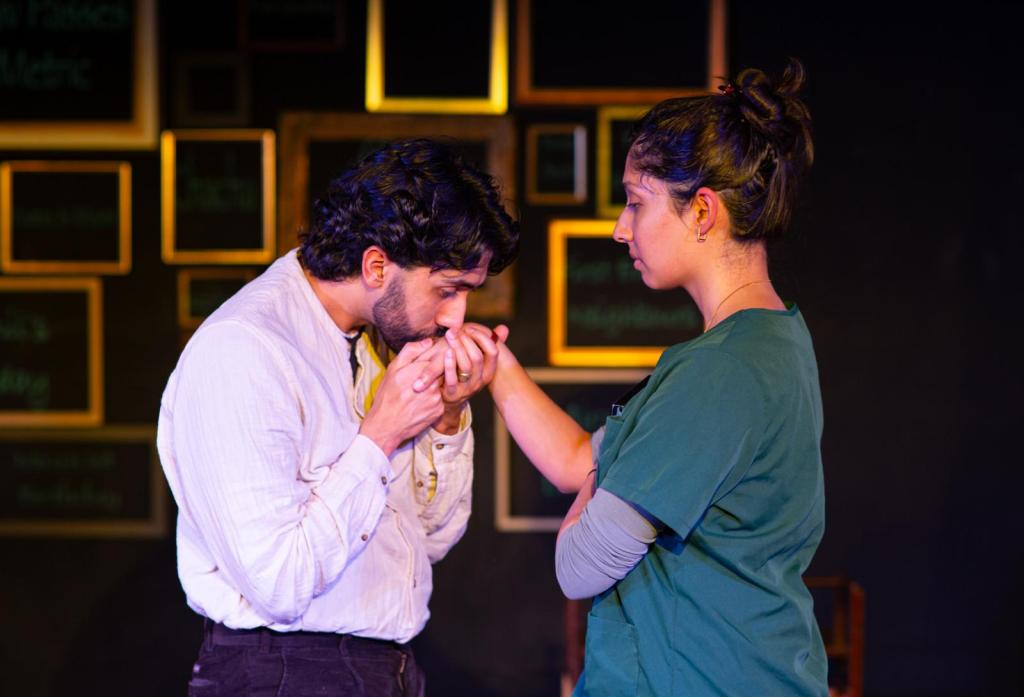
Amba’s newfound lease of life, and learning of the freedoms that women now have speaks to wider ideas of gender politics and the role of women in Indian culture. Survaprakash is given a lot to do, and handles it with real depth – especially when the couple recount the death of their young daughter. Themes of feminism and gender peak early on, but run throughout the play. It is at this point that Prav follows suit and takes a pill.
Whilst Amba enjoys the challenges in her newfound youth, Prav’s story draws inspiration from masculinity and male fragility. He struggles to find independence and his place in the world, without Amba. Although it could be argued that Prav is exhibiting sexist behaviour, Dennhardt Patel is sympathetic, and tries to explain the root cause of his dependency by delving into his childhood trauma. The ending is an ironic one, as both Prav and Amba’s lives take them in different directions, but in many ways they end up in similar places that they were in at the beginning… which I guess speaks to the cyclical nature of birth, life and death.
There are a lot of ideas within this play. I have been ruminating on it for most of the day. Part of me thinks it could benefit from a slightly longer run time as there’s plenty to unpack. Sometimes it can feel like three plays in one. The middle of the play is pacey, and does encompass all the messiness, love and meaning of marriage. The start and denouement do feel slower, and perhaps some of this time should have been given to the middle section, allowing certain plot points to have more breathing time. In the sparring between Amba and Prav, I did miss the important note that as your body-age halves, you lose the memories associated with those years.
Something I will question though, is why both characters, as they get younger, lose their Indian accents. Perhaps it would’ve made more sense to show then with British accents in their old age, and as they get younger, they get closer to the Indian accents that they were born with? Something to think about, but not a dealbreaker.
‘The Undying’ is a twisty multi-genre show that poses some interesting questions -all bolstered by a talented team and cast.
4/5
Thanks for reading!
Photography by Tobi Ejrele
 Khambay's Words, Words, Words