‘Sing Street’ at the Lyric Hammersmith Review: An immersive blast of 80s rock, rage and youthful hope

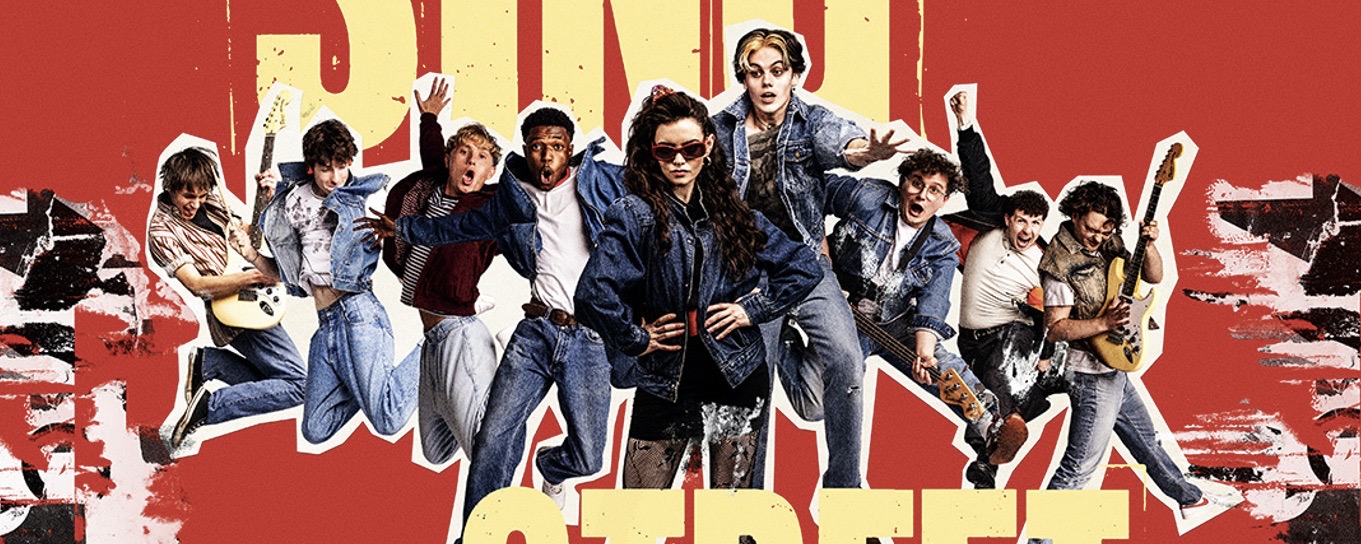
I was back at the Lyric Hammersmith last week for the opening of ‘Sing Street’! Based on John Carney’s 2016 film of the same name, the musical follows schoolboy Conor (Sheridan Townsley) who claims to be in a boy band to impress his mysterious crush, Raphina (Grace Collender). Set in 1980s Dublin, the show is a real blast of 80s rock, rage and youthful hope. Although the second half is weaker than the first, the musical’s biggest selling point is its talented company and its homage to the culture and music of the 80s.

The show is unique in its style. Using high quality projections, and a camera with a live link to the back of the stage, the show is wonderfully immersive, and gives it an authentic feel that is reminiscent of 80s television. Although the story of the first act is simple, make the band to get the girl, the momentum is strong and there is plenty of humour in it. Conor’s motley band, and their 80s costumes, provide plenty of laughs, even though there are too many members to truly get to know any of them. The way that Raphina is introduced, gliding onto the stage in a phone box, is suitably fun and ethereal.

Grace Collender as Raphina and Sheridan Townsley as Conor

The first act builds to a crowd-pleasing crescendo, with Conor successfully wooing Raphina, both of which have a touching, and believable chemistry. The performances all round are incredibly strong, and this multi-talented group of young actors is certainly one to watch.

However, it is the second act that falters, as the premise of the show is complete – Raphina is won. The songs still inspire and impress, but in-between there is a bit of a plot vacuum. The show never quite manages to capitalise on the dramatic themes that it touches on, including poverty, incest and bullying. We keep being told that Dublin is ‘dead end,’ but we never actually know why. Conor’s parents also split up in a scene that feels slightly underwhelming.

This act preoccupies itself with defeating Lloyd Hutchinson’s Brother Baxter, who, up until this point, has had a relatively small role. Although the boys do triumph, staging a concert at their school despite Baxter’s protests, the thread is not as strong as Conor’s pursuit of Raphina. At the end, Raphina and Conor decide to go to London to try and make it in the music industry.

The cast of ‘Sing Street’

Although I’m slightly concerned as to whether Raphina and Conor will survive the crossing in Conor’s grandads’ boat, this hopeful energy is consistent throughout the musical, and the performances of the core cast make it easy to get behind them in their endeavours. It is when the cast flex their musical muscles on stage that the production truly soars, and the show is worth seeing for that, as well as its blast of 80s nostalgia.

3/5

Thanks for reading!

‘Sing Street’ is playing at the Lyric Hammersmith until August 23rd!

Tickets: https://lyric.co.uk/shows/sing-street/#performances

Photography by Manuel Harlan

‘Flat 2’ at the Wandsworth Arts Fringe Review: An acute and nuanced study of the awkwardness and humour of the grief experience

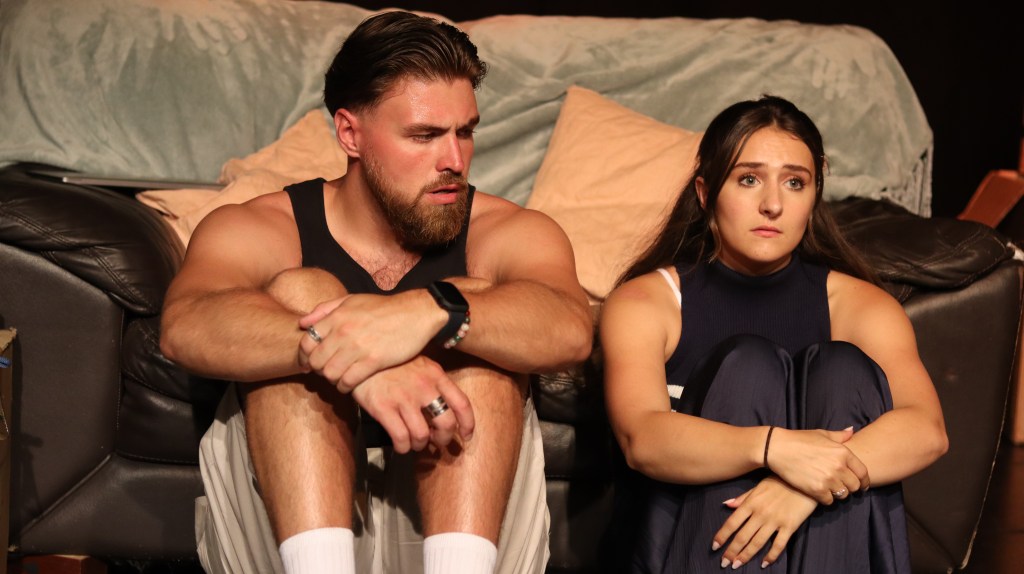
‘Flat 2’ asks a wonderfully morbid and unique question – if two couples move in together, and after forty-eight hours one half of each couple dies, what do you do? Lucy Foley’s debut play premiered in London last year, and then moved to Edinburgh Fringe. I caught the show at the Wandsworth Arts Fringe Festival, and was especially impressed with how the show’s ability to examine the awkwardness, and trauma, of grief through a darkly comic lens.

Although the venue that I saw the show in was not its permanent one, it was in Wandsworth was for two days, it was well utilized. An underground arch with a leak is as ‘student housing’ as you can get, and the intimate nature of the space served the story, as, when you are the one grieving, all eyes are on you.

Tom Ashen as Freddie and Lucy Foley as Ava

From the off, the play manages to reflect the reality of grief, as it fields the age-old question of ‘what do we do now?’ The play accepts that grief has no guidebook, especially when you are in your twenties. Ava (Lucy Foley) and Freddie (Tom Ashen) are left debating what an appropriate mourning food is, and whether ordering a Deliveroo would be offensive. This is not only witty, but painfully relatable. I, after losing a loved one, questioned whether watching TV was an acceptable activity. While there is a slowness to this opening, as the characters process their immediate situation, it works, as at the shows core are two eminently watchable and sophisticated performers.

Foley and Ashen both capture the subtle nuances of their characters’ grief experiences. Foley looks longing into the distance, Ashen turns his back to the audience and quietly sobs. Both performers make these two very different grief experiences palpably real, and relatable. From the off, both have a delicious chemistry even though we know as an audience, they really shouldn’t.

The play has an uncanny ability, as mentioned, to go from darkness to dark comedy. A good example of one of these early switches is the appearance of Freddie hyping up a bunch of imaginary five-year-olds dressed as The Stig for Tyler’s fifth birthday party. Foley and Ashen’s dynamic, as well as the early appearance of our fake Stig all contributed to the air of unpredictability that surrounds the piece, and I’ll admit, the directions it took surprised me for the better.

Lucy Foley as Ava

I know we shouldn’t have preconceptions or assumptions, but based on the press released I believed that we would be with these characters for the early days of their grief. Instead, we get a smart montage of the days after the deaths of Stefan and Billie. Ava and Freddie repeat the same day, over and over and prove the inevitable fact that after death, life stops for no one. The play follows these two characters for several months, allowing for a proper, nuanced examination of grief.

Every plot point has time to properly breathe, be addressed, and as a result, we end the show with a pair of fully rounded characters. The show elicited laughs and tears provided a nuanced interrogation of grief and managed to be light hearted at the same time. To accomplish this, in such a short amount of time, is impressive.

Shine bright like a diamond.

5/5

Thanks for reading!

‘Miss Myrtle’s Garden’ at the Bush Theatre Review: A moving piece of theatre that takes time to examine love, loss and memory

I was lucky enough to be back at the Bush Theatre this week to see their latest offering ‘Miss Myrtle’s Garden.’ Written by Danny James King and directed by Taio Lawson, the show follows the eponymous Miss Myrtle as she, and the characters around her tend to her garden, and contend with the past. The play is more of an experience than a linear story, much like life itself, and makes for a moving, relatable, piece of theatre that takes time to examine the human conditions of love, loss and memory.

What is immediately striking is Joshua Gadsby’s lighting. Not only does it reflect the feelings of the characters, but simply works to show the passing of time, a core theme within the play. The lighting also lets the audience in, when it wants to, and at times blacks out, when Miss Myrtle herself does not want to remember something, or does not want to let us in. Khadija Raza’s titular garden is charming, and blooms and evolves as the characters do.

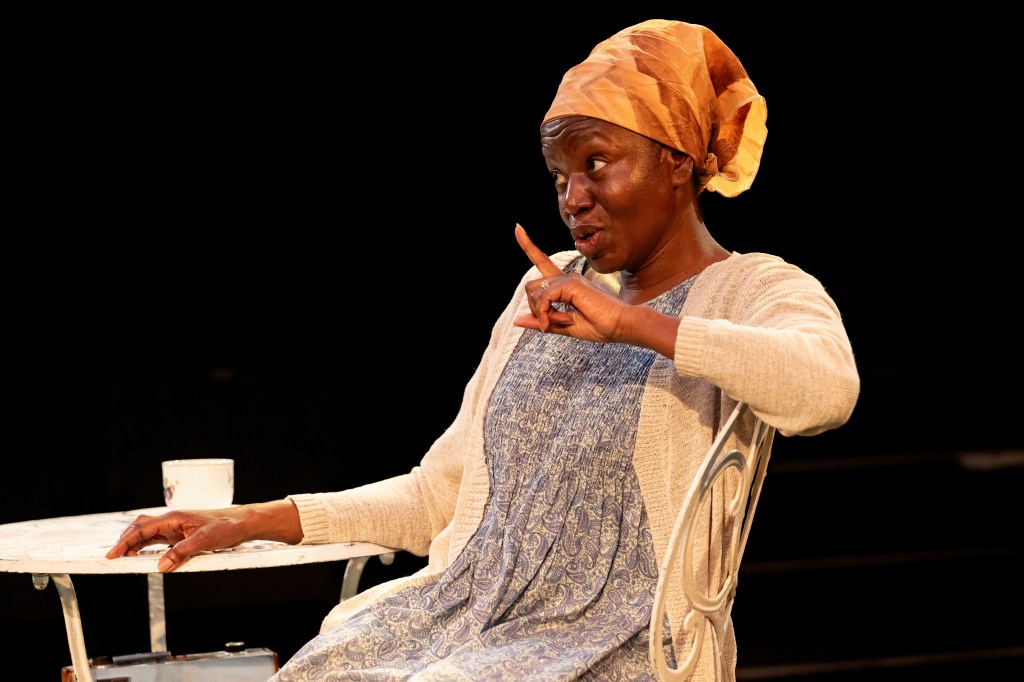
Diveen Henry as Miss Myrtle

The slow burn first half introduces all characters with humour and depth, but as you may suspect, the main star is Diveen Henry’s Miss Myrtle. Acid tongued and quick witted, Henry crafts a character that subtly evolves over the course of the show, and one who is instantly relatable. We all know someone like Miss Myrtle, that older, female relative who speaks their mind when they want to, and turns you away when they do not want to look back. She claims: ‘I don’t visit the past. The past visits me.’ Initially, this comes in the form of her deceased husband ‘Melrose,’ played by Mensah Bediako. Despite his lack of dialogue, his presence, mainly due to his chemistry with Henry, makes for some incredibly moving moments between the two as Miss Myrtle remembers her husband. Her take on the past becomes more complex in the second half, as the audience learns that she has dementia, so whilst she claims the past visits her, it is also evaporating before her very eyes.

This puts her slightly at odds with grandson Rudy, (Michael Ahomka-Lindsay), who is keen to learn more about his father, and his past. As the child of an immigrant, there is a desire to learn about their life before, as it helps piece together where you came from, but those who made that journey are not always keen to retread that path, as Miss Myrtle proves.

Michael Ahomka-Lindsay as Rudy and Elander Moore as Jason

Whilst grappling with this aspect of his identity, Rudy also struggles with his queerness and introduces secret boyfriend Jason (Elander Moore) as his friend… although Gary Lilburn’s Irish neighbour Eddie sees right through that. Rudy and Jason both present their queerness in different ways, but that does not detract from their validity, chemistry and the strength of their relationship. Their struggles to be themselves, and accept themselves, make for a highly relatable story about queer identity and self-acceptance. Nothing is too sensationalised, or grandiose, and the issue is treated with nuance and reverence, again reflecting life itself. Not everything is loud like soap opera.

I would say the play is like a snapshot. Like someone has rolled out Miss Myrtle’s timeline, taken a piece of it and placed it on stage. It works as a window into the changing lives of one family, and definitely deserves a second watch. It’s honest portrayal of an evolving family means that, for everyone watching, it is accessible, and there is something there that everyone can relate to.

4/5

Thanks for reading!

‘Miss Myrtle’s Garden’ is playing at the Bush theatre until July 12th!

Tickets: https://www.bushtheatre.co.uk/event/miss-myrtles-garden/#book

Photos by Camilla Greenwell

‘Come Fall in Love – The DDLJ Musical’ at the Manchester Opera House Review: A colourful, joyous adaptation of the Bollywood classic that is easy to fall in love with

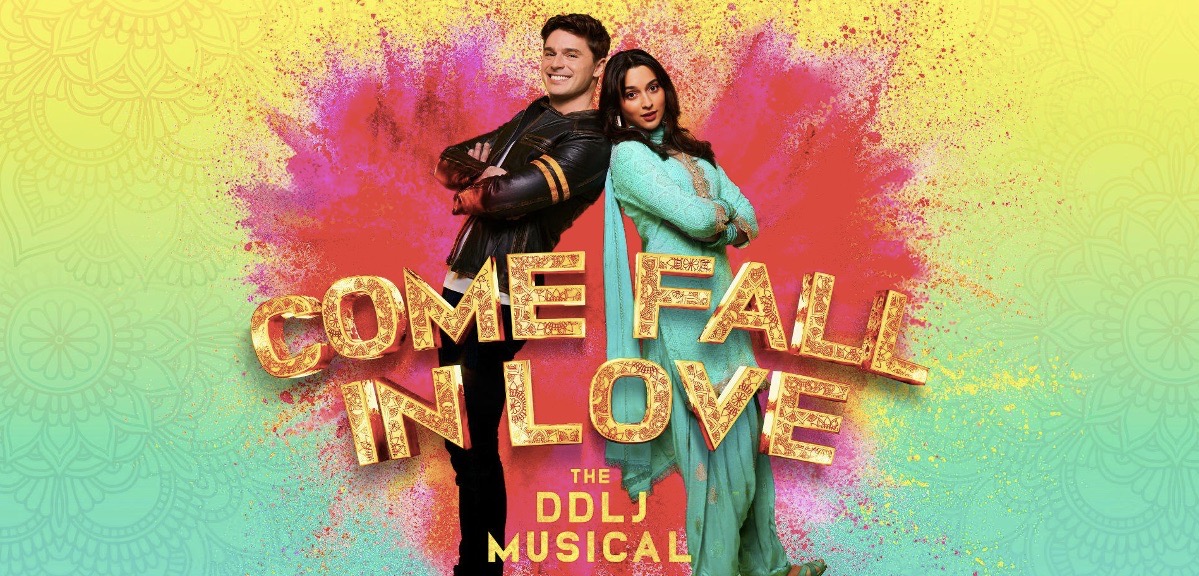
East meets west in ‘Come Fall in Love – the DDLJ Musical’ which is playing at the Manchester Opera House. Based on Aditya Chopra’s 1995 classic ‘Dilwale Dulhania Le Jayenge’ the story follows British Indian born Simran (Jena Pandya) and Roger (formerly Raj, played by Ashley Day) as they embark on a trip around Europe and an unexpected whirlwind romance. However, these lovers have a thorn in their side – Simran is promised Kuljit (Kinshuk Sen) in Panjab, India. It captures the heart and spirit of the original, and boasts an extremely talented cast, colourful costumes and impressive choreography that draws from a range of genres. Although, the show could do with a little bit more depth when dealing with the nuances of Indian culture at times, the show asks you to come and fall in love, and overall, it is pretty difficult not to.

Irvine Iqbal as Baldev and Jena Pandya as Simran

Early on we are introduced to Simran, who has just graduated from Oxford. Although her cleverness sometimes could lean into know it all, Pandya does an excellent job of making her likeable and relatable, whilst communicating her internal struggles particularly in her song ‘Twice as Good.’ Simran recalls how her father Baldev (Irvine Iqbal) told her in her youth that to gain the same opportunities as her Caucasian peers, she must be just that. Twice as good. It is an obstacle that many ethnic minorities face.

Unlike the film, Simran already has her tickets to Europe, her trip has been agreed, and the audience does not learn about her impending arranged marriage until the latter half of Act One. In the film, Simran uses this marriage as leverage to gain her father’s permission to go on the trip, leading to a heartfelt conversation between father and daughter about love, family and culture, which communicates the depth, and love, of their relationship. This might have helped the audience empathise with Baldev and his struggles more, and not just see him as the man forcing his daughter into marriage, which is how Roger’s family see him. With the omission of this conversation, the audience may not fully understand the cultural implications of arranged marriage, and to be honest, Roger does not either, as Simran never really explains them to him. This is an example of where the east half of the show needs to be bolstered a touch. The famous scene of Simran running on the train with Roger’s help drew cheers from the audience, as did all callbacks to the original film, be them dialogue or instrumental.

Jena Pandya as Simran and Ashley Day as Roger

Simran and Roger’s trip boasts some impressive staging and set design, which continually reflects the country the two are in, setting the scene for one of the longer, and more memorable dance numbers, ‘Come Fall in Love.’ Pandya has a difficult job keeping up with Day’s boundless energy, who risks drawing the audience in more with his money and partying ways, whilst Simran geeks out over Voltaire in the corner. However, their scenes in Switzerland put them on more equal footing, and Simran’s drunk state that spawns the song ‘Better Get Right’ allows Pandya to add some comedic flair to the beloved heroine. The first act does feel a tad slower than the second, but serves as important build up for the long awaited jump to the mustard fields of Panjab.

Act Two opened with quite a magical moment. The Mool Mantar, a Sikh prayer, is played into the auditorium, over the image of the Golden Temple which is projected onto the stage. It was quite breathtaking, having been to Amritsar myself, but I worry that without proper reference to the importance of this to Simran and her family, it may not have had quite as big an impact on the whole audience as it did me.

Kinshuk Sen as Kuljit

The vibrant second half picked up the pace and exposed the audience to a multitude of dances, like Bhangra and Giddha, and it was joyous, and comedic, to see Roger fully embrace Simran’s culture. What I am more mixed on though, is Roger’s mother Minky’s (Kara Lane) burlesque-esque number and romance with Kuljit, something that I felt detracted from the main love story unnecessarily. The inclusion of ‘Mehndi Laga Ke Rakhna’ from the original film also felt like a massive cultural moment, one that was enjoyed by all.

As the second half dances to a close, Roger proves that he has taken the time to learn about Indian culture, and recounts to Simran that seva, an idea that was mentioned throughout the show, is the Sikh concept of selfless love and charity. It is moments like this where the east meets west formula really works, putting both sides of the globe on equal footing, and showing the meeting of two different cultures. I will admit, seeing one of the scariest fathers in Bollywood history sing and dance was something to get used to, but Baldev’s cry of ‘jao Simran jao’ still feels as visceral and impactful as the first time I saw it on film. The productions’ closing number ‘Holi Hai’ was brilliantly energetic and is the best thing to take as a lasting impression.

Overall, my cultural criticisms do not detract from the joy of what we are seeing in front of us – the meeting of two cultures, and ultimately a celebration of love. Especially given the current racial climate a show that celebrates the coming together of an Indian woman and Caucasian man is the kind of equality and understanding that we should all be championing. The joy felt in the auditorium was palpable, and it is rare to see so many people of colour in the theatre… you could definitely hear them! Myself included! If an audience can be so delighted by a show that showcases Indian culture, then surely, by and large, this is truly something to fall in love with.

Jao Simran Jao!

4/5

Thanks for reading!

‘Come Fall in Love – The DDLJ Musical’ is playing at the Manchester Opera House until the 21st of June!

Tickets are available from: https://www.atgtickets.com/shows/come-fall-in-love/opera-house-manchester/

‘Permission’ at the Tara Theatre Review: A nuanced and thought-provoking take on the Muslim woman’s fight for liberation

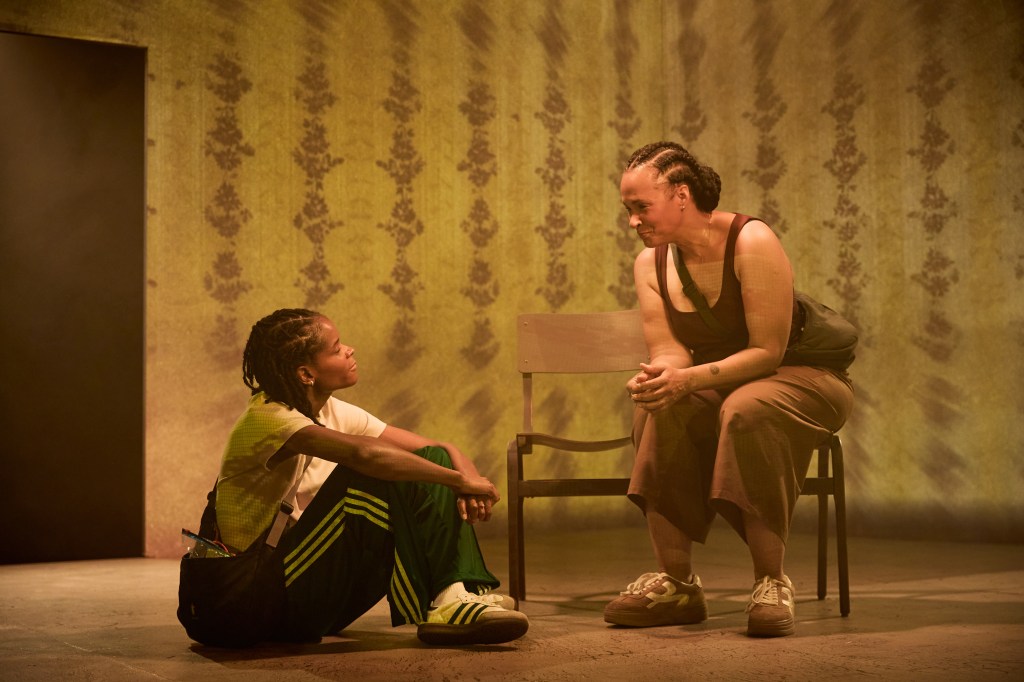
The Tara Theatre in Earlsfield is known for crafting compelling work that explores the world through a South Asian lens. It’s latest production, ‘Permission,’ written Hunia Chawla and directed by Neetu Singh, follows the friendship of Hanna and Minza, two young women from Karachi whose lives take them in different directions. Anisa Butt’s Hanna travels to attend university in the UK, while Rea Malhotra Mukhtyar’s Minza stays in Karachi. The show touches on a multitude of prevalent issues such as freedom, protest, liberation and of course, permission. The play provides so much food for thought that I worry it almost buckles under its own weight, running at a short seventy minutes.

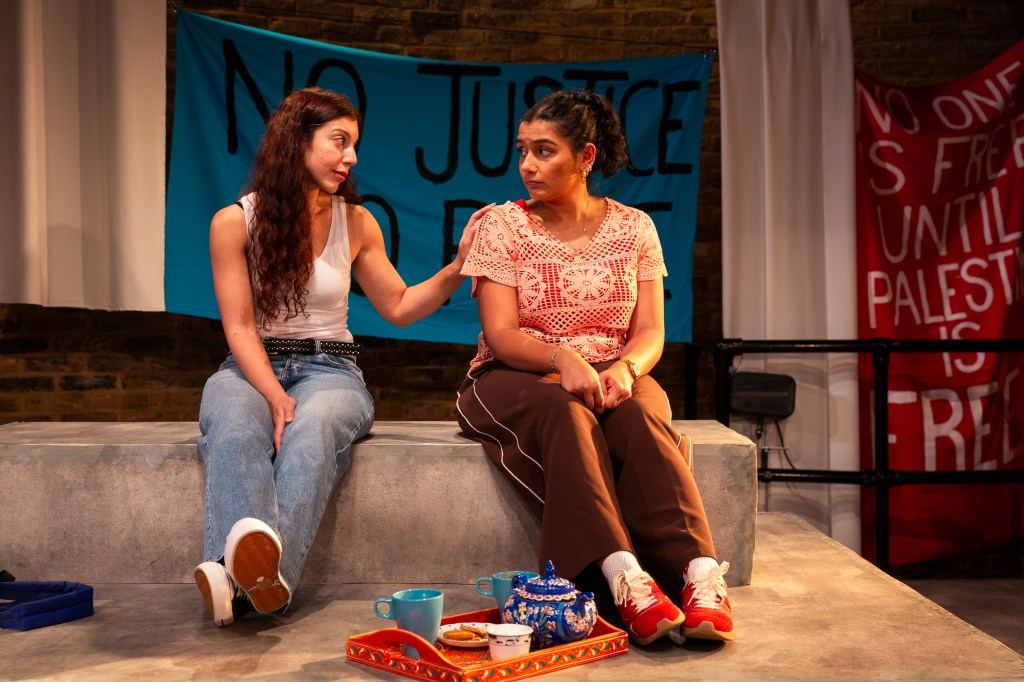
Anisa Butt as Hanna and Rea Malhotra Mukhtyar as Minza

Hanna’s and Minza’s friendship is the heart of the show, and their chemistry and humour make them highly watchable. We open with Hanna trying to keep her boyfriend secret from her parents, and it is clear that in Karachi, women do not always have full autonomy. Hanna suppresses her sexuality, cannot leave the house alone, and her and Minza both dream of liberation. But how to achieve it is the question. Hanna believes that she will find this liberation when moving to the UK for university, and it is here that the play really engages with the uniqueness of the immigrant experience.

Traditionally, the Muslim woman is portrayed as oppressed, and saved by the liberating attitudes of the West, but Chawla’s writing is far too smart and nuanced for that. Yes, Hanna finds freedom to a degree, she can walk in the street unchaperoned, but ultimately is a fish out of water. Her world comes to a stop when compromising photos of her are released online, and sent to her family. She is ashamed, and the audience probably think that her traditional parents will disown her. Minza disbelieves this, but Hanna’s fear, and exposure to perceived westernised values by flatmate Anushe, also played by Mukhtyar, makes Hanna question whether owes her parents anything at all. These are two very different ends of the spectrum, and Anushe’s assertions directly conflict the traditional relationship between Asian child and parent. Parental approval is important to Hana, and Asian culture, and Anushe’s liberal thinking is shocking to Hanna’s traditional family values. This is just one of the many examples of nuance within the production.

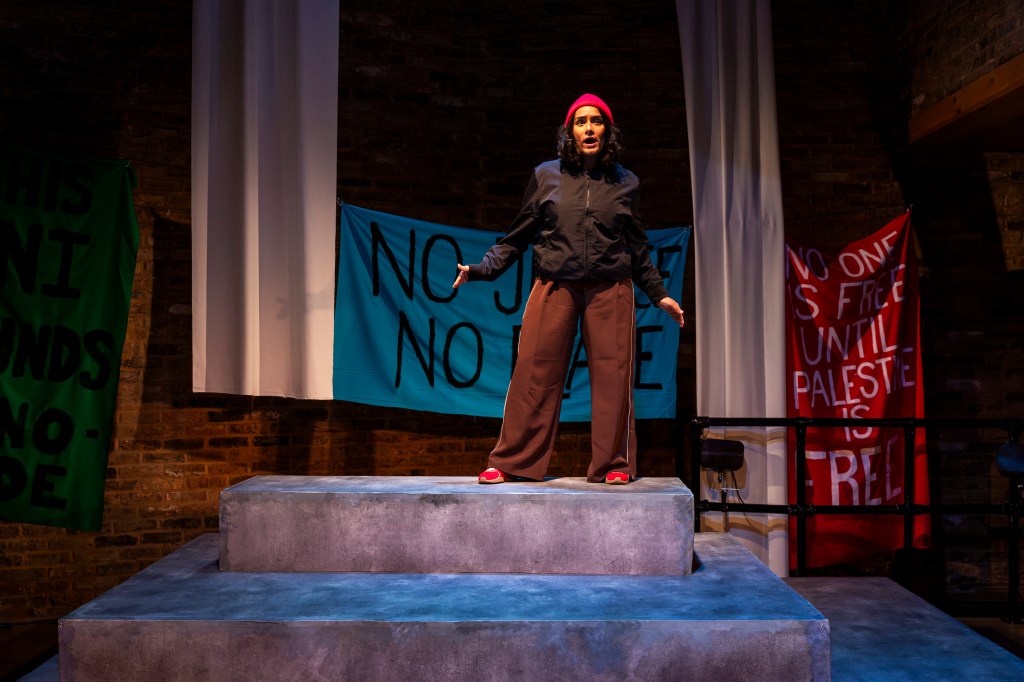
Rea Malhotra Mukhtyar as Anushe

Ultimately, the West is not the ideal that Hanna envisaged, as when attending a protest, she is caught, her visa is revoked, and she is sent back to Karachi. In the UK, she does not have the same level of autonomy as Anushe does, because she is on a student visa. Hanna’s father also welcomes her home, showing her compassion, not disdain. Stereotypes do not seem to exist in this space. Minza has grown more confident in her fight for liberation, maintaining that, action is action. Whilst sometimes it cannot be radical, they can only do what they can do, based on their surroundings. Hanna initially dismisses Minza’s Aurat Marches, prompting Minza to remind her that, in the context of Karachi, a group of women marching to demand liberation is just as powerful as a bunch of students taking over the students’ union in the UK. Both are pushing the boundaries as much as their surroundings allow. It depends on the context, and depends on the person.

So, it is not necessarily the happy ending audiences might have hoped for, it does not provide any answers, but then again, most things in life do not operate as most shows do, with a distinct beginning, middle and end. And most things are not black and white. The play is a realistic snapshot of an important time in these women’s lives. It is pessimistically realistic, but also hopeful.

With such a short runtime, I wonder if the play could have benefited from a greater length to unpack its many themes. I am also divided on its stylistic choices. The two women do interact with men, in the form of several voiceovers. It is not something that I have experienced before, and while it does work to keep the focus on the two women as the centre of their own story, it is hard not to shake the idea that they are both just talking to thin air. I am also unsure whether the audience interaction works, as it takes you out of Hanna’s world, particularly at a point where she is supposed to feel isolated and lost. It does provide comedy to lighten the scene, but so does Hanna’s interaction with Anushe.

Maybe to conclude we should look back at the show’s title. Do we ever have permission to fully do anything? To live freely? To fight for liberation? If so, at what cost? Like life itself, the play offers enough food for thought to keep you full for weeks, but just like Hanna and Minza’s fight for liberation, it could all benefit from having a little more time.

4/5

Thanks for reading!

‘Permission’ is playing at the Tara Theatre until the 7th of June!

Photography by Adam Razvi

‘The Great Gatsby’ at the London Coliseum Review: A star-studded spectacle that infuses the American classic with a newfound vitality

The West End’s latest offering, ‘The Great Gatsby,’ officially launched last Thursday with what has been described as the press night to end all press nights. I was lucky enough to attend and can safely say that this statement is pretty bang on. Based on the successful Broadway show, which itself is based on F. Scott Fitzgerald’s 1925 novel, the story details the class divides, greed and materialism of America in the 1920s. Specifically, the story revolves around the enigmatic and extravagant Jay Gatsby, as told to the audience through the eyes of narrator Nick Carraway. Although I feel the musical could have done with fleshing out some of its characters a little more, ultimately it succeeds in breathing new life into the classic novel and puts forward a star-studded spectacle which is more than worthy of a spot on London’s famed West End.

Visually the production is faultless. Linda Cho’s opulent costumes reflect the style of 1920s America and there are probably hundreds – the wardrobe department deserve a pat on the back and perhaps a lie down after this run has finished. Dominique Kelley’s choreography is incredibly impressive, particularly the extended tap dance sequence. Paul Tate dePoo III’s scenic and projection design was particularly innovative, blending physical sets with computer-generated imagery. When I entered the theatre to take my seat, I was very early, and the theatre was empty. The image of the bay was projected onto front of the stage, the infamous green light glinting, the sounds of the sea lapping on the shore could be heard. This immediate calm, especially after the buzz of the red carpet, gave me goosebumps. Normally in the West End there may be music, but usually we just sit waiting in front of a blank curtain or empty stage. The addition of the CGI made the whole show incredibly immersive, and gave the production a much bigger scale, mirroring that of Gatsby’s infamous parties.

The show capitalises on the vibrant, vitality of 1920’s America that the novel promises and takes the opportunity to inject new life into its story and characters. I am sure we would all like to frequent one of Gatsby’s famous parties, and having the novel splashed all over the West End stage in London’s biggest theatre is surely the best, and only, way to do it. Being, quite literally, bathed in the famed green light was also an exhilarating moment and is a fine example of Cory Pattak’s atmospheric work. The music was catchy too, and allowed for a greater exploration of Scott Fitzgerald’s iconic characters.

Speaking of them, they are famous for being rather unlikeable. Gatsby’s undying hope warrants some sympathy, but others, like Daisy Buchanan, whom her own cousin describes as ‘careless’ seem beyond redemption. My studying of literature leaves no doubt in my mind that the novel acts as an important social commentary on 1920s America, but not one that I have ever personally enjoyed. This is where the musical does the novel a favour – it makes the characters more relatable, and therefore more accessible to a broader audience.

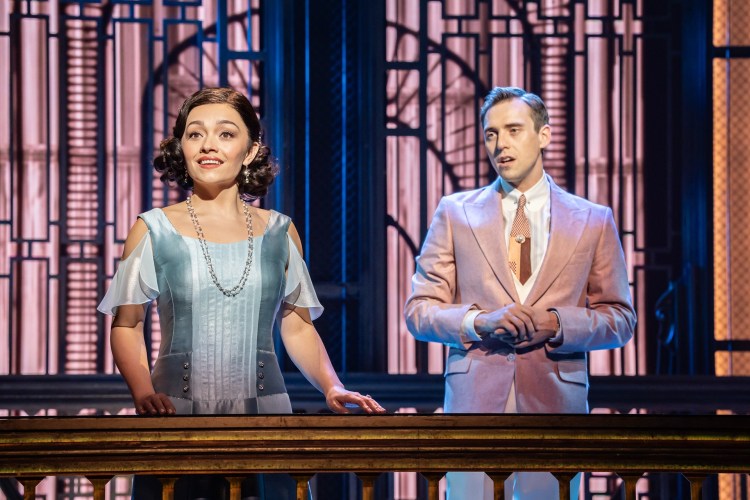
Frances Mayli McCann as Daisy Buchanan and Jamie Muscato as Jay Gatsby

The addition of musical numbers soliloquizes each character’s thoughts and feelings, making for more intimate characterisation, something which was notably missing from Baz Luhrmann’s 2013 film, and perhaps the novel, as primarily we only get Nick’s point of view. Let’s take Daisy for example. It is clear in the novel that she is shallow, and materialistic. She has some affection for Gatsby but not enough to leave her horrid husband Tom and trade in her lavish lifestyle. The musical adds greater depth to their romance through some pretty impressive power ballads. Daisy is given several, both sprung directly from her quotations in the novel about roses and girls being fools, the latter of which makes her more sympathetic. She is restricted by her sex and social convention – all of which is discussed in Scott Fitzgerald’s original work. This particular song takes place after Gatsby’s funeral. In the novel, following Gatsby’s death, Daisy and Tom flee with no word. This song, and preceding conversation with Nick acts almost as an epilogue. Daisy’s song with Gatsby at the close of the first act, ‘Save Me Too,’ also makes their desire for each other believable, especially given Jamie Muscato and Frances Mayli McCann’s strong vocals.

What is interesting about this it that some critics have stated that the musical’s softening of Daisy misses the entire point of the novel. While this is true in some ways, Daisy is famously careless, I would argue that, for a West End show, this characterisation might not make for the most emotionally satisfying experience. This switch veers the iteration of the story into tragedy territory, Gatsby meets a tragic end, which I found to be much more moving, and emotionally involving, than the original.

Amber Davies and Corbin Bleu as Jordan Baker and Nick Carraway respectively

Many characters really benefit from the inclusion of musical numbers, especially Corbin Bleu’s Nick Carraway. In Scott Fitzgerald’s novel he is a subdued observer, but his musical numbers in the show give him an extra warmth and humour. His song ‘The Met’ in which he is horrified by Tom’s hedonistic behaviour and wishes he had been taken to the Metropolitan Museum of Art as promised, drew laughs from the audience. Bleu portrays Nick as a sweetly naïve everyman, a much more relatable, and likeable, audience surrogate than his written counterpart.

Another character that benefits from the musical numbers is Jordan Baker, played to sardonic and comic perfection by Amber Davies. Her characterisation mirrors that of the novel, she is cool and sharp, and quick to criticise social convention. She is the archetypal ‘new woman’ of the ‘20s, and provides a good foil for Daisy. A standout performance in my opinion, Davies’ sass coupled with Bleu’s bumbling charm make for a sweet pairing, that is strong enough to rival that of the show’s title couple. Her song ‘New Money’ is my personal favourite, and I bet that the wide-legged pants that Davies sports in it will be a sellout this summer.

Rachel Tucker as Myrtle Wilson

Myrtle Wilson’s three musical numbers add multiple dimensions to her character. In the novel and Baz Luhrmann’s film Myrtle barely gets a look in, but in Rachel Tucker’s capable hands her presence and demise drew visceral reactions from the audience.

However, I do have some characterisation critiques. Gatsby’s past, which Luhrmann goes into through a flashback sequence, does not feel like it is given enough exploration in this adaptation. It is very explicit that ‘it is all for’ Daisy, but his rising through the ranks is not quite as fleshed out. Also, although John Owen-Jones’ has some catchy tunes as Meyer Wolfsheim, he is not quite there long enough to compete with the impressions made by the other characters.

I would like to take a second to talk about the diverse cast. Both Bleu and Mayli McCann hail from ethnic minority backgrounds, which should be celebrated. Their presence suggests that wealth and beauty do not just have one Caucasian form, and as a young Asian creative, a definite minority in this industry, their presence does not go unnoticed.

Despite some minor characterisation quibbles, ‘The Great Gatsby’ does exactly what a West End show should, it presents dazzling spectacle, some of the best musical talent out there and delivers a toe tapping soundtrack that will stay with you for hours afterwards. While it might not satisfy some of the literary purists out there, I have no doubt that it will satisfy London theatregoers this summer, which, especially in this format, is the point. It is the West End after all, old sports!

4/5

Thanks for reading!

‘The Great Gatsby’ is playing at the London Coliseum until the 7th of September!

Photography by Johan Persson

‘Ghosts’ at the Lyric Hammersmith Review – a gripping reimagining that digs deeper into the heart of Ibsen’s scandalous classic

Countless students have pored over Henrik Ibsen’s stories and characters, myself included. Whilst his works were shocking and scandalous at the time of publication, ‘Ghosts’ was first performed in 1882, restaging Ibsen’s plays today runs the risk of losing the original shock factor. This is where Gary Owen and Rachel O’Riordan’s reimagining of the source material succeeds, it retains the scandal and adds to it. Whilst using the framework of Ibsen’s original piece, this production uses a contemporary lens to add greater dimensions to its characters, ensuring that they all, particularly the women, are explored in greater depth and have a piercing agency that previous adaptations missed.

The drama opens with Victoria Smurfit’s Helena Alving preparing to set up a charitable foundation in the name of her late husband Carl, but revelations about his past behaviour and the arrival of her son Oz threaten to unbury some dark family secrets. Although physically absent, Merle Hansel’s minimalist staging ensures that Carl is forever present, images of the back of a man’s head adorn the left and right walls of the set, presumably representative of the Alving patriarch that the family can never truly escape. The back glass wall is an innovative addition, the fog behind it constantly rolling forward – a fantastic reference to the slow unravelling of family secrets and a direct reference to the Nordic fjord in which the play is originally set. Due to Helena’s pure white athleisure outfit, it is her that is most clearly reflected in the glass, an image reading as if she is almost talking to herself… or her personal ghosts in the fog.

Victoria Smurfit as Helena Alving

Smurfit’s Helena is the powerhouse that anchors and drives the play. Smurfit showcases a deft versatility in portraying Helena’s many faces, as the victim, the controller, the dominating mother but also the vulnerable woman, sometimes in the same stroke. Whilst, like the original, Helena scrambles to keep her husband’s past indiscretions a secret from her son, Helena is gifted a life of her own, notably a past in which she did wield power, and in the present, without her husband she is emboldened. She constantly delights in doing things her late husband would have ‘hated.’ We learn more about her past through her relationship with Rhashan Stone’s lawyer Andersen, this productions’ response to the hypocritical Pastor Manders. Her flirtatious hold over him is far more subtle in Ibsen’s text, but works here to make Helena a fully developed human being, and ramps up the sexual tension early on in the piece. Ibsen’s Helen would be clutching her pearls.

In a quick chat, director Gary Owen described to me that the choice to make Helena more rounded just ‘made sense,’ as otherwise the audience might struggle to relate to and understand her. He’s bang on, and her humorous snipes make her instantly likeable and attention-grabbing, her later vulnerability elicits immediate sympathy. It is here that the contemporary lens really elevates the character, as in the original text, Helena is more of a passive narrator in her own story – here she is imbued with greater agency and character which is strengthened by the backstory Owen has crafted for her.

Callum Scott Howells as Oz Alving

Callum Scott Howells’ comically self-absorbed Oz is an actor in this version, not a painter, and joyously undercuts some of the shows more serious moments with a dangerous humour, whilst poking fun at the acting elite in the process. His connection with Patricia Allison’s Reggie seems much more a meeting of equal minds than in the original. Simisola Majekodunmi’s lighting follows Oz’s various bursts of enlightenment, a stylistic note seemingly lifted from the original text – Ibsen always took care to mention stoves and candles in his stage directions. Oz and Reggie proceed to sleep together, again, marking another explicit update to Ibsen’s original, in which the incest is only hinted at, never coming to physical fruition. This addition serves to heighten the stakes and keep the audience gripped, as affirmed by their gasps, as they anticipated a scandalous fallout.

While Ibsen’s original piece emphasises that it is the sins of the father that threaten the family, physically represented by Oz’s syphilis, this production jettisons the references to venereal disease and points the finger at Helena. The sin is not just paternal, but also maternal building to the overarching theme that it is inter-generational sin and trauma that threatens the Alving line, not an inherited disease. Ideas around inherited trauma will certainly resonate with viewers today.

The play also goes into depth about Helena’s trauma in a moving monologue, with Andersen describing Helena’s treatment by Carl as coercive control. Such a concept did not exist in the minds of Victorian theatregoers, but this exploration reflects society’s developments in recognising such toxic relationships and aftercare for its victims, as highlighted by the #MeToo movement. It is moments like this that the contemporary lens of the show really pays off.

Patricia Allison, Victoria Smurfit and Callum Scott Howells as Reggie, Helena and Oz respectively

The first act ends with Helena revealing to Oz and Reggie that they are half siblings, the plot point that ends Ibsen’s original play. Owen’s choice to place it here allows for a greater exploration of the fallout of this revelation in the slower, second act, and finally gives Reggie the chance to have her say, in a commanding turn by Allison. Ibsen does not give his Regina this opportunity, as in his work, at the realisation that Oz is her half-brother, she bolts out the door, and out of the play, never to be seen again. The play boils down to a confronting conversation about the blurred lines of consent, enabler, victim and controller between mother and son, as they thrash out whether they can ever survive this inherited trauma and be free of it. Smurfit and Scott Howells anchor these big ideas whilst O’ Riordan’s direction ensures that these closing discussions are gripping and affecting, and it is here that Scott Howells’ Oz really shines, his characters journey gathers speed as he swaps the comedy for tragedy.

By going for more explicit discussions of sex, coercive control and trauma, this production adds greater layers and depths to Ibsen’s classic story and characters, digging deeper into the heart of ‘Ghosts’ and laying it bare for all the audience to see, whilst raising pertinent questions about human nature along the way.

5/5

Thanks for reading!

‘Ghosts’ is playing at the Lyric Hammersmith until 10th May!

Photography by Helen Murray

‘Speed’ at the Bush Theatre Review and Analysis: A Portrait of South Asian Rage, Trauma and Identity

The Bush Theatre’s newest show, written and directed by Mohamed Zain-Dada and Milli Bhatia respectively, follows four British Asians whose paths cross at a speed awareness course, set in the basement of a Birmingham-based hotel. A play with an all-Asian cast, writer and director slots well into the Bush Theatre’s rich history of giving a platform to underrepresented voices, and whilst veiled in comedy, ‘Speed’ successfully uses its intimate setting to tackle the wider themes of South Asian rage, trauma and identity. Fasten your seatbelts.

The cast of ‘Speed’

The main question Nikesh Patel’s Abz, as course facilitator, asks is what has made the three participants so angry? They are girl boss Faiza, nurse Harleen and delivery driver Samir. Although initially appearing as stock characters, the play successfully uses its setting to pile on the pressure and dig deeper into their respective psyches. Abz notes that they are ‘mirrors’ of each other. By that logic, the characters mirror us as well.

The action takes place on a central stage, adding to the interrogatory feel of the production – these four characters are under the microscope, surrounding by our prying eyes, rabbits in headlights. This also allows the audience to feel as if they are participating in the course, in the way that a traditional theatre set up would not. Throughout the 90-minute production, we see characters bend and break, resulting in an emotionally charged therapy session.

Spoilers to follow…

Shazia Nicholls as Faiza

The characters’ varying acceptance of their Asian roots initially causes divides. Sabrina Sandhu and Arian Nik’s Harleen and Samir are in touch with their Asian identity, dropping words in Panjabi and Urdu. However, Shazia Nicholls’ brilliantly comedic Faiza is prouder of her St Albans heritage and is complemented when Samir opines that she ‘don’t look Pakistani.’ Her distinct departure from her Asian side, as we later discover, might have more practical reasoning. She details that one of her business ventures fell through because ‘the FSA don’t want brown women to succeed.’ Although this garnered laughs, it speaks to the wider theme of the struggles that women, specifically Asian women, face in the business-world. Faiza has had to fight to earn that BMW, and perhaps suppress her Asian-ness in the process. The idea that South Asian’s need to downplay our identities, and that they could be under threat, is revisited throughout the play.

The simple question of what has made Faiza, Samir and Harleen angry and end up on the course is fairly simple – the patriarchy, unfair and unsympathetic systems, and racial abuse. Faiza, Harleen and Samir stand by the actions that led them here, as do we, but Abz refuses to look at each of their stories holistically, instead concluding that the law, no matter the injustice that they faced, should be upheld.

Nikesh Patel as Abz

Abz, coupled with the DVLA, is representative of a system of reform. RUNDI, a speed awareness course of Abz’ own devising is what is on trial here, as well as the three participants. He believes in meaningful engagement and the idea of ‘unlearning and rehabilitating.’ His maintenance of these ideals, as well as the distinctly British phrase of ‘keep calm and carry on’ means that he fails to consider each participants’ individual identities and experiences. We see this early on when he continually calls Harleen ‘Helene.’ I go by Harpal, or Harps, but have had Hearts, Harpy and Harpull to name a few botched examples of my name. The irony is that, while Abz encourages this meaningful engagement, he fails to properly engage with those in front of him, enforcing a ‘one size fits all’ system. It is throughout the course of the play that we see that this is wholly untrue, and if it does not work for these three, why would it work for wider society? This little microcosm, this mirror, is deftly used by Zain-Dada to make broader statements about British society.

A good example of this is the discussion about the race riots last year. The play does well to include this, as the situation last summer presented the greatest racial unrest I have experienced in my lifetime. I was advised by people in my high street to go home for my own safety. Whilst Harleen and Samir detail the racial abuse they witnessed and experienced, Faiza is silent and Abz maintains that, despite this horror, we should ‘take it on the chin,’ and keep calm and carry on. Sabrina Sandhu shines as Harleen here, her passion and controlled anger crackles under the surface and gives her enough confidence to silence comedy duo Samir and Faiza, and authoritarian Abz. Samir and Harleen ask why South Asians should be silent in the face of racial attacks, and calls out the very behaviours that many of us have over the past year.

Sabrina Sandhu as Harleen

As the tension between the four bubbles over, ‘Speed’ puts its foot down veering into the thriller genre with the revelation that for all his high and mighty behaviour, Abz has not been honest. After some shouting and road rage, albeit without the car or road, the wheels fully come off and Abz is forced to admit that, after also being racially abused, he engaged in dangerous driving that had dire consequences. Unfortunately, this gear switch may not come as a surprise, Jessica Hung Han Yun’s lighting throughout the play foreshadows some sort of trauma. However, this revelation gives Patel the chance to show his range, and his quick switches from disciplinarian, desperation and devastation succeeds in making this plot point genuinely affecting.

Abz’ suppression of his Asian side, in response to his racist encounter, has manifested into internalised racism, hinted at throughout the play by his desire to save the participants from what he describes as their ‘base selves.’ His paternalistic attitude towards the participants echoes the very historical arguments that white supremacy and racism were founded upon. Although Faiza did indulge in some of the stereotypes that Abz perpetuated, referring to Samir as a typical ‘brown boy,’ her distancing from her Pakistani roots has not marred her judgment to the point at which she can be described as racist.

Arian Nik as Samir

Due to Abz’ harsher treatment of Samir throughout the play, even going as far to refer to him as a ‘typical paki,’ it is fitting that the pair close the show. Although both men have bared their souls, a rarity for South Asian males, but a staple of Zain-Dada’s work, see ‘Blue Mist,’ Abz and Samir cannot come to an understanding. Both Abz and Samir, and by extension Patel and Nik, come full circle, shedding the stock characteristics established at the beginning, of the disciplinarian and the joker, to add real nuance to their characters in the closing moments. They are two sides of the same coin, their experiences of racial prejudice are similar, but their response, perhaps due to their differing age, and how they deal with their trauma are markedly different. The ending is not quite the ‘let’s unite against racism and celebrate our cultural heritage’ message that audiences might expect or hope for. ‘Speed’ poses bigger questions, asking what will become of South Asians if we do not unite and find strength in our shared experience, even if that experience involves the trauma of experiencing racial discrimination.

While Abz’ revelation may not be break-inducing, the play succeeds when it speeds towards the wider themes of South Asian rage, trauma and identity. The nuanced presentation that the plays characters and themes showcase makes for compelling, revealing, and relevant viewing, especially for members of the South Asian diaspora. It’s certainly a speed awareness course I will not forget.

4/5

Thank you for reading!

Speed is playing at the Bush Theatre until May 17th!

Tickets: https://www.bushtheatre.co.uk/event/speed/

Photography by Richard Laker

‘Anora’ 2024 Analysis: Sex, Class and the Fairytale Narrative

TW: Sex and Sexual Assault

Sean Baker’s tragic, romantic comedy-drama took the most recent Oscar’s ceremony by storm and clinched the best actress award Mikey Maddison, who plays the eponymous heroine. There’s no doubt that from the opening seconds of the film, Maddison grabs the audience by the throat and does not let them go, and I do think it is safe to say that she is key to the film’s success. I’ll admit, certain narrative points within the film did lose me, but it cannot be denied that the film had a lot of interesting points to raise about the sex industry, class, treatment of women and the fairytale narrative.

Let’s start with our heroine. I found the name ‘Anora’ to be intriguing and beautiful, it almost has a princess quality, probably due to its suffix, reminiscent of Disney heroines such as Cinderella, Tiana and Aurora, ex cetera. Already I am drawing links to Disney narratives! In Latin, ‘Anora’ translates to ‘honour.’ Although to me, the name seemed quite unique, Anora prefers to be known as ‘Ani.’

Immediately, Ani feels different – she crushes existing stereotypes with her heels. Ani is not a sex worker because she was trafficked, or forced, or destitute, unlike other fictional heroines such as Fantine. She is in her control; this is her choice. This is why we are drawn to her, she stands out, and her brassy Brooklyn accent is instantly distinct and recognisable. She also does not comply with the ‘hooker with a heart of gold,’ stereotype either, an example of this being Julia Roberts’ Vivian March from ‘Pretty Woman.’ Ani is brash and ballsy; we see her in the opening moments of the film wrapping men round her little finger with ease, and going for what she wants.

The film has received praise for its depiction of the sex industry, and for me, the film appeared to demystify and decriminalise it. Scenes of Ani dancing are intercut with scenes of her having a cigarette break with a friend, and eating her dinner out of a Tupperware box. The film is trying to say that the structure of her life is not that different to ours. The job she is doing is different, but then… my job is probably different to yours. She lives as we do. She works, she laughs with her friends, catches up on sleep, she parties. She is not discriminated against because of her personality, but only because of her job. This is evidenced by Vanya’s Russian, oligarchical family, who, without even meeting Ani, declare that their son has ‘shamed’ his ‘family by marrying someone like’ her. It feels like the film is asking us why. Why is she so discriminated against for her work? She is just a young woman making a living, which surely, many people of all genders and ages can relate to.

We see her go home in the morning, make up free in her beanie hat. It could be conceivable to think that dollars we see Ani receive, the dizzying bright lights, dresses and heels imply that she earns a lot of money. The film further normalises her by presenting her as a standard twenty-three-year-old in a flat share with her sister. All these plot points work to break the stereotypes that already exist around sex work, and sex workers themselves.

I think it’s important to remember from the start that Ani is only twenty-three. She is incredibly young. She does seems older, as Ivan points out, but this is probably due to her clothes and confidence. Her youth and girlishness are hinted at by the tinsel in her hair that shimmers throughout the film. Note the how the colours change. While she is in her abrupt wedded bliss with Vanya, it is a shocking pink.

The first half of the film does indeed play like a Disney fairytale. Ani is swept off her feet, has a world-wind romance and marries a wealthy suitor, Vanya. It is important to note that Ani does not see Vanya as a way to leave her sex work behind but work in general behind. Ani seeks freedom from the tedious, boring nature of work. Don’t we all? She is not looking to be saved from what others perceive to be a shameful profession. She is not ashamed of her work. I originally doubted if the relationship was genuine on Ani’s part, because we see her flatter her clients all the time. However, after remembering her age, I think it is conceivable. I think many twenty-three-year-olds would see Vanya’s lifestyle as an escape from the mundane. We also see this genuine nature reflected in her make up. Her look becomes more natural in the film, as we begin to peel back the layers of her character. She becomes more transparent and vulnerable, as her relationship with Vanya progresses. Both her and Vanya are swept up in the moment and make that age old mistake of ultimately mistaking lust for love.

The situation Ani finds herself in is very different to what she is used to in the nightclub, and just proves that the power dynamics in the nightclub are just a simulation. In the night club, women hold the cards, men hold the dollar bills. On the outside world, I Baker’s Brooklyn, women, especially of Ani’s age and class, do not have this power. This is proved throughout the film, as she is berated and manhandled by the men around her, first and foremost because they are men, but also because they possess greater wealth than her. Now, it is the nightclub that looks like a fantasy land, as in Baker’s real-world Brooklyn, a woman of Ani’s age and economic status is no match for the wealthy man.

Vanya’s poor treatment of Ani speaks to the wider theme of men’s treatment of women in the world. Vanya is spoiled, and sees Ani as a possession, he literally buys her as a plaything in his playground. He then discards her when told to by his family and replaces her with a co-worker. Vanya’s abandonment of Ani is incredibly traumatising for her as it leads to her encounter with his bodyguards.

Ani finds herself in a scary situation once Vanya’s family bodyguards come for him and try and force the two to divorce. Ani is bound and gagged, and in a disturbing image, bodyguard Igor pulls Ani on top of him, almost simulating a lap dance, but in this dance, Ani is not in control. She is forced into silence by the men around her, which seems like a broader thematic statement about the treatment of women. The blood red of the scarf used to gag Ani could refer to passion and sexuality but is also disturbing as it the colour of blood. It could therefore imply the potential violence that Ani could be subjected to in this situation. At the end of the film, Ani asserts her belief that, if given the chance, Igor would have raped her in this scene.

Igor brings the red scarf with him on their quest to find Vanya, offering it to Ani when she becomes cold. Ani wraps it around her neck. It seems like she is taking back control here, but her choice to wrap it around her neck simulates that of a hangman’s noose, implying the desperate, and perilous situation she has found herself in. The changing use of the scarf contributes to the wider question of control in the film. Is Ani ever in control? Or is she constantly controlled?

After realising she is no match for Vanya’s wealthy family, Ani agrees to leave Vanya for the sum of ten thousand dollars. This negotiation scene simultaneously gifts Ani with control but also takes it away. She wins, because she has the money, but she is still being bought, and controlled. This led me to wonder whether people would see Ani as a gold digger, but this presents an interesting discussion of gender. Would someone consider Ani a gold digger because she is a woman? What is the male equivalent of a gold digger? Although not explicitly gendered in its form, the phrase ‘gold digger,’ is almost exclusively associated with women, not men.

We close the film with a conversation between Ani and Igor. It is here Ani claims that Igor would have previously raped her. For her, it is inconceivable to think that someone would not want sex from her. Despite their difficult relationship at the beginning, Igor later shows kindness to Ani and defends her, proclaiming that she deserves an apology from Vanya. Some commentators claim that it is the relationship between Igor and Ani that would blossom into genuine romance. Whilst I would not personally say that their first meeting could be described as a meet-cute, they certainly start with the bickering and dislike, and then end in an intimacy.

We see Ani incredibly vulnerable at the end of the film with Igor, and when simulating sex with him, she takes control and places herself on top of him. Unlike Vanya, Igor does not break eye contact with her, and it presents the most intimate portrayal of intercourse in the film. Vanya would not look Ani in the eye during their furiously fast coital sessions. Ani’s relationship with sex is complicated, and I did wonder why she would want to engage in sex with Igor at this moment. Perhaps she needs comfort after what she has just experienced, or perhaps it is because she only encounters men who want sex from her. This is the only thing she knows. This thread, however, does not appear to empower Ani, and victimises her further, massively contrasting how we first saw her at the club in Brooklyn.

It is also tragic, as Ani finally has the space to process her trauma and breaks down in tears. There is also the realisation that despite this experience, nothing in her life has really changed. To the outsider, her life almost seems worse, as the last few frames of the film are less aesthetically pleasing and exciting than the opening of the film, Ani strutting across the club floor. Unlike the classic fairytale formula, Ani does not ascend to wealth, riches and happiness, but seems to fall much further as it all comes crashing down. Unfortunately, there is no happily ever after here. It appears that this film is very much a fairytale that is grounded in reality.

Thanks for reading!

Snow White: Origins, Womanhood and Christian Allegory

Disney’s Snow White hit cinemas last weekend after many controversies and tribulations. At the heart of the story is the famed fight for the fairest of them all between two iconic Disney, and literary, characters, the Evil Queen and Snow White. In the most recent adaptation these characters are played to perfection by Gal Gadot and Rachel Zegler. To interrogate the relationship between the two popular characters, not just in the Disney world, we will have to go back to their origins.

Both characters first appear in a collection of fairytales written by the Brothers Grimm, published in 1812 and originally titled ‘Schneewittchen.’ Much of it is familiar, but as you may have already guessed, the original story has some darker elements. For a start, the Evil Queen is Snow White’s biological mother, and when she tries to kill her daughter Snow White is only seven. Also, said Queen does not originally ask the Huntsman for Snow White’s heart, but her lungs and liver, so that she can eat them with salt. Well, at least she is using seasoning. I found this plot point particularly shocking, as it was not enough for the Queen to dispatch Snow White, she also feels that she must ingest her. Snow White quite literally was intended to be engulfed by the Queen like her prey, implying the Queen’s sheer force and influence was nearly enough to overcome Snow White. Did the Queen think that by cannibalising Snow White, she could absorb or ingest her fair nature? Perhaps this mutilation was the Queen’s way of ensuring that Snow White was truly dead and gone. After letting Snow White go, the Huntsman provides the Queen with a boar’s lungs and liver instead.

In the Grimm fairytale, the Queen, after twigging that Snow White is alive, embarks on not one, but three attempts to kill her. The Queen, disguised as a peddler, offers a silk, laced bodice to Snow White, who faints after the Queen ties it too tightly. The dwarves arrive home and cut her out of it. Next, the Queen sells Snow White a poisoned comb, but once the dwarves remove it, she is restored. Her third attempt involves the poisoned apple. However, only one half is poisoned, the Queen takes a bite from the white, non-poisoned half to reassure Snow White, who then tucks into the other red half. These methods of killing all seem gendered, they are all objects associated with femininity. If Snow White were a man, I doubt anyone would be selling poisoned combs or laced bodices to him. If we were dealing with a wizard and a prince, I am sure there would be some violence or sword fighting involved. The above three scenarios describe female warfare, one that is rooted in the domestic and free of explicit violence.

The colouring of the apple is significant and ironic. Despite Snow White being the innocent and purest of all, normally associated with white, it is the red half that she takes. While referencing passion and sexuality, nowadays red is reminiscent of danger, both symbolic of the Queen herself, building the image that the Queen is the one who killed Snow White in ‘apple form.’ The two halves of the apple represent the Queen and Snow White herself and highlights their incompatibility. When Snow White bites from the red half, she dies. Snow White and the Queen are antithetical to each other, and therefore incompatible. In Marc Webb’s 2025 version, the sweetness of apples is highlighted by Snow White, who as a child, would pick apples and bake apple pies for the townspeople, noting that something sweet can remind people that there is ‘more to being alive than mere subsidence.’ I would argue that the Queen uses an apple to lure Snow White in this version because she is aware of this emotional attachment.

While the apple is not present in every version of Snow White’s story, bear in mind many countries have their own versions, the apple is a feature in majority of them. An apple might have been chosen as the poisonous fruit due to its biblical connections. In Genesis, after being tricked by Satan, Eve eats the fruit from the Tree of Knowledge and brings all sin into the world. The Queen, as Satan, tricks Snow White into eating the forbidden fruit, thus releasing evil into her own body, killing her.

In the 1812 version, an unassuming Prince then stumbles upon the scene of Snow White in the glass casket and is so taken by her story that he stays with her. Ironically, despite the amount of poison that the Queen is serving Snow White does not ‘die.’ Although how it occurs is slightly different version to version, once the chunk of apple is knocked out of Snow White’s throat, she is as right as rain. So… she was more choked into a coma? When revived, the Prince then declares his love for Snow White, and they marry. Enraged, the Queen, after being told by the Mirror that Snow White is still alive and kicking, storms the wedding, and tries to kill her again! She’s persistent I’ll give her that. The Queen is then forced to dance in red hot iron slippers until she drops dead. Snow White’s resurrection and the vanquishing of good over evil can similarly draw Christian interpretations.

In the 1937 Disney film the Queen, whilst being chased by the dwarves, falls off a cliff and is crushed. In the most recent film, the Queen destroys the Magic Mirror, which is the source of her powers. She then turns into glass herself and is pulled into the Mirror, which repairs itself. In a way, Gadot’s Queen is immortalised in the Mirror. Her turning into glass, and the fragility of the material, is stark contrast to her previous immortality.

Snow White and The Evil Queen are representative of two different sides of womanhood. Two sides of the same coin or two sides of the same apple, if you will. Feminist scholars Sandra Gilbert and Susan Gubar believe Snow White and the Evil Queen to be the two female stereotypes of the angel and the monster. Snow White is pure, innocent and in Disney’s version maternal and loving. We see this through her interactions with woodland creatures and the dwarves. The Queen is antithetical to that, and therefore antithetical to the prevailing idea of womanhood at that time. Snow White and the Queen could also be discussed in the context of Freud’s Madonna-Whore complex. It is obvious that Snow White fulfils the Madonna trope, but it is never explicitly stated that the Queen is promiscuous. However, she is styled as a femme fatale, and in the most recent adaptation it is revealed that the Queen enchanted and then murdered Snow White’s father. The Queen, in this version and Disney’s 1937 version, is seen wearing make-up, unlike Snow White. Historically, heavy make up in society was an indicator of sexual promiscuity or prostitution, particularly in the Victorian era. Again, this does not suggest that the Queen is promiscuous, but she is portrayed as a sexual being, who has used that sexuality to gain power, and dispatch of their rivals. This is how she captured the attention of Snow White’s father. Gadot’s recent portrayal of the famed villain certainly leans into this idea, and into the Queen’s obsession with material wealth. At the close of the film, the Mirror tells her that her beauty is only ‘skin deep.’

Snow White has grown up with nothing, and is reduced to rags. She is generous and loving, as showcased in the 1937 film. She has no desire for material things, but for love and happiness. While the Queen in the 1937 film is not explicitly concerned with material wealth, Gadot’s iteration of the character is. This material obsession matches well with the Queen’s desire to be the fairest of them all. It is from this beauty that she exerts her influence and maintains her power, something Gadot explains in her solo song, ‘All is Fair.’ Again, Snow White is not concerned with such things, she seeks to be fair in her personality, not physically.

This is explicitly fleshed out more in the recent film, as Zegler’s Snow White goes head-to-head with the Evil Queen to take back her kingdom, using kindness and fairness as her weapon. Zegler attracted criticism when discussing the original 1937 film, and implied that Snow White was passive. Upon a recent rewatch, I believe she was more active than people give her credit for. She stands up to the dwarves, most notably Grumpy and at times she tells them off. Yes, she fills the maternal role, and perhaps her limitation is that she was active in the domestic space which is typically gendered female.

Zegler was accused of promoting the ‘Girlboss’ narrative. The ‘Girlboss’ narrative was popularised by Sophia Amoruso and described an empowered woman who is successful in the capitalist world. While praising individual achievement, people have criticised the narrative as it does not focus on encouraging systemic change. Promoting such a narrative risk invalidating Snow White, and other women who are happy in the domestic space. An example of this is the relationship between Meg and Jo March in ‘Little Women.’ Meg must remind Jo that, just because she dreams of being a wife and mother, this does not mean that her dreams are any less than that of Meg’s.

The 2025 film gives Snow White greater agency, a subtle example of this is in ‘Whistle While You Work.’ In this version, she encourages the dwarfs to clean with her, instructing them. In the original she tidies up their mess upon her arrival. Zegler also criticised Snow White’s decision to marry the prince, someone who she barely knows. This is also rectified in her version, and her relationship with vigilante Jonathan is given much more time to develop.

To be honest, I feel like Zegler could not win and, and the response she received was incredibly sexist. If Disney did not seek to update the previous story for a 2025 audience, it would have come under fire, and Snow White’s decision to marry a man she barely knows would, I am sure, have provoked the ire of many women out there. Especially in light of dramas like ‘The Crown’ shining the troublesome light on the mismatched union of Charles and Diana.

It is also unlikely that a man would find themselves in Zegler’s position, as they perpetually exist in the male version of a ‘Girlboss’ narrative. By and large, it is male characters that drive stories and have greater agency than women, therefore, it is not a fight or argument that they would have to make. Men would not ever find themselves in Zegler’s position, and if a man advocated for another male character to be a strong, fearless leader, I am sure that no one would bat an eyelid. We can see these feminist updates in other Disney adaptations, such as 2019’s ‘Aladdin.’ Now, Jasmine seeks to rule the kingdom herself, she is not just concerned with marriage as she was in the original. Women must actively advocate for greater autonomy and agency in the fairytale world but also the real world.

I have already talked about the Queen’s obsession with her appearance, but over the past few years, it is the public who have been obsessed with Snow White’s. In the original story, Snow White has ‘skin as white as snow, lips as red as blood and hair as black as ebony.’ When Zegler was cast, in an example of colour-blind casting, she was subjected to racist abuse online. This response, and Snow White’s original story, perpetuates the narrative that whiteness is superior. Zegler hit back at the abuse, citing the fact that Snow White is popular in Spanish-speaking countries, and is known as ‘Blanca Nieves.’ In Zegler’s version, the title character is named Snow White after surviving a snow blizzard as a child.

Snow White holds the special Disney status of being the original Princess, and the film itself is instantly recognisable due to its iconic imagery and iconography. The changes made between Disney’s two versions, and countless iterations unmentioned, showcase Snow White’s adaptability and versatility, but also the idea that the themes within her story, as with many other Disney fairytales will forever be universal.

Thanks for reading!