
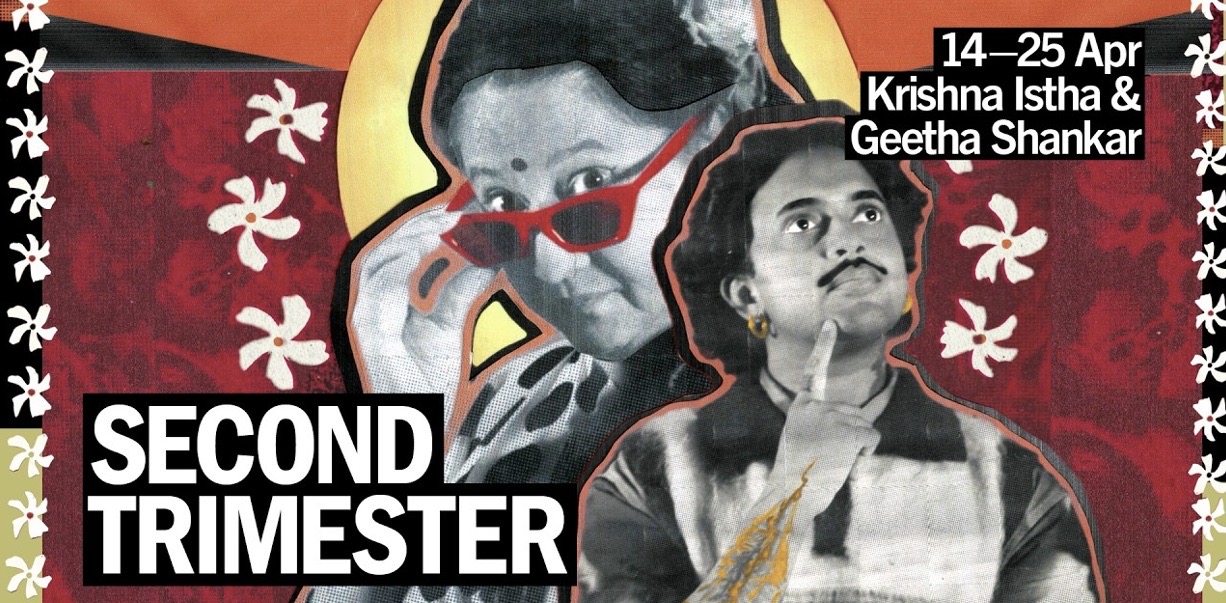
Last night I attended the press night of Krishna Istha’s ‘Second Trimester’ at the Battersea Arts Centre. The second in a planned trilogy, this show focuses on the relationship between Krishna Istha and their mother, Geetha Shankar, and stems from Geetha’s initial lack of understanding at Istha’s desire to get pregnant as a trans man. What follows is an intimate, truthful look at a parent and child relationship, that has plenty to say about gender, identity and generation divides – particularly within the South Asian community. What is unique about Istha’s work, is that, through the use of live cameras and green screens, it balances the deeply personal and affecting subject matter with Bollywood-inspired visuals. Director Milli Bhatia ensures that both aspects are equally honoured in this timely and poignant piece.

By using the fictional platform of ‘Notflix,’ Shankar’s story is divided into several chapters, which characterise major life moments and geographical movements. The use of projections, green screens and Bollywood-inspired aesthetics allow for some levity in amongst the deep subject matter, but also help to illustrate the more emotionally demanding aspects of Shankar’s life. This, plus the unscripted elements, make the piece feel especially immersive, and Shankar and Istha’s openness and vulnerability make it feel inviting – it’s almost like a shared experience, not your run of the mill show where you might expect to just ‘sit down and watch.’ The audience are engaged with by both performers from the off, and are welcomed into their world and their past, which is used to ask pertinent questions about the present.

For me personally, it speaks to a generation of South Asians who locked their past away to protect their children, and to that generation of children who are digging into their past to understand where, and why, they are today. This is something so universal, whether you are part of the South Asian community or not. In this way, the piece acts as a bridge between the two generations, and two different ways of thinking, established by Istha and Shankar’s clash about the former trying to get pregnant. In the process, Shankar is also given the chance to process her past and feel heard. Her lack of professional performance does not matter here – her authenticity and vulnerability are more than enough to win the audience’s undying support.
What is healing, is that by the end, that gap between the two generations seems to close. Istha and Shankar prove that, by opening up the conversation, and opening up the past in a safe and controlled way, progress can be made and we can reach an understanding that promises the hope of a more tolerant future.
Theatre that promotes openness, understanding and progress, especially in today’s world, is no bad thing.
4/5
Thanks for reading!
Photography by Ali Wright
‘Second Trimester’ is playing at the BAC until April 25th!
Tickets here: https://bac.org.uk/whats-on/second-trimester/

