
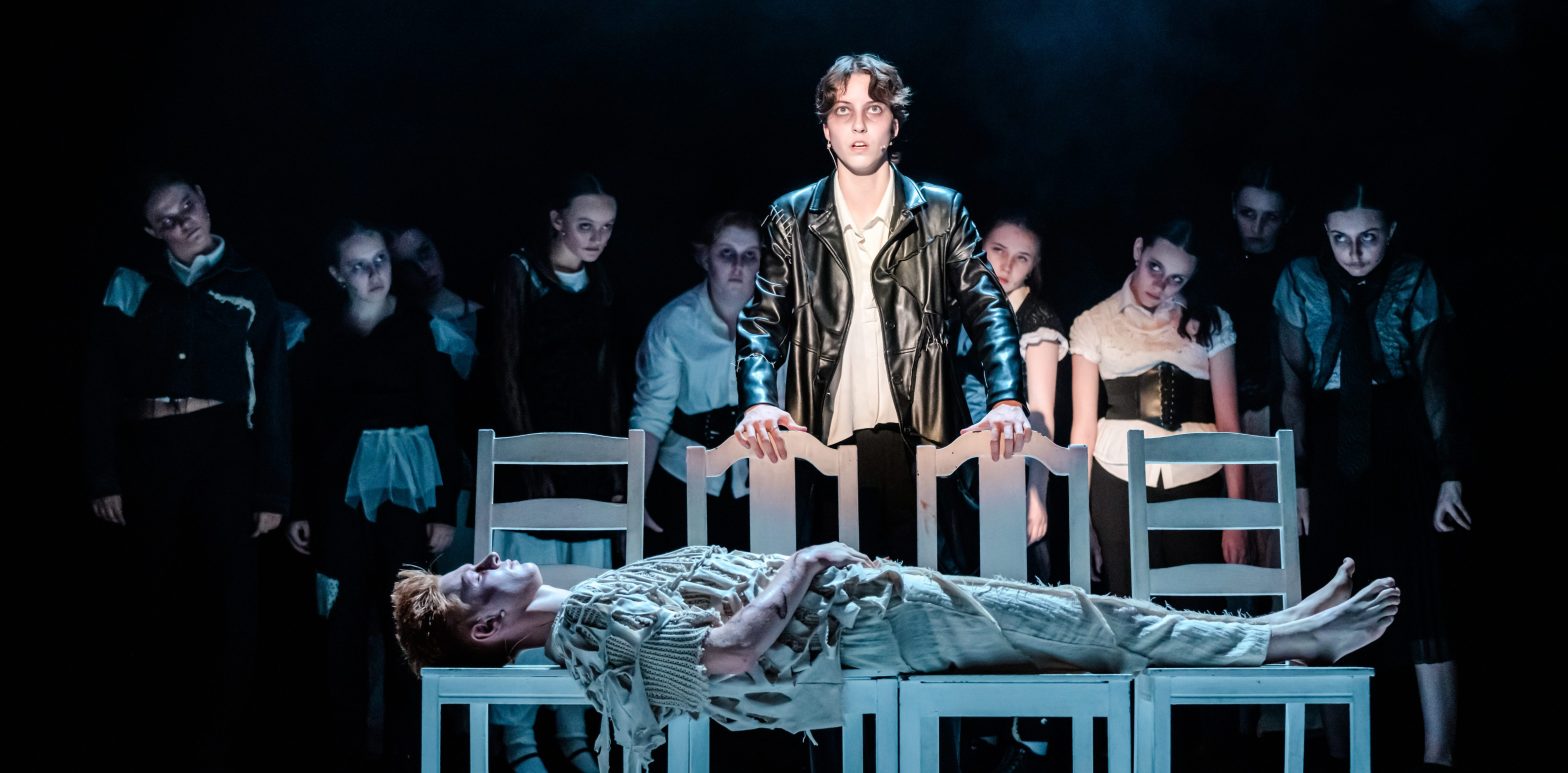
Yesterday the British Youth Music Theatre successfully reanimated Frankenstein, a musical adaptation of Shelley’s novel first staged at Theatre Royal Plymouth in 2006. Although the first half has a habit of telling not showing, and does not quite settle on what it wants to be, juggling gothic horror, musical theatre and at times, melodrama, the second half works through these inconsistencies and presents an adaptation that allows the promising young cast and audience to engage with the story’s emotional depth.
It is clear from the off that this young cast can handle Shelley’s gargantuan morality tale, as well as the musical numbers, even though the latter yields mixed results. The show does not quite settle on what it wants to be. Interestingly, I noted that this mirrors the description of the show on BYMT’s website, which reads not like an introduction to the story, but an in-depth review of the show, and a list of ideas and themes that the show does try to tick off on stage.
There are songs that resemble the theatrical and gothic numbers of Sweeney Todd, but are performed by a cast that bring the infectious physicality of Matilda. Also, the music is not always deployed where it can be used best – to showcase the emotions of the characters and move the story forward, which leads the production to fall into the trap of telling the audience, not showing.
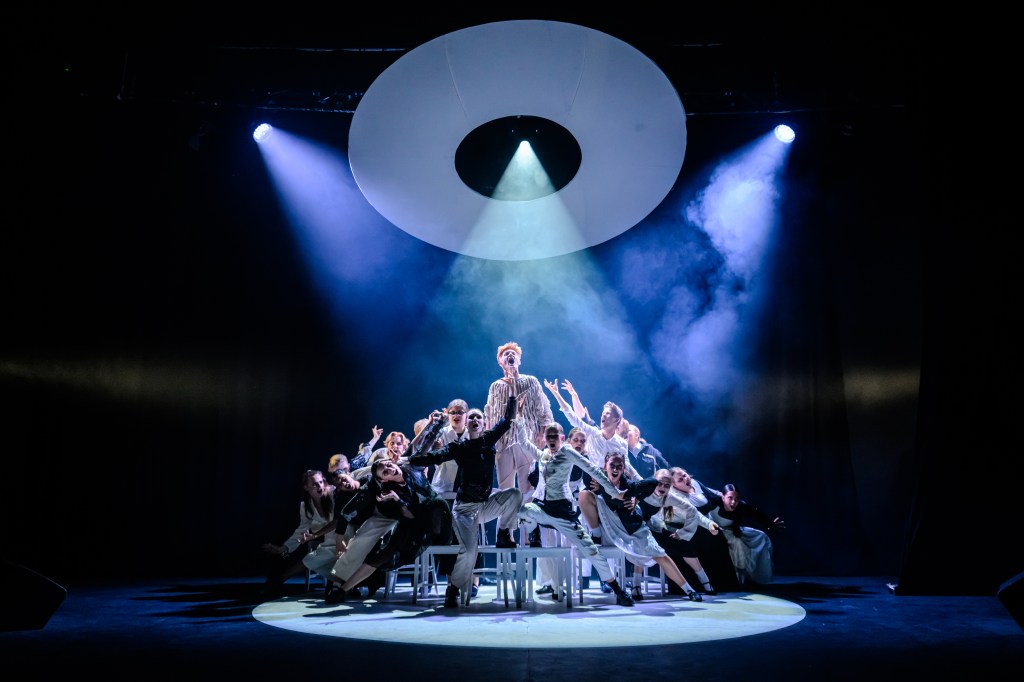
This on-the-nose storytelling can result in some moments that lack subtext and appear over-explicit. A corpse-like Greek chorus convulsing as the Creature comes to life treads a fine line between unsettling and comical, and Caroline’s (Bryony Rochfort) screams of ‘it burns! It burns!’ during her death scene takes away from a performance that communicates this sensation already.
The show fares better in the second half, where it uses subtext to allow the story to speak for itself. At the Creature’s (Freddie Summers) creation, the two performers reach a hand out to each other, resembling the imagery of God creating Adam in the Sistine Chapel, a moment that is played again at the end when Victor (Eleni Chivers) dies. It is a great example of visual storytelling that explains the changing relationship between the two characters, and does not require a member of the chorus to sing that Victor failed to care for the creature ‘like a father should.’ This action communicates the power dynamic of their relationship, and demonstrates how a familiar story can find new meaning when reimagined for the stage.
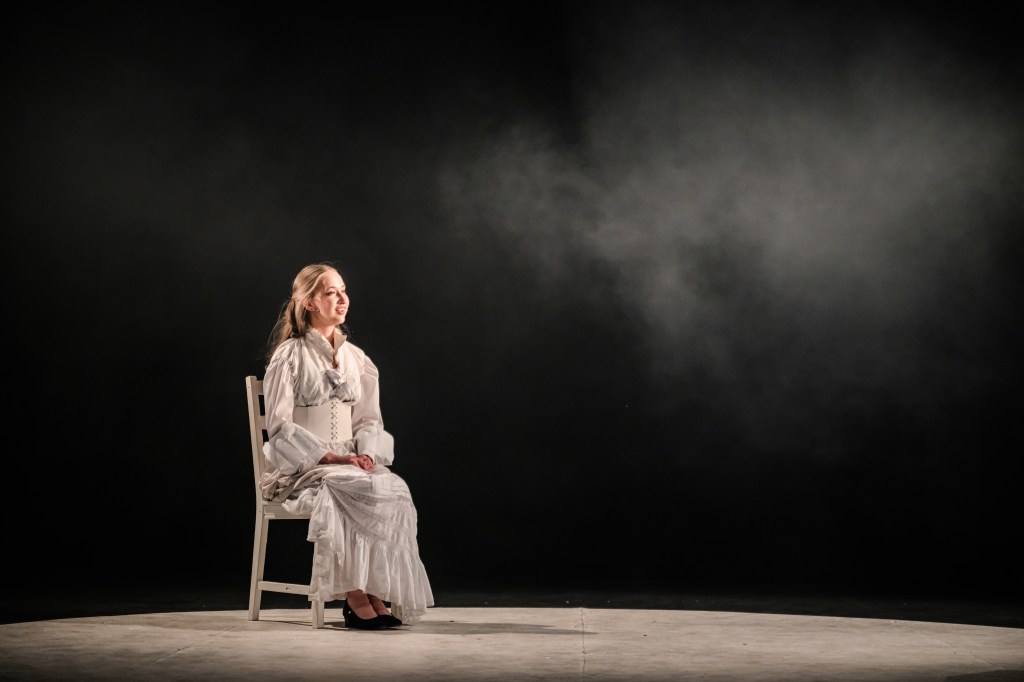
The show’s quieter moments stand out by mining their emotional depth, such as the Creature’s encounters with kindness and the tender moments between Elizabeth (Catherine Lewis) and Victor. Elizabeth’s ballad about feeling seen is a particular highlight, and Lewis is arguably the show’s strongest performer. Together with the script, Lewis brings Elizabeth a greater depth and character than Shelley originally gave her. This benefits the story, as Elizabeth is no longer a cipher but the tale’s emotional core. The yellow lighting that surrounds her exudes calmness and warmth, making her eventual demise genuinely affecting and more than a mere plot point.
The chorus also work better when the Creature is up and running as they serve a clearer dramatic purpose, acting as an extension of Victor’s paranoia. They move with the Creature, and even if the Creature is not present, work as his eyes and ears. During Elizabeth and Victor’s wedding, their switches from happy guests to judgemental, prying eyes, create a gripping contrast between joy and foreboding, showing us Victor’s conflicted mental state. When they surround him, we know he is gripped by an ever-present fear that the other characters cannot see. Similar tricks are deployed during the trial of Justine.
Although on paper such a comical scene might not fit with a show that, as described on BYMT’s website, is based on a ‘horror story,’ it works as an exploration of the consequences of Victor’s actions, adding to his guilt. For the audience, it is as much Victor’s trial as Justine’s. This tension and dramatic irony is really effective, and reinforces that the show is at its best when it is showing rather than telling.
The closing shot is one of the show’s strongest, and leaves a lasting impression. The Creature, standing above the rest of the cast, holds a flame that eventually fades – the life spark that Victor wanted to create, and the story itself, is finished.
Although it takes a little time to find its feet, much like Shelley’s iconic monster, the show broadly succeeds in its aims and is worth revisiting.
3.5/5
Thanks for reading!
Playing at the Greenwich Theatre until August 30th!
Tickets: https://greenwichtheatre.org.uk/events/frankenstein/
Photography by Charlie Flint

