‘The New Colossus’ 1883: An Analysis

The Statue of Liberty is one of the most recognisable sculptures in the world, and is symbolic of America, the American Dream and freedom. Gifted to America by the French, and designed by Frédéric Auguste Bartholdi, Lady Liberty is probably inspired by Libertas, the Roman goddess of Liberty and was originally conceived in 1865, to celebrate the upcoming centennial of US Independence. Although many tourists flock to see the famous copper statue, not everybody takes note of its cultural significance and might miss the inclusion of Emma Lazarus’ sonnet ‘The New Colossus.’ This was installed at the base of the statue in 1903.

Lazarus originally wrote the sonnet in 1883, and throughout her life helped refugees who were fleeing antisemitic pogroms in eastern Europe. Her activism is credited with inspiring her most famous work, the original manuscript of which is housed in the American Jewish Historical Society. Let’s take a closer look:

Not like the brazen giant of Greek fame,
With conquering limbs astride from land to land;
Here at our sea-washed, sunset gates shall stand
A mighty woman with a torch, whose flame
Is the imprisoned lightning, and her name
Mother of Exiles. From her beacon-hand
Glows world-wide welcome; her mild eyes command
The air-bridged harbor that twin cities frame.

“Keep, ancient lands, your storied pomp!” cries she
With silent lips. “Give me your tired, your poor,
Your huddled masses yearning to breathe free,
The wretched refuse of your teeming shore.
Send these, the homeless, tempest-tost to me,
I lift my lamp beside the golden door!”

The opening lines of the poem directly reference the Greek Colossus of Rhodes, one of the Seven Wonders of the Ancient World. As described, the ‘giant’ statue had ‘conquering limbs astride from land to land.’ The use of the word ‘conquering’ implies that the statue exercises an unbridled power over its surroundings, and the placing of its feet directly references the land that the statue claims. This masculine statue, and the forced violence associated with ‘conquering’ is directly contrasted with Lazarus’ ‘New Colossus’ – the Statue of Liberty.

Lazarus states that the Statue of Liberty is as ‘mighty’ as the Colossus. The statue has so much power that it is not just flame in her torch, but ‘imprisoned lightning.’ Whilst the Colossus exercises physical power of Rhodes and its people, the Statue of Liberty’s power is not directly used to control people, but instead mother nature. Whilst the Colossus seeks to conquer, or control, the people below it, the Statue of Liberty is described as a welcoming ‘Mother of Exiles.’

By personifying the Statue as a ‘Mother’ Lazarus feminises the statue by implying that is a symbol of maternal instinct. This directly contrasts with the masculine energy hinted at by the description of the Colossus. The Statue of Liberty is here to take care of the ‘Exiles’ who journey to America. ‘Exiles’ refers to the immigrants flocking to America to find a home. Due to Lazarus’ activism, she was well aware that for many America was a fresh start and a chance to escape persecution. This explains the Utopian description of the United States as ‘sea-washed’ with ‘sunset gates,’ which have been interpreted as the mouths of the Hudson and East Rivers. Lady Liberty’s influence is far reaching, and the flow of her ‘beacon-hand’ is ‘world-wide.’ The statue does not discriminate and welcomes all.

The Statue goes on to decry ancient culture and tradition, referring to them as ‘storied pomp!’ ‘Storied’ implies a famous history, and ‘pomp’ references a display of splendour. Lady Liberty declares that ‘ancient lands can ‘keep’ such traditions, implying that America is a new world that is moving away from outdated customs and into modernity. The note about her ‘silent lips’ reinforce that, although the poem describes her as speaking, the statue is just that. She speaks directly to those coming to America from foreign lands:

“Give me your tired, your poor,
Your huddled masses yearning to breathe free,
The wretched refuse of your teeming shore.
Send these, the homeless, tempest-tost to me,”

This references the immigrants from around the world who flock to America to escape persecution. Lady Liberty welcomes the ‘tired’ and the ‘poor,’ and states that she can help those ‘yearning to breathe free.’ America is the antidote to oppression and persecution. By describing these people as ‘wretched refuse,’ Lady Liberty implies that these immigrants have been used and discarded by their homelands, and that America offers safe refuge.

The Statue refers to these ‘homeless’ as ‘tempest-tost.’ ‘Tempest’ refers to a violent storm, a pathetic fallacy that could reflect their personal turmoil at being displaced from their homeland. The poem ends with the Statue of Liberty further immortalising the United States of America as a transformative paradise:

“I lift my lamp beside the golden door!”

By lifting her ‘lamp’ to light the way of the lost, the Statue guides travellers to the ‘golden door.’ Behind said door is presumably America, its wealth and riches implied by its gold colouring.

Thanks for reading!

Female Companions of Colour in ‘Doctor Who’

‘Doctor Who’ showrunners have always championed inclusivity and diversity. Chris Chibnall’s condition of taking over as showrunner was that The Doctor should be a woman, when Steven Moffatt cast Pearl Mackie as Bill, he openly stated that the show should ‘do better’ on the diversity front and Russell T Davies’ most recent run is probably the most inclusive to date, featuring the groundbreaking trans character of Rose Noble and the first ever black incarnation of the Time Lord.

As a viewer, and as a person of colour, the diversity debate is always a tricky one, mainly because, more often than not, those having the debate are not people of colour themselves. So, even though characters with our background, and our stories are being put out there, now more than ever, we are not the ones contributing to it, and therefore can be rendered slightly powerless. I work in the television industry myself, and being the only person of colour in the room can be a burden, and it is difficult to stand up, as the minority, and speak up. We are not always listened to, which quite frankly only heightens the imposter syndrome. I am not saying that only people of colour can write people of colour, but I think it is pretty fair for us to ask to contribute to telling our own stories if the occasion calls for it.

I would say that nowadays there are more people of colour on screen, which is lovely. However, sometimes they work and sometimes they don’t – and they don’t work when it is obvious that they are there to tick a box, or if we are not afforded the same presence and autonomy as Caucasian characters. I am not saying that every person of colour should always be the hero, should never be the underdog and should always be the main character. There has to be equality across all bases, and we are only just getting there now. Equality means that, South Asian actors for example, are not just doctors or corner shop owners. Yes, some South Asians do hold those roles in society, but not all of us do. Some of us do other things, and this should also be represented on screen. Caucasian characters can do or be anything on screen, and people of colour deserve that same equality. Only perpetuating that one idea, that South Asians are only doctors and corner shop owners spreads ignorance, which, as we can see, erupted into violence last summer. We can break stereotypes and encourage equality, by allowing people of colour and characters to wear as many hats as Caucasian people do.

First off, I love ‘Doctor Who’, and I think it does some fantastic work. I recently met Russell T Davies at a press night and clumsily told him that, and then went on to tell him about my love for current companion Belinda. He was a lovely man, who totally understood the burden of being the only person of colour in the TV production office. And whilst I have enjoyed Ncuti Gatwa’s second season, more than his first, it was Varada Sethu’s Belinda Chandra that became the main inspiration for this article.

I had not come across Varada Sethu before her ‘Doctor Who’ appearance, but at the announcement of her casting I was excited. Seeing a South Asian woman in ‘Doctor Who’ every week was genuinely thrilling, and I sometimes could not quite believe it. Sethu has also spoken out admirably about reclaiming her cultural heritage, and the difficulties ethnic minorities face in the industry, all of which I keenly relate to. So, not only was she representing us on screen, but she was also using her influence to do some really important work, and I would like to take a second to thank her for that. However, I feel that Belinda has fallen foul of several person-of-colour pitfalls. But, before we get to her, let’s go back to the beginning and start with the original companion of colour, and absolute icon, Martha Jones.

Freema Agyeman’s casting drew attention, and criticism, as she was dubbed as the first full time black companion. Agyeman herself is half Ghanaian and half Iranian Kurdish. On the surface, I would argue that Martha’s cultural heritage was not as openly discussed as much as Yasmin’s or Belinda’s, and her name on paper does not immediately scream any cultural affiliation like say, Yasmin Khan.

This may be indicative of the time that Martha was created, as following cultural movements like Black Lives Matter, there has been greater discussion about accurately representing all races and cultures on screen. In 2021 Agyeman stated that she could not ‘rationalise’ the racism that she was subjected to at the announcement of her casting. I do wonder what it would have been like for her, even behind the scenes, where decisions about her characters’ story, costume, hair and make-up would have been made.

Whilst nowadays it is more common for shows to create a racially diverse world in which all are accepted, like ‘Bridgerton,’ thankfully, throughout her series Martha’s skin colour was not ignored. In ‘The Shakespeare Code,’ David Tennant’s Tenth Doctor prepares to go swanning around Tudor England, with Martha questioning whether she would be ‘carted off as a slave,’ as she was ‘not exactly white, in case [he] hadn’t noticed.’ Writer Gareth Roberts and RTD should be praised for this frankness. Martha highlights racial inequality by quite literally pointing out the obvious. While the Doctor’s colour-blindness towards Martha is a good thing, he goes a bit too far by not realising, and respecting, her concerns about the environment that he has surprised her with. Martha encourages The Doctor to check his own privilege and ignorance, as of course, being Caucasian male presenting, he is able to move freely and will not be discriminated against in this environment.

Martha’s comment is representative of the person of colour experience. I would argue that we are more hyperaware of our surroundings because of our skin colour. Being in the minority at work makes me hyperaware of how I carry myself, as I can easily attract labels. Standing up for myself, and people of colour, risks the ‘woke’ label, or the ‘playing the race card’ label. In the same way, Martha, being a black woman, like all black women, is at risk of attracting the loud, angry, black woman label. Ncuti Gatwa’s Fifteenth Doctor and Belinda subtly discuss this labelling in 2025’s ‘The Story and the Engine’ with both explaining that, in Lagos and India, they feel fully accepted and embraced for who they are. They do not feel different or reduced to stereotypes. The residents of Lagos and India treat The Doctor and Belinda as one of their ‘own.’

Martha suffers another bout of causal racism when caring for John Smith in ‘Human Nature’ and ‘The Family of Blood,’ with Jeremy Baines implying that her hands are the colour of dirt, hindering her from ever being able to tell if the floor she is scrubbing is ‘clean.’ Martha brushes it off, but shows a bit more bite when dealing with Nurse Redfern, recounting all the bones of the hand.

It is Martha’s unrequited love for the Doctor that receives the greater criticism. Agyeman was placed in the tricky position of trying to win over a universe grieving for Billie Piper’s Rose Tyler, and in pining after The Doctor for thirteen episodes, Martha is immediately written as the other woman. This was never exactly going to make people warm to her, as she is characterised as being second best from the off. Without even realising, or probably intending, the storyline turns into a ‘black woman is second best to white female’ narrative, something that The Doctor does not help. Although he never shows any racism towards Martha, The Doctor’s treatment of her is problematic and speaks to wider ideas of racial inequality.

Instead of embracing Martha as a new friend, like Fifteen embraces Belinda after he loses Ruby, Ten is pretty snappy with Martha, throwing around phrases like ‘well find out!’, ‘not that you’re replacing her’ and ‘just one trip then back home!’ Even in her own flat in episode twelve The Doctor silences her when she asks about The Master, quipping ‘that’s all you need to know.’ He negatively compares Martha to Rose in ‘The Shakespeare Code’, saying ‘Rose would know. Right now, she’d say exactly the right thing.’ He never lets Martha choose where they go, and even takes her to the same places he took Rose, signalling to Martha that she is merely a ‘rebound.’

The Doctor also fails to see Martha, sometimes literally, as explored in ‘Human Nature’ and ‘The Family of Blood.’ Asking her to take care of him in a racist Britain is a pretty tall order, and all she gets is a ‘thank you.’ He later jokes in episode twelve that, wearing a perception filter is like ‘when you fancy someone but they have no idea you exist.’ The Doctor is aware of Martha’s feelings for him, as she tells him in ‘The Family of Blood’ that she loves him ‘to bits.’ In the next series he even brags to Donna that Martha ‘fancied’ him, with Donna responding that she must be ‘mad,’ ‘blind’ and calling her ‘charity Martha.’ This is not Martha Jones’ fault, and it is unfortunate that no one on the production thought that this dynamic is kind of uncomfortable.

On the surface, and in The Doctor’s eyes, she never quite manages to be Rose’s equal, and while this is not racially motivated, on the surface the relationship is unintentionally racially insensitive. The Doctor makes his only companion of colour feel inferior to her white predecessor to the point that she agrees, worrying that she was ‘second best.’ It is only at the end of the season that Martha realises her worth, and capitalises on the agency that she always had, in what I would call the best, and most satisfying, RTD companion exit. Martha had always been capable and clever, more so than Rose, she was training to be a junior doctor after all.

This is a key part of her character, and perhaps unintentionally, she ends up looking after The Doctor on many occasions. She saves him in ‘Smith and Jones’ and ‘42,’ looks after him in ‘Human Nature’ and ‘The Family of Blood,’ supports him with a job in a shop during ‘Blink,’ briefly houses Jack and The Doctor in ‘The Sound of Drums,’ and later nips out for a chip run. Martha seems to be the one making sacrifices for The Doctor, more so than Rose ever did. Yes, Rose did her dinner lady stint, but I would say in Series One Rose rules the roost, her and The Doctor are pretty much equals from the off, and remain so until her departure in ‘Doomsday.’ It is unfortunate that the first black companion does not always get to choose, and puts her wants and needs aside for The Doctor, something that her Caucasian predecessor or successor did not have to do.

It is weirdly meta, and perhaps was intended to reflect the world that we live in. It is a sweeping general statement to say that people of colour are merely tolerated, and it is certainly not true across the board. However, considering the race riots last year, and my own experience, racism and racial ignorance are still very much alive. The Doctor never fully embraces Martha for who she is, and even though he invites her on board, he does so at first with snippiness and restrictions.

Even when Martha is leaving, he interrupts her when she begins explaining her reasoning, asking ‘is this going anywhere?’ Worse, Ten is totally oblivious to his own behaviour, and Martha never calls him out for his poor treatment of her. This would have been particularly empowering, and perhaps would have inspired viewers to call out poor behaviour that they have received. The harmful dynamic that has played out over the series, which is probably reflective of society, is never challenged. When comparing the optics of this relationship to that of Ten and Rose and Ten and Donna, it does not compare well.

Now, I hear someone saying, ‘well Twelve was not very nice to Clara.’ And yes, I would say in Series Eight, at times he was not. But we knew that he ultimately respected her, he listened to her, and asked for her opinion, specifically on whether she believed that he was a good man. Whether or not you agree with The Doctor’s actions in ‘Kill the Moon,’ in his eyes, he was ‘respecting’ her. It is not as clear cut and one sided as the dynamic of Ten and Martha.

After Martha leaves The Doctor, she flourishes. She becomes a doctor, as she always intended, and makes waves at UNIT and Torchwood. This is pretty impressive character development, and from Series Four onwards, she is The Doctor’s equal, and earns the respect she always deserved. Interestingly, as soon as Martha leaves, The Doctor welcomes Astrid with open arms, which is very different to how he initially received Martha.

Martha’s mission at UNIT in Series Four really speaks to me. In conversation with the Doctor, she explains:

‘It’s alright for you, you can just come and go but some of us have got to stay behind. So I’ve got to work from the inside, and by staying inside maybe I stand a chance of making them better.’

Here Martha is referring to UNIT’s values of course, but this is how I personally think of the Film and TV industry. I talk about it more at the conclusion of the article, but my belief is that, as an ethnic minority, if I keep fighting for my place in this industry, I can get to a point where I can affect positive change. I can champion new talent, and champion diversity. For Martha, this is her greater calling. She has experienced a different life with The Doctor, and is now using her experiences to better her world. Martha Jones – a true icon and role model.

Martha’s appearance in ‘The End of Time Part Two’ is a divisive one, most notably for her marriage to Mickey Smith, a union which has of course been subjected to the race debate. Do I think they are together because they are both black? No, I don’t believe RTD thinks that way. People of colour do gravitate to each other, I can attest to that, and they do have a deep, shared experience. Martha and Mickey both were treated as second best, and both had unrequited loves. Perhaps it was simpler and was just easier for the filming schedule. I think it is probably the lack of development that the romance had on screen that jars people, and I will say that I was a bit disappointed that Martha had seemingly ditched her medical career.

So, following Martha and RTD’s exit in 2009, we did not have a full-time companion of colour until Pearl Mackie’s Bill Potts in 2017. Steven Moffat openly searched for a non-white actor for the role, and interestingly, it is not Bill’s race that takes centre stage, but her sexuality. She does come up against racism in ‘Thin Ice,’ prompting Peter Capaldi’s Twelfth Doctor to land a pretty heavy punch. Also, at the start of the episode set in Victorian London, Bill points out that ‘slavery is still a thing,’ which, unlike Ten, Twelve acknowledges. Apart from that it is her sexuality that pops up far more frequently.

Twelve is much more responsive to Bill, than Ten was to Martha. Perhaps this is because Twelve was not grieving, he had processed the loss of River Song. Although Twelve and Bill are not equal in terms of rank, he is tutor, she is student, he never treats her as less than him. Is this reflective of growing sensitivities, or purely character choices? I think Bill is a likeable and fun character, but for me, she fails to leave a big mark because she lacks agency, something which Martha did exercise throughout her tenure.

Most companions do something to save the day during their introductory episode, Rose, Martha, Donna, River and Amy, and although Clara may not explicitly, her echoes do have impact. Even Yaz contributes by driving the crane. Most companions also have some agency in their own exit, Rose chooses to stay behind and help Ten, Martha leaves, Donna attempts to kill Davros causing him to trigger the meta crisis within her, Amy chooses Rory and Clara chooses to take Rigsy’s tattoo. Bill’s cyber exit, whilst no doubt shocking viewing, is forced upon her, and never quite had the emotional mic drop that other companion exits had because it was not character driven.

Bill does challenge The Doctor, and supports him, but in terms of character defining acts, I can only think of a couple from The Monks saga. In Series Ten’s two part, albeit brilliant finale, Bill’s primary function is to first be turned into a Cyberman. She is definitely generally liked by the fanbase, I would argue more so than Martha, but neither of them ever top any companion polls like Sarah Jane, Rose or Donna.

One interesting thing to note, is that Bill is very normal. Like Martha, Yaz and Belinda, Bill does not have any mystery box narrative surrounding her, and does not become superhuman like Rose, Donna, Clara or, in part, Ruby. An interesting coincidence.

Next, we get Yasmin Khan in 2018, the first televised companion of South Asian descent. I’ll admit, I do find Yaz tricky. First off, props to Chris Chibnall for crafting a consistent cultural heritage for her. Her name implies that she is Pakistani Muslim, a note that is supported and commented on throughout Series Eleven.

We hear about her experiences as a person of colour in ‘Rosa,’ as she and Ryan discuss their experiences of racism. Top marks here Chibnall. Using your characters to contextualise/explain the wider themes of the story while making them more relatable, and developing said characters’ relationships at the same time? That is the mark of good representation.

In ‘Arachnids in the UK,’ we meet Yaz’s family, their names all consistent with her established cultural heritage. In ‘Demons of the Punjab’ The Doctor takes the team to India at Yaz’s request, so that she can learn more about her family. For me, as a Sikh Panjabi, the idea of an episode set in India was very exciting, and it felt even more meaningful that it was written by South Asian writer, Vinay Patel. Regardless of what you think of his tenure, I do commend Chibnall for encouraging greater diversity behind the camera.

In my analysis of Yasmin you may think that I am implying that a character’s cultural heritage needs to be mentioned in every single episode, but this not the case. I believe that it enriches a character, and if touched upon, can open a plethora of new stories, as ‘Demons of the Punjab’ and ‘The Story and the Engine’ prove. As Meera Syal said in her BAFTA Fellowship acceptance speech, we do have some great stories, people just need to listen. So, from the cultural perspective side, Chibnall did some good work with Yasmin, especially in her first series. It is just a shame though, that the character has received very mixed reviews, and I personally find her quite unmemorable.

Apart from ‘Demons of the Panjab,’ I do not feel that Yaz contributed much to the series. She did not have an arc like Graham and Ryan in Series 11, so, although within the show she is never considered by The Doctor to be second best like Martha, to the viewer, she was frequently an afterthought. I cannot recall any significant thing she did in Series 11, bar driving the aforementioned crane and kicking the Pting in ‘The Tsuranga Conundrum.’ This is where the tickbox debate rears its ugly head, as, if Yasmin’s character does not impact that much on plot, then we have to ask, why is she there? To enrich the diversity optics on screen? In terms of big, series or universe defining moments, Rose absorbed the Time Vortex, Martha walked the Earth, Clara jumps into The Doctor’s time stream and Bill gifted the planet to The Monks. Nothing of this much note springs to mind for Yaz. She is currently faring less well than Bill. Yaz does assist the team, and is helpful, but this is something all companions do. It is harsh to say but it is almost the bare minimum. In my opinion Yaz fills the stock companion role more than any other discussed in this list.

Also, Yaz is incredibly humourless. When people think of comedic companions they probably think of Donna and Bill, but they all have their moments. Martha saying ‘we’re on the bloody Moon’ in her first episode, Rose being comedically camp when possessed by Cassandra and Clara gleefully teases a relationship with Jane Austen. Take Captain Jack’s surprise return in ‘Fugitive of the Judoon,’ for example. He had more charisma and humour than Yasmin, Ryan and Graham put together.

Her role kind of grows in later seasons, but more due to her longevity, not because she really does anything. Thirteen confides in her in Series Twelve, and Graham tells us that Yasmin is amazing, without us really seeing it. She springs Dan from Karvanista’s trap in ‘The Halloween Apocalypse,’ but, even after all these years, in ‘Flux,’ Thirteen draws back, becomes more secretive, asking Yasmin: ‘does everything have to be a discussion? Go on. In.’ Pretty hard to influence the narrative when you are being told to shut up and move. Martha’s ears must have been burning.

A recurring joke within the fanbase throughout Yasmin’s run was that she would frequently pick up and drop the idea of being a police officer. Her exclamation in ‘Fugitive of the Judoon’ that she is a ‘police officer’ drew more laughs than cheers, especially because she then claimed to speak the Judoon’s ‘language.’ To her credit, we do see some police skills spring into action in ‘It Takes You Away’ and ‘Village of the Angels,’ but something that was marketed as key to her character does fade away pretty quickly.

Martha and Belinda were more consistent on the job front. It was well tied to their character. We see her fix Hath Peck’s arm, and we see Belinda administer alien IV lines in her debut episode. Ok granted, Martha later goes freelance in a move that I am still not sold on, but I will let that one-minute scene slide.

Perhaps now Yasmin is more remembered for her near romantic relationship with The Doctor. While Bill’s sexuality is fully realised and explored, she has a love interest that develops over time and reaches a conclusion, Yasmin really does not have much to go on. It could have been an interesting story, and in RTD’s most recent episode ‘The Reality War’ he does confirm that it was really a thing… but I think the reception from the fanbase is pretty lukewarm as people just assume it was tacked on for the last three episodes, and wished into existence by the fans themselves.

So how does Yasmin fare overall? Yasmin’s cultural background is well utilised, as epitomised by ‘Demons of the Panjab.’ This episode is a good example of representation, and supports the idea that, when you take note of someone’s cultural heritage, it opens doors for stories. It is just a shame that her overall blandness and half-baked love for The Doctor land her on the lower end of companion polls.

Next, we get RTD with Belinda Chandra in 2025. In my mind, she manages to take steps forward, but also backwards. Now, there is probably a Keralan woman out there called Belinda, but Varada Sethu is South Indian, she does have a cultural background that can be drawn from. My question is, why not capitalise on that and choose a South Indian name, for a companion who is quite openly South Indian? She longs to take Poppy to Kerala, her parents are called Lakshmi and Hari.

Chandra is also more commonly associated with North India, as demonstrated by Panjabi character Rani Chandra in ‘The Sarah Jane Adventures.’ Belinda is a South Indian woman with an Italian and Spanish first name, and North Indian surname. It’s not all quite adding up. If this cultural incoherence is not going to be explained at all, then perhaps the writers should just play it safe, to avoid people like me writing pieces like this. Yasmin Khan is probably the most Pakistani Muslim female name you can find, there’s a reason both names pop up on television frequently.

There is a moment in her first episode where Belinda is referred to as ‘Linda’ by a housemate, and she swiftly corrects him. People get my name wrong all the time, and although people get names wrong in all cultures all of the time, it is very common for people of colour, and leads to people of colour changing their names, or anglicising them. I am Harpal, but I go by Harps. Varada goes by V, character Darwish Zubair Ismail Gani from ‘Parks and Recreations’ goes by Tom Haverford. Sethu recently spoke about the correct pronunciation of her name on BBC Asian Network, and how she is reclaiming it, like so many other South Asians. If Belinda had a South Indian first name, this moment would have acknowledged one of the microaggressions that people of colour experience, giving it a greater cultural and societal relevance. Interestingly Belinda is happy with The Doctor calling her Bel, something he does without her permission.

Maybe Belinda is Indian Christian. Indian Christians make up two percent of the Indian population, and a significant population is concentrated in the South, totalling five percent. Perhaps that is the answer, Belinda is Indian Christian… but her connection to Kerala confuses with her North Indian surname. Hey, if Belinda is Indian Christian, then explain it, it could make a good story, there was space for it in ‘The Story and The Engine.’ In film and TV, there are probably more Asian characters with non-Asian names due to colourblind casting. Chibnall had Mitch in ‘Resolution.’ Colourblind casting is a good thing to a point, but it works both ways. If you ignore somebody’s skin colour fully, you ignore a key component of their identity in the process. It’s steps forwards and steps backwards.

You are probably wondering why I get so bogged down with names. Well, there have probably been a million characters named Belinda on screen. Probably loads named Bill and Martha too. A companion of colour presents the opportunity for a new name to enter the Whoniverse lexicon. It’s a chance to hear different names on screen and a chance to normalise them. Out of four full time female companions of colour, only one has a name that reflects their cultural heritage. If you read the names in a list, you would probably only assume that one is a person of colour: Rose, Martha, Donna, Amy, Clara, Bill, Yasmin, Ruby and Belinda. We have decent visual representation, but surely it enhances this representation even more if the names follow suit. As we can see, there is clear imbalance.

If we work backwards, in her last episode, Belinda longs to show Poppy Kerala. So, Belinda is clearly in touch with her cultural heritage, specifically Kerala, which is nice to see. However, this specificity, that Yasmin had, wavers. In episode seven, Belinda refers to her mother as ‘amma,’ meaning mother in several South Indian languages. In episode five, Sethu refers to her nan as… nan. This seems inconsistent. Belinda states that her nan would take her to ‘India whenever she could.’  Perhaps Belinda’s nan took her all over the country, but, surely it makes more sense to take Belinda to Kerala, as, as, described in episode eight, this is something she wants to do for Poppy. It would only strengthen her connection to Kerala and explain why she wants to take Poppy there, she is following some sort of family tradition.

RTD has written two companions of colour. Belinda is embraced by The Doctor, unlike Martha, and has a stronger connection to her cultural heritage, which enriches and adds dimensions to her character. It also strengthens her understanding of The Doctor in this body, something we see in ‘The Story and The Engine.’ Belinda is also the second woman of colour to be an NHS worker. This kind of leads into what I mentioned earlier, stereotypes are ok in moderation, as long as you tell people that it’s not ALL that we do. So maybe Belinda should have been something totally different, like a CEO. That would be very cool!

I am more critical of Belinda’s NHS hero status more than Martha, because, as the series progresses, Belinda gets more and more detached from this job. Part of Martha’s exit was her desire to finish her medical training, something so essential to her that it informs all her later appearances, it is not abandoned like Belinda’s status as a nurse or Yaz’s as a police officer. In episode six, Belinda calls The Doctor wonderful after she sees him torture someone. She is a nurse, why is she not more horrified by this? After saving the universe in episode eight, she is also happy to fly around the universe with The Doctor and happy, seemingly abandoning her one motivation all series – to get home for her shift.

It’s in the two-part finale that Belinda really suffers. Normally, companions play a pivotal role in the finale. Ruby and her mother defeat Sutekh, Amy Pond brings The Doctor back at her wedding, Martha’s actions restore The Doctor. Belinda is sidelined more than any other companion in her own series, even beating Yasmin, and ends up playing second fiddle to her Caucasian predecessor, Ruby in an RTD repeat.

So, in episode seven Belinda is reduced to the dutiful wife as she is trapped in Conrad’s Wish World. It is supposed to be unsettling, and it is supposed to feel abnormal, and not true to either The Doctor or Belinda. I do not have an issue with this, as this is the storyline. The whole point is that it is meant to set alarm bells off for the audience. The failure is, is that in episode eight, she fully becomes the satire that we were meant to be horrified by, and goes all out to protect a daughter she was given without her consent, and nearly hinders the entire rescue mission in favour said daughter. It is a lot to ask the audience to be willing to sacrifice the universe and a Doctor for a child that is very new to the narrative.

Worse still, after The Rani and Omega are defeated, Belinda is willing to travel the stars with The Doctor and Poppy, abandoning her one motivation across the whole series – to go home for her shift and to the parents that she loves so much. She also becomes strangely and unsettlingly saccharine. Very Stepford wife.

Hey, if Belinda always dreamed of having a child, then fair play. It probably would have been quite moving to see The Doctor sacrifice himself for the dreams of his companion. But satirising her passive role in ‘Wish World,’ and showing her growing distress at it, cue her screaming in a forest, and then making it real extinguishes the character that everybody loved in her debut. She becomes the character that she tried to escape as a teenager, the woman that Alan would have forced upon her.

The fact that she sits tight in a box for most of episode eight is also upsetting, as Ruby, who is not this series’ main companion, does all the heavily lifting. Any agency Belinda had vanishes, as well as her concept of consent. She did not choose to have this child, and yet is willing to pledge her life to her at the expense of the universe. She is happy for The Doctor to fight in the battle to save Poppy, contradicting her dialogue in ‘The Robot Revolution’ that she can fight her own battles. It makes far more sense for Poppy to be the daughter of The Doctor and Ruby, as Ruby actually has memories of her.

From what I can see from reviews and vlogs online, the conclusion to Belinda’s character arc generally has been poorly received. I have seen a lot of content makers saying that Belinda in episodes one to three was winning, and after that, she just goes downhill. It is a real shame, that Belinda as a companion is one of the least liked, with people arguing that she was ‘wasted’ and ‘mistreated.’

Now obviously this dislike and disappointment of her character is not related to Belinda’s ethnicity, it is down to the writing of her character arc, much like Martha. However, it would be nice to have a POC (person of colour) companion celebrated in full by the fanbase, otherwise people of colour in the show just get forgotten in favour of Rose’s, or Donna’s or Clara’s.

What makes it worse is that Martha and Belinda both end up playing second fiddle to their Caucasian predecessors. Martha does so because The Doctor constantly compares her to Rose, Belinda does so because the narrative compels her. As I said before, I am not saying that all companions of colour have to be heroes, but when they are SO few and far between, it is frustrating that when we get one, they never really have the opportunity to shine. They are underserved by the narrative, or The Doctor. Bill Potts probably fairs the best, she is liked by The Doctor, and generally praised by the audience. Martha, Yasmin and Belinda have received much more mixed reviews.

Archie Panjabi’s lack of screen time in the finale as The Rani also stings. She too is sidelined in favour of her Caucasian predecessor, Anita Dobson’s Mrs Flood, who does not contribute anything to the episode, or the previous episode. I was SO excited to see British Asian icon Archie Panjabi in the show, especially playing an alien Time Lady with a Sanskrit name. But alas, she is unceremoniously eaten. The most prominent, South Asian female villain in the whole of the show’s history, eaten. Both South Asian women in ‘The Reality War’ fare pretty terribly.

Maybe all of these women fare better than Naoki Mori’s Toshiko Sato of ‘Torchwood.’ Toshiko is the stereotypical, quiet, nerdy Asian girl, who for most of the first season is separate from the group and almost ostracised. She does more in Series Two, but is still a walking tragedy. She also pines after a Caucasian lead who barely registers, Burn Gorman’s Owen Harper. Doctor and Martha parallels?

I am probably going to be criticised for drawing comparisons. Hey, Bill is one parent down, as is Rose and Clara, Yasmin has a sibling as Martha does, all companions have similarities. But I would argue that the companions of colour have MORE similarities than their Caucasian counterparts. For example, all of them work in the public service sector. Martha the doctor, Bill the canteen worker, Yasmin the police officer and Belinda the nurse. It is common that ethnic minorities do enter into these sectors, which probably is part of the reason that there are fewer working in the creative industries.

The reason that these discussions matter is that, at the end of the day, people of colour, especially women of colour, come under so much scrutiny. They have to contend with sexism AND racism.

I will say, as a minority at work, I do feel that there is more weight on my shoulders to represent, and Sethu recently opined that ethnic minorities feel extra pressure to succeed. If I fail at something, as the only person of colour in the office, I feel as though I am not just letting myself down, but people of colour down as well, as I am the only one there. I am everybody else’s only example of a person of colour in that space, at that time – I end up being the one speaking for all of us. Just as Martha, Bill, Yasmin and Belinda have. It is immense pressure for them, as they are on television. When Caucasian character’s faulter, like Bruno Langley’s Adam Mitchell, I would argue that the impact is not as great, as we have every Caucasian Doctor to be heroic. ‘Adam was terrible but at least we have…’ then we can run off a list. When she arrived, Martha just had Martha. And as society has shown us, particularly with the race riots of 2024, some people in society paint people of colour with the same ignorant, racist brush.

So, when crafting diverse characters, what is the answer? If it is going to be done, then it has to be done properly, for sure, but maybe, no matter what is done, the show cannot win. In ‘Doctor Who’ definite strides have been made, but considering the cultural work done by shows like ‘Bridgerton’ and ‘EastEnders’ in crafting compelling characters who are enriched by their cultural heritage, surely a beloved companion of colour that is the whole package must be on the horizon somewhere in the future.

Thanks for reading!

‘Not Your Superwoman’ at the Bush Theatre Review: A cathartic and empowering mother-daughter saga that tackles loss, identity and self-discovery

The Bush Theatre rolled out the orange, yes, orange, carpet last night for the world premiere of Emma Dennis-Edwards’ ‘Not Your Superwoman.’ Starring Golda Rosheuvel and Letitia Wright as mother and daughter duo Joyce and Erica, the show examines their relationship following the death of their family matriarch, Elaine. Both journey to their ancestral homeland of Guyana to spread Elaine’s ashes, and discover a lot about themselves, and their history, along the way. Rosheuvel and Wright offer powerful performances in a show that viscerally addresses loss, trauma, identity and healing – whilst laying a smackdown on the ‘strong black woman’ trope.

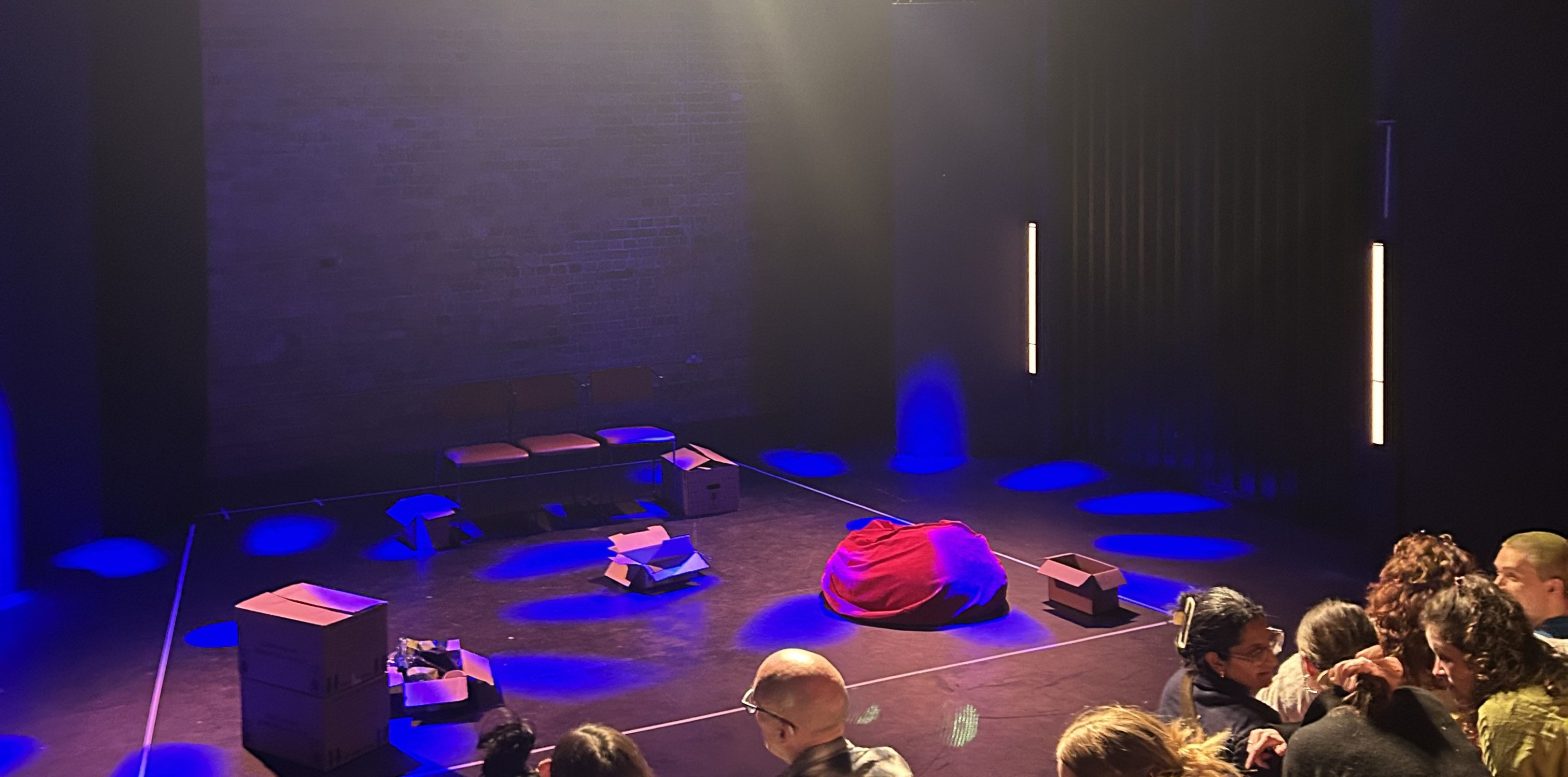
The box-like stage juts out to the audience, meaning that, wherever you sit, you get a unique angle of the drama. It is intimate, as if we are looking at the characters through a shop window, they are observed on all sides. What struck me at the beginning of the show was Jai Morjaria’s lighting design. The lighting is like a character in itself, and although both Joyce and Erica only really interact with luggage and chairs, we know where they are through the lighting. The airport is a cold blue, but when we reach Guyana, we are bathed in a warming glow of orange, one that mirrors the marketing campaign and the theatre’s lovely orange carpet. Gion Ricardo Green’s projections also add to this, allowing us to see what the characters see, making for an immersive and involving experience. As Erica discovers her past, we do too.

Golda Rosheuvel as Joyce and Letitia Wright as Erica

Rosheuvel and Wright turn in powerful and punchy performances as Joyce and Erica. The script requires them to be funny, argumentative, angered, devastated… the list continues, and you can see that they are constantly giving 110 percent. Both are particularly impressive when they alter their physicality to portray Elaine and younger versions of themselves.

Rosheuvel’s Joyce is very much the ‘fun mum,’ often leaving daughter Erica to pick up the pieces. As the play progresses, Erica forces her mother to confront her past, while Erica tries to make peace with it in order to face her future. Due to the intimate nature of the story, and their performances, it is easy for the audience to relate to. We all have lost somebody, we all have complicated family relationships, we all have a past.

The play interrogates the type of multigenerational trauma that people of colour in particular face. Although there is a longing to go back to the past, and ancestral homeland as symbolised by Erica, Joyce knows that going back into the past will bring up all kinds of pain. Elaine knew this too. It is something that I have realised as I have grown up, immigrant parents’ priority was to provide, provide, provide. To them, hugs and kisses was not going to keep a roof over their children’s heads. The play does well to empathise and validate both women, it is Erica’s right to want to know more about her past, but we do recognise the pain that it will bring up for Joyce. The show encourages the audience to see the situation from both points of view and says things that are often left unsaid in POC families. Neither women are at fault, both women are just dealing with the hand that they were dealt. And how do they deal with this hand? Become Superwoman.

Although Joyce and Erica spend the entirety of the play together on this trip to Guyana, they still cannot quite be honest with each other, instead quietly telling themselves to keep it together. This is where the show takes down the ‘strong black woman trope,’ – it shows us the consequences of what it is like to live with that label. Majority of the audience were people of colour, and, although the story may tread on familiar territory, I could see how they were affected by the piece. People laughed, and people cried. You know that it has been a good night at the theatre when you are watching something that has such a profound effect on the audience.

Erica and Joyce also reach some kind of conclusion. I was concerned that the show might be open ended, however, we get a tender embrace. It is not a soliloquy, but it is just as, if not more, cathartic. In a hopeful moment they both express to each other that they will try to better understand one another. This is enough to know that there is hope, and where there is hope, there is potential progress for these women, and for all those that share their story.

4/5

Thanks for reading!

Tickets are currently sold out, more information can be found here: https://www.bushtheatre.co.uk/event/not-your-superwoman/

Photography by Richard Lakos

Birthdays: A Brief History

Everyone knows what birthdays are – they are the anniversary of someone’s birth. A birthday comes around once a year, ie, September 10th, a birthdate, is the complete date, ie, September 10th 1999. Nowadays birthdays are heavily celebrated with cake, with some birthdays carrying more weight and importance than others. But where did these traditions come from? And why do we eat cake?

Going back to ancient Egypt, the Pharoah’s did not celebrate the anniversary of their birth, but the anniversary of their ascension to the throne, which was seen as their ascension into godhood. Greek Historian Herodotus noted in his works that Persians took great pleasure in celebrating their birthdays, and that the rich treated themselves to baked cow, horse or camel. The Romans however did not initially celebrate people, but institutions. So perhaps the anniversary of the founding of a temple, or a university was celebrated. Over time, the Gods associated with the place in question became more directly celebrated, for example, March 1st is known to be the birthday of the God Mars.

As does most things, this changed overtime, as ordinary people began celebrating the anniversary of their birth. Romans believed that every individual had divine nature, and that this aspect of their being needed to be worshipped and respected. For men, this spirit was called the Genius, and for women, Juno. So, on the day of their birth, the Romans would make offerings in the lararium, or the household shrine. This expanded, and birthday parties began to enter the picture.

Birthday parties solidified alliances, familial bonds and friendships, and were seen as great social occasions. In 1973, Robin Birley discovered the Vindolanda tablets, the oldest surviving documents in Britain that dated back to Roman times. Transcribed was an invitation to a birthday party. Books were also popular gifts. If a high profile member of society died, their birthday would be celebrated in the following years, which is something that is a popular tradition across the world. Sikh people celebrate the birthdays of the ten Gurus, known as Gurpurb, Hindus also celebrate Ganesha Chaturthi which marks the birthday of Ganesha.

Saint’s days have historically been celebrated, typically on the day of the named saints’ death or martyrdom. During in the Middle Ages, the majority of the population celebrated their saint’s days, which was the saint they were named after. In Roman Catholic and Eastern Orthodox countries, Saint’s Days were known as name days. The festivities resembled that of a birthday and were celebrated on the day of a saint with the same Christian name as the birthday person. In ‘War and Peace,’ Pierre visits Natasha on her name day at the start of the novel.

During the Middle Ages, it was the nobility that celebrated the anniversary of their own birth, and whilst early Christians regarded birthdays as pagan rituals, nowadays Christians are quite open to the idea. Jehovah’s Witnesses are still sceptical however, citing Christianity’s previous condemnation of birthdays and their potential links to superstitions and magic. Sikhs also do not encourage the celebrations of birthdays, viewing them as superficial festivities. Sikhs instead view the day as an opportunity for spiritual reflection.

The tradition of eating cake dates back to ancient Greece, where offerings of round, moon-shaped cakes with candles were made to honour the goddess Artemis. In Germany, during the 18th century, this tradition continued with Kinderfest, where candles were used to ward off evil spirits who would attempt to steal the children’s souls. It is from here that many of the birthday traditions that we see today originated, and it is estimated that in-between 50 to 100 million birthday cakes are eaten every day!

Some birthdays hold more significance than others, particularly 18 and 21. As you may have guessed, these are the ages where you are legally seen as an adult, also known as ‘coming of age.’

The well known ‘Happy Birthday’ song was written by American sisters Patty and Mildred J Hill, and first appeared in print in 1912. The melody was originally composed with the aim of helping children to learn, with the phrase ‘Good Morning to All’ originally being used.

Happy Birthday everyone!

Thanks for reading!

‘Make Me Feel’ at the Bush Theatre Review: A fun and enjoyable look at the highs, lows and politics of friendship

I was back at the Bush Theatre this week for the world premiere of ‘Make Me Feel.’ Written by Bush Writers’ Group alumni Will Jackson for the 18-25 Bush Young Company, the play follows Jamie (Joshua Aketse-Entsie) and Ruby (Dejuan Desiree) as they plan their nuptials. Also, along for the ride is their seventeen friends, who all go through their own highs and lows in the run up to the big day. It is accurately described as a cross between ‘Love Actually’ and ‘Normal People,’ and does offer a heartwarming and fun look into the politics of the 18-25 age bracket. Although, inevitably, several characters and plot points do fall by the wayside, the overall experience is a highly enjoyable one.

The cast of ‘Make Me Feel’

As a start, the Bush Theatre should be commended for its endeavours to educate and empower a new generation of diverse theatre talent. It is clear that the cast, and the creative team, are all ones to watch. The set is immediately striking, and the space is used well to communicate a multitude of places, including clubs, pubs and the wedding venue itself. The lighting is well used to communicate changes in mood and location, and a particularly immersive, albeit slightly irrelevant, protest scene is made more immersive through the use of smoke effects.

The show soars when focussing on the wider dynamics of the friendship group, and often makes for a humorous and relatable piece of theatre. A particular standout is a scene depicting the Hens’ and Stags’ Whatsapp group chats as they plan their respective Hen and Stag nights, which drew laughter from the audience. It was during these moments that the audience was most engaged.

The cast of ‘Make Me Feel’

However, balancing many characters and plot threads does not always work. Scenes that particularly feel out of place are a speed awareness course, and a pro-Palestinian protest. The latter is particularly ripe for criticism, as it seems that, without reference to it throughout the rest of the play, a political message is included for the sake of including a political message. Although I have seen other reviewers focus in on these gripes, if you sit back and enjoy the ride, the show is guaranteed to take you on an interesting journey, much like life itself.

4/5

Thanks for reading!

Don’t miss the last shows today!

Tickets: https://www.bushtheatre.co.uk/event/make-me-feel/?gad_source=1&gad_campaignid=7179390604&gbraid=0AAAAADniBzdAvrN4574a0SHQLcg0TEsK_&gclid=Cj0KCQjwqqDFBhDhARIsAIHTlkt7nlCzFu7Ydb5iiz77lXxdffkvvjv6tg-8i9sCNGhtzdnd5tFH_gcaAjFmEALw_wcB#book

Photography by Harry Elletson

The Partition of India: A Brief History

The 14th and the 15th of August is the anniversary of the Partition of India, an event that occurred in 1947 and refers to the splitting of British India into India and Pakistan. As well as affecting India’s borders, the seminal event is often cited as the cause of certain religious and cultural divides.

India and Britain have a complicated history, dating back to the East India Company which was established under Elizabeth I in 1600. It was not until the death of Emperor Aurangzeb and the fall of the Mughal Empire in 1707 that Britain gained a stronger foothold in India, and used their naval fleet to transport more British men over to secure that hold. The foundations of the British Empire are attributed to Warren Hastings, who was appointed the head of the Supreme Council of Bengal in 1772, and Robert Clive, a military man who led a decisive victory over the Nawab of Bengal at the Battle of Palashi (anglicised as Plassey) in 1757. Under Hastings’ rule Calcutta was redeveloped and became the capital of British India.

The East India Company fell after the Indian Rebellion of 1857, and India found itself under the control of the crown. It was in 1877 that Queen Victoria added ‘Empress of India’ to her title, and it was during this time that Britain introduced several new modes of transport to the country. India was longing for independence, and this reached its head in the 1900s.

The roots of partition can be traced back to 1905, and the Partition of Bengal. Viceroy of India, Lord Curzon, divided Bengal into Western Bengal and Assam, and Bengal. Curzon did this as he believed the large province of Bengal was too large to govern as one. This decision was heavily based on religion, with Muslims dominating Western Bengal and Assam, and Hindus occupying Bengal. This divide, based on religion set precedents for how boundaries would be drawn going forward, and encouraged a nationalist movement in India.

British India in 1909

However, decisions-based on religion were rarely based on established, reliable facts, and instead encouraged religious hostility. India itself is a large melting pot of many different cultures and religions, and so drawing borders based on generalisations is viewed today as extremely reductive. At the time though, it took hold, and the two-nation theory began to gain traction, formalised in the creation of the India National Congress Party and the All India Muslim League.

The India National Congress Party was formed in 1885, and the All India Muslim League was formed in 1906, both vying for Indian independence. The All India Muslim League however argued that due to their differing religions, Hindus and Muslims had distinct cultural differences, and therefore, could not coexist in one nation. The All India Muslim League believed that a united India would be majority Hindu, and would therefore overlook the needs of the Muslim population.

In an attempt to try and appease both parties, Britain allowed the people of India to vote in the 1909 local elections, but, they gave Muslim people a separate electorate. This created two separate power structures in the same geographical area, only fuelling the All India Muslim League’s belief that Muslims needed their own independent state. The two-nation theory was something that Muhammed Ali Jinnah continued to champion when he became head of the All India Muslim League in 1913. Under Mahatma Gandhi, the India National Congress Party won the 1937 Indian election, something that only fuelled the All India Muslim League’s initial concerns.

During the Second World War, Churchill worked with Jinnah, who cooperated with the war effort during the Second World War. In return, an agreement was made that the All India Muslim League could secede from an independent India, should the occasion arise. Following World War II, it became obvious to many Britons, bar Winston Churchill, that Indian Independence was inevitable.

Clement Attlee was sworn in as Britain’s Prime Minister in 1945, and was sympathetic towards Indian Independence. In the 1946 elections, the prospect of an independent Pakistan became more of a reality as the All India Muslim League won 87% of Muslim seats, and the Indian National Congress Party won 90% of non-Muslim seats. Jinnah also announced a Direct Action Day, which erupted into violence now known as the 1946 Calcutta riots, beginning on 16th August 1946. With this announcement, Jinnah aimed to encourage strikes and economic shut downs to protest for an independent Muslim state. This violence continued into the next year, and Britain essentially lost control of the situation.

Lord Mountbatten, the Viceroy of India at the time also wanted an independent, but united India, one that would hopefully become a strong ally in future. These bubbling tensions, fuelled by beliefs about the two-nation state continued, and led to the eventual decision to split India into India and West and East Pakistan, a name formed of several different areas:

P = Panjab

A = Afghania

K = Kashmir

I = Indus

S = Sindh

TAN = Balochistan

It was up to the British to adjust the actual borders, with most areas in India opting to either join India or Pakistan. However, the districts of Bengal and Panjab were to be divided based on the density of religious populations, a tactic used to Partition Bengal in 1905. The new map, drawn by Sir Cyril Radcliffe, who had never been to India, was released two days after India and Pakistan became independent, on the 17th of August. This is what prompted mass migration, as some families, quite literally, found themselves on the wrong side of the border. It was this mass migration, an estimated 10 to 12 million people, that prompted religious violence and bloodshed. Although at the time the borders seemed absolute, East Pakistan became Bangladesh in 1971.

The Radcliffe Line dividing India and Pakistan

Partition explains why some important Sikh locations are now based in modern day Pakistan, such as Guru Nanak’s birthplace. It also explains why the Panjabi language has variations, as there is a version of the language influenced by India, and one by Pakistan.

The event has had a significant impact on popular culture, and is referenced in literature, film and television, including Salman Rushdie’s ‘Midnight’s Children’ and even a Series 11 episode of ‘Doctor Who.’ The ramifications of the widespread suffering caused by the divide are still felt today, and explain certain religious and cultural conflicts within India.

Partition also explains the ongoing Kashmir conflict. Initially, Kashmir was left to decide it’s own future, and at the time, their ruler, Hari Singh decided to bring Kashmir under India’s rule. Singh needed India’s military backing against Pakistani tribal invaders. This led to the Indo-Pakistani War of 1947, a conflict that resulted in the drawing of another border, the Line of Control. The Indian Pakistan conflict over Kashmir has peaked and troughed for decades.

It is clear from this alone that Partition still inspires complex debates about religion, culture and identity, communicating that its effects are still keenly felt today.

Thanks for reading!

‘Sing Street’ at the Lyric Hammersmith Review: An immersive blast of 80s rock, rage and youthful hope

I was back at the Lyric Hammersmith last week for the opening of ‘Sing Street’! Based on John Carney’s 2016 film of the same name, the musical follows schoolboy Conor (Sheridan Townsley) who claims to be in a boy band to impress his mysterious crush, Raphina (Grace Collender). Set in 1980s Dublin, the show is a real blast of 80s rock, rage and youthful hope. Although the second half is weaker than the first, the musical’s biggest selling point is its talented company and its homage to the culture and music of the 80s.

The show is unique in its style. Using high quality projections, and a camera with a live link to the back of the stage, the show is wonderfully immersive, and gives it an authentic feel that is reminiscent of 80s television. Although the story of the first act is simple, make the band to get the girl, the momentum is strong and there is plenty of humour in it. Conor’s motley band, and their 80s costumes, provide plenty of laughs, even though there are too many members to truly get to know any of them. The way that Raphina is introduced, gliding onto the stage in a phone box, is suitably fun and ethereal.

Grace Collender as Raphina and Sheridan Townsley as Conor

The first act builds to a crowd-pleasing crescendo, with Conor successfully wooing Raphina, both of which have a touching, and believable chemistry. The performances all round are incredibly strong, and this multi-talented group of young actors is certainly one to watch.

However, it is the second act that falters, as the premise of the show is complete – Raphina is won. The songs still inspire and impress, but in-between there is a bit of a plot vacuum. The show never quite manages to capitalise on the dramatic themes that it touches on, including poverty, incest and bullying. We keep being told that Dublin is ‘dead end,’ but we never actually know why. Conor’s parents also split up in a scene that feels slightly underwhelming.

This act preoccupies itself with defeating Lloyd Hutchinson’s Brother Baxter, who, up until this point, has had a relatively small role. Although the boys do triumph, staging a concert at their school despite Baxter’s protests, the thread is not as strong as Conor’s pursuit of Raphina. At the end, Raphina and Conor decide to go to London to try and make it in the music industry.

The cast of ‘Sing Street’

Although I’m slightly concerned as to whether Raphina and Conor will survive the crossing in Conor’s grandads’ boat, this hopeful energy is consistent throughout the musical, and the performances of the core cast make it easy to get behind them in their endeavours. It is when the cast flex their musical muscles on stage that the production truly soars, and the show is worth seeing for that, as well as its blast of 80s nostalgia.

3/5

Thanks for reading!

‘Sing Street’ is playing at the Lyric Hammersmith until August 23rd!

Tickets: https://lyric.co.uk/shows/sing-street/#performances

Photography by Manuel Harlan

‘Flat 2’ at the Wandsworth Arts Fringe Review: An acute and nuanced study of the awkwardness and humour of the grief experience

‘Flat 2’ asks a wonderfully morbid and unique question – if two couples move in together, and after forty-eight hours one half of each couple dies, what do you do? Lucy Foley’s debut play premiered in London last year, and then moved to Edinburgh Fringe. I caught the show at the Wandsworth Arts Fringe Festival, and was especially impressed with how the show’s ability to examine the awkwardness, and trauma, of grief through a darkly comic lens.

Although the venue that I saw the show in was not its permanent one, it was in Wandsworth was for two days, it was well utilized. An underground arch with a leak is as ‘student housing’ as you can get, and the intimate nature of the space served the story, as, when you are the one grieving, all eyes are on you.

Tom Ashen as Freddie and Lucy Foley as Ava

From the off, the play manages to reflect the reality of grief, as it fields the age-old question of ‘what do we do now?’ The play accepts that grief has no guidebook, especially when you are in your twenties. Ava (Lucy Foley) and Freddie (Tom Ashen) are left debating what an appropriate mourning food is, and whether ordering a Deliveroo would be offensive. This is not only witty, but painfully relatable. I, after losing a loved one, questioned whether watching TV was an acceptable activity. While there is a slowness to this opening, as the characters process their immediate situation, it works, as at the shows core are two eminently watchable and sophisticated performers.

Foley and Ashen both capture the subtle nuances of their characters’ grief experiences. Foley looks longing into the distance, Ashen turns his back to the audience and quietly sobs. Both performers make these two very different grief experiences palpably real, and relatable. From the off, both have a delicious chemistry even though we know as an audience, they really shouldn’t.

The play has an uncanny ability, as mentioned, to go from darkness to dark comedy. A good example of one of these early switches is the appearance of Freddie hyping up a bunch of imaginary five-year-olds dressed as The Stig for Tyler’s fifth birthday party. Foley and Ashen’s dynamic, as well as the early appearance of our fake Stig all contributed to the air of unpredictability that surrounds the piece, and I’ll admit, the directions it took surprised me for the better.

Lucy Foley as Ava

I know we shouldn’t have preconceptions or assumptions, but based on the press released I believed that we would be with these characters for the early days of their grief. Instead, we get a smart montage of the days after the deaths of Stefan and Billie. Ava and Freddie repeat the same day, over and over and prove the inevitable fact that after death, life stops for no one. The play follows these two characters for several months, allowing for a proper, nuanced examination of grief.

Every plot point has time to properly breathe, be addressed, and as a result, we end the show with a pair of fully rounded characters. The show elicited laughs and tears provided a nuanced interrogation of grief and managed to be light hearted at the same time. To accomplish this, in such a short amount of time, is impressive.

Shine bright like a diamond.

5/5

Thanks for reading!

‘Miss Myrtle’s Garden’ at the Bush Theatre Review: A moving piece of theatre that takes time to examine love, loss and memory

I was lucky enough to be back at the Bush Theatre this week to see their latest offering ‘Miss Myrtle’s Garden.’ Written by Danny James King and directed by Taio Lawson, the show follows the eponymous Miss Myrtle as she, and the characters around her tend to her garden, and contend with the past. The play is more of an experience than a linear story, much like life itself, and makes for a moving, relatable, piece of theatre that takes time to examine the human conditions of love, loss and memory.

What is immediately striking is Joshua Gadsby’s lighting. Not only does it reflect the feelings of the characters, but simply works to show the passing of time, a core theme within the play. The lighting also lets the audience in, when it wants to, and at times blacks out, when Miss Myrtle herself does not want to remember something, or does not want to let us in. Khadija Raza’s titular garden is charming, and blooms and evolves as the characters do.

Diveen Henry as Miss Myrtle

The slow burn first half introduces all characters with humour and depth, but as you may suspect, the main star is Diveen Henry’s Miss Myrtle. Acid tongued and quick witted, Henry crafts a character that subtly evolves over the course of the show, and one who is instantly relatable. We all know someone like Miss Myrtle, that older, female relative who speaks their mind when they want to, and turns you away when they do not want to look back. She claims: ‘I don’t visit the past. The past visits me.’ Initially, this comes in the form of her deceased husband ‘Melrose,’ played by Mensah Bediako. Despite his lack of dialogue, his presence, mainly due to his chemistry with Henry, makes for some incredibly moving moments between the two as Miss Myrtle remembers her husband. Her take on the past becomes more complex in the second half, as the audience learns that she has dementia, so whilst she claims the past visits her, it is also evaporating before her very eyes.

This puts her slightly at odds with grandson Rudy, (Michael Ahomka-Lindsay), who is keen to learn more about his father, and his past. As the child of an immigrant, there is a desire to learn about their life before, as it helps piece together where you came from, but those who made that journey are not always keen to retread that path, as Miss Myrtle proves.

Michael Ahomka-Lindsay as Rudy and Elander Moore as Jason

Whilst grappling with this aspect of his identity, Rudy also struggles with his queerness and introduces secret boyfriend Jason (Elander Moore) as his friend… although Gary Lilburn’s Irish neighbour Eddie sees right through that. Rudy and Jason both present their queerness in different ways, but that does not detract from their validity, chemistry and the strength of their relationship. Their struggles to be themselves, and accept themselves, make for a highly relatable story about queer identity and self-acceptance. Nothing is too sensationalised, or grandiose, and the issue is treated with nuance and reverence, again reflecting life itself. Not everything is loud like soap opera.

I would say the play is like a snapshot. Like someone has rolled out Miss Myrtle’s timeline, taken a piece of it and placed it on stage. It works as a window into the changing lives of one family, and definitely deserves a second watch. It’s honest portrayal of an evolving family means that, for everyone watching, it is accessible, and there is something there that everyone can relate to.

4/5

Thanks for reading!

‘Miss Myrtle’s Garden’ is playing at the Bush theatre until July 12th!

Tickets: https://www.bushtheatre.co.uk/event/miss-myrtles-garden/#book

Photos by Camilla Greenwell

‘Come Fall in Love – The DDLJ Musical’ at the Manchester Opera House Review: A colourful, joyous adaptation of the Bollywood classic that is easy to fall in love with

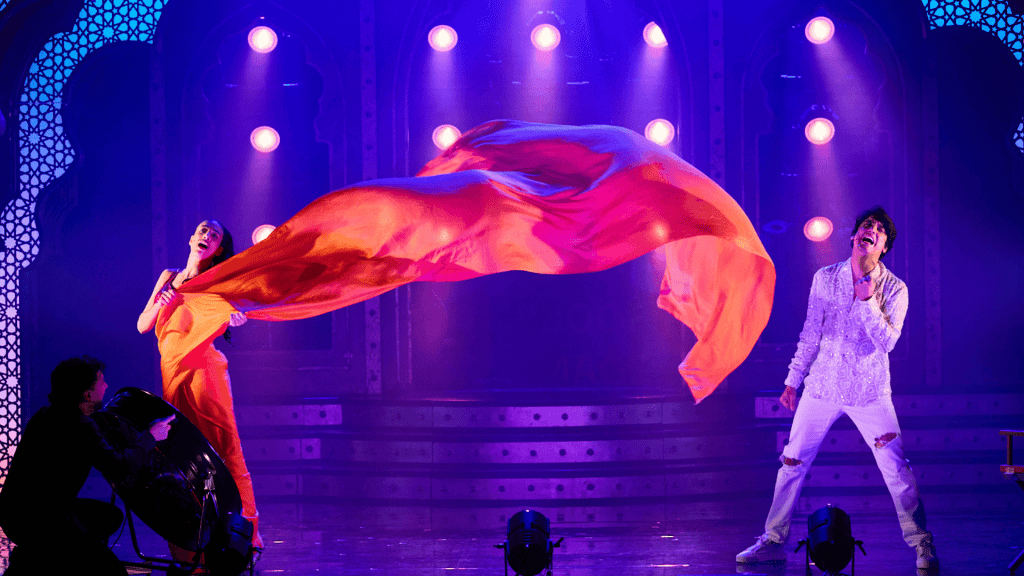
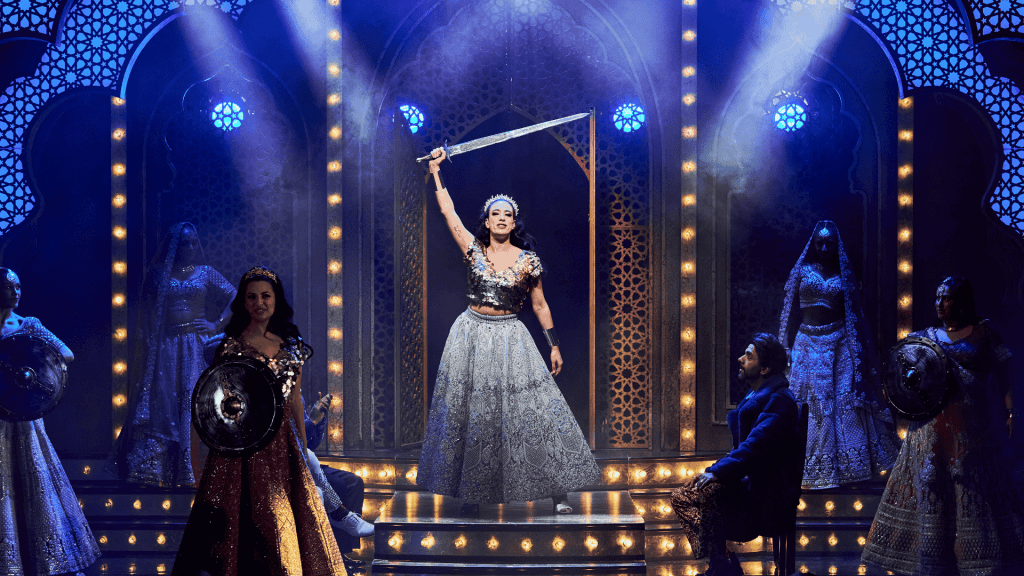
East meets west in ‘Come Fall in Love – the DDLJ Musical’ which is playing at the Manchester Opera House. Based on Aditya Chopra’s 1995 classic ‘Dilwale Dulhania Le Jayenge’ the story follows British Indian born Simran (Jena Pandya) and Roger (formerly Raj, played by Ashley Day) as they embark on a trip around Europe and an unexpected whirlwind romance. However, these lovers have a thorn in their side – Simran is promised Kuljit (Kinshuk Sen) in Panjab, India. It captures the heart and spirit of the original, and boasts an extremely talented cast, colourful costumes and impressive choreography that draws from a range of genres. Although, the show could do with a little bit more depth when dealing with the nuances of Indian culture at times, the show asks you to come and fall in love, and overall, it is pretty difficult not to.

Irvine Iqbal as Baldev and Jena Pandya as Simran

Early on we are introduced to Simran, who has just graduated from Oxford. Although her cleverness sometimes could lean into know it all, Pandya does an excellent job of making her likeable and relatable, whilst communicating her internal struggles particularly in her song ‘Twice as Good.’ Simran recalls how her father Baldev (Irvine Iqbal) told her in her youth that to gain the same opportunities as her Caucasian peers, she must be just that. Twice as good. It is an obstacle that many ethnic minorities face.

Unlike the film, Simran already has her tickets to Europe, her trip has been agreed, and the audience does not learn about her impending arranged marriage until the latter half of Act One. In the film, Simran uses this marriage as leverage to gain her father’s permission to go on the trip, leading to a heartfelt conversation between father and daughter about love, family and culture, which communicates the depth, and love, of their relationship. This might have helped the audience empathise with Baldev and his struggles more, and not just see him as the man forcing his daughter into marriage, which is how Roger’s family see him. With the omission of this conversation, the audience may not fully understand the cultural implications of arranged marriage, and to be honest, Roger does not either, as Simran never really explains them to him. This is an example of where the east half of the show needs to be bolstered a touch. The famous scene of Simran running on the train with Roger’s help drew cheers from the audience, as did all callbacks to the original film, be them dialogue or instrumental.

Jena Pandya as Simran and Ashley Day as Roger

Simran and Roger’s trip boasts some impressive staging and set design, which continually reflects the country the two are in, setting the scene for one of the longer, and more memorable dance numbers, ‘Come Fall in Love.’ Pandya has a difficult job keeping up with Day’s boundless energy, who risks drawing the audience in more with his money and partying ways, whilst Simran geeks out over Voltaire in the corner. However, their scenes in Switzerland put them on more equal footing, and Simran’s drunk state that spawns the song ‘Better Get Right’ allows Pandya to add some comedic flair to the beloved heroine. The first act does feel a tad slower than the second, but serves as important build up for the long awaited jump to the mustard fields of Panjab.

Act Two opened with quite a magical moment. The Mool Mantar, a Sikh prayer, is played into the auditorium, over the image of the Golden Temple which is projected onto the stage. It was quite breathtaking, having been to Amritsar myself, but I worry that without proper reference to the importance of this to Simran and her family, it may not have had quite as big an impact on the whole audience as it did me.

Kinshuk Sen as Kuljit

The vibrant second half picked up the pace and exposed the audience to a multitude of dances, like Bhangra and Giddha, and it was joyous, and comedic, to see Roger fully embrace Simran’s culture. What I am more mixed on though, is Roger’s mother Minky’s (Kara Lane) burlesque-esque number and romance with Kuljit, something that I felt detracted from the main love story unnecessarily. The inclusion of ‘Mehndi Laga Ke Rakhna’ from the original film also felt like a massive cultural moment, one that was enjoyed by all.

As the second half dances to a close, Roger proves that he has taken the time to learn about Indian culture, and recounts to Simran that seva, an idea that was mentioned throughout the show, is the Sikh concept of selfless love and charity. It is moments like this where the east meets west formula really works, putting both sides of the globe on equal footing, and showing the meeting of two different cultures. I will admit, seeing one of the scariest fathers in Bollywood history sing and dance was something to get used to, but Baldev’s cry of ‘jao Simran jao’ still feels as visceral and impactful as the first time I saw it on film. The productions’ closing number ‘Holi Hai’ was brilliantly energetic and is the best thing to take as a lasting impression.

Overall, my cultural criticisms do not detract from the joy of what we are seeing in front of us – the meeting of two cultures, and ultimately a celebration of love. Especially given the current racial climate a show that celebrates the coming together of an Indian woman and Caucasian man is the kind of equality and understanding that we should all be championing. The joy felt in the auditorium was palpable, and it is rare to see so many people of colour in the theatre… you could definitely hear them! Myself included! If an audience can be so delighted by a show that showcases Indian culture, then surely, by and large, this is truly something to fall in love with.

Jao Simran Jao!

4/5

Thanks for reading!

‘Come Fall in Love – The DDLJ Musical’ is playing at the Manchester Opera House until the 21st of June!

Tickets are available from: https://www.atgtickets.com/shows/come-fall-in-love/opera-house-manchester/