
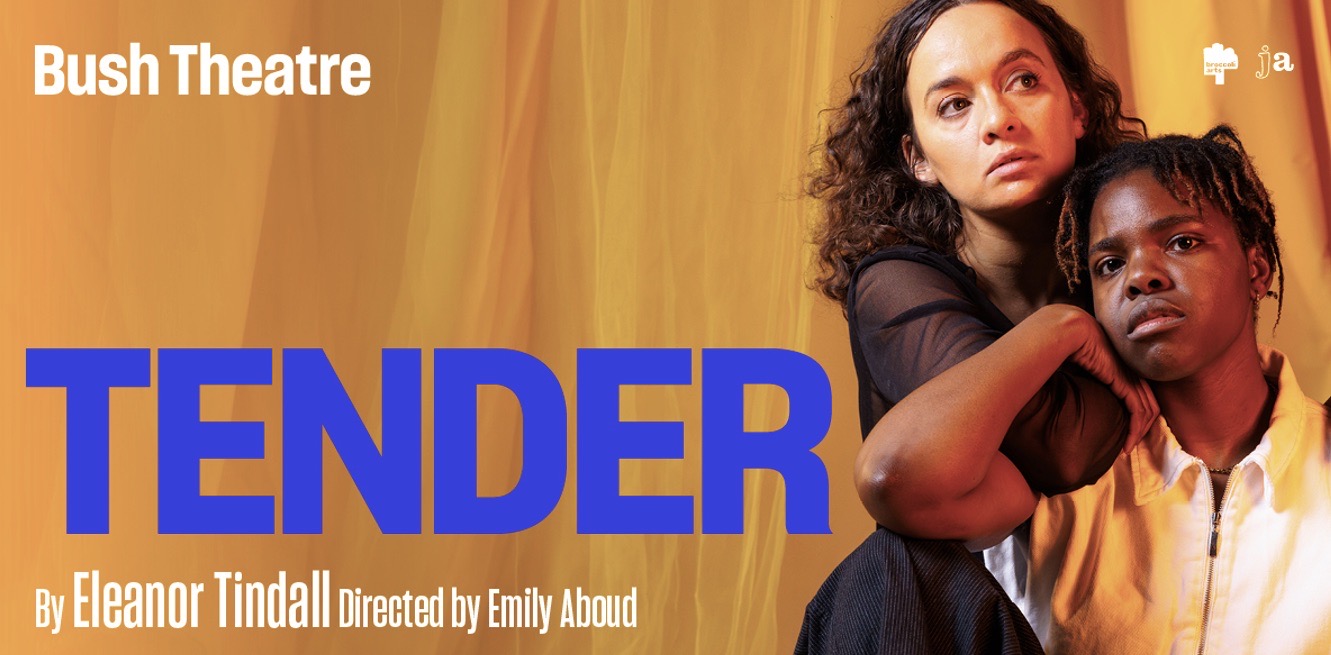
Eleanor Tindall’s queer rom-com Tender has returned to the Bush Theatre, moving to their main space, following its initial staging in the Studio in 2024. Directed by Emily Aboud, the show follows the burgeoning connection between Ivy (Nadi Kemp-Sayfi) and Ash (Francesca Amewudah-Rivers). As well as a raw and intimate meditation on queer love and acceptance, communicated through some beautiful movement, the show’s thriller elements and smattering of body horror make for an edge-of-your-seat experience, injecting the classic rom-com formula with an exciting bite.
At the heart of the show are Kemp-Sayfi and Amewudah-Rivers. Their natural chemistry and engaging performances make the growing connection between Ivy and Ash incredibly believable. Kemp-Sayfi balances Ivy’s sarky, wry humour with vulnerability, ultimately making her, and her struggles with self-acceptance, empathetic and believable. Her line that she doesn’t ‘know how to be’ really resonates and feels familiar, and Sayfi expertly articulates Ivy’s inability to express herself. Amewudah-Rivers’ Ash exudes confidence from the outset, making her later nervousness around Ivy all the more endearing. This is well balanced with the haunting trauma of her previous relationship, with Amewudah-Rivers switching between emotional states with ease. She also takes on two other roles, Ivy’s boyfriend Max and brother Cas, in an interesting stylistic choice – the booming voices of the men through the microphone fill the theatre and surround the women, suffocating them. Tindall’s naturalistic comedy is timely and sharp, and it is also nice to see a queer romance that isn’t inevitably doomed, and underlined with how difficult it is to be queer.
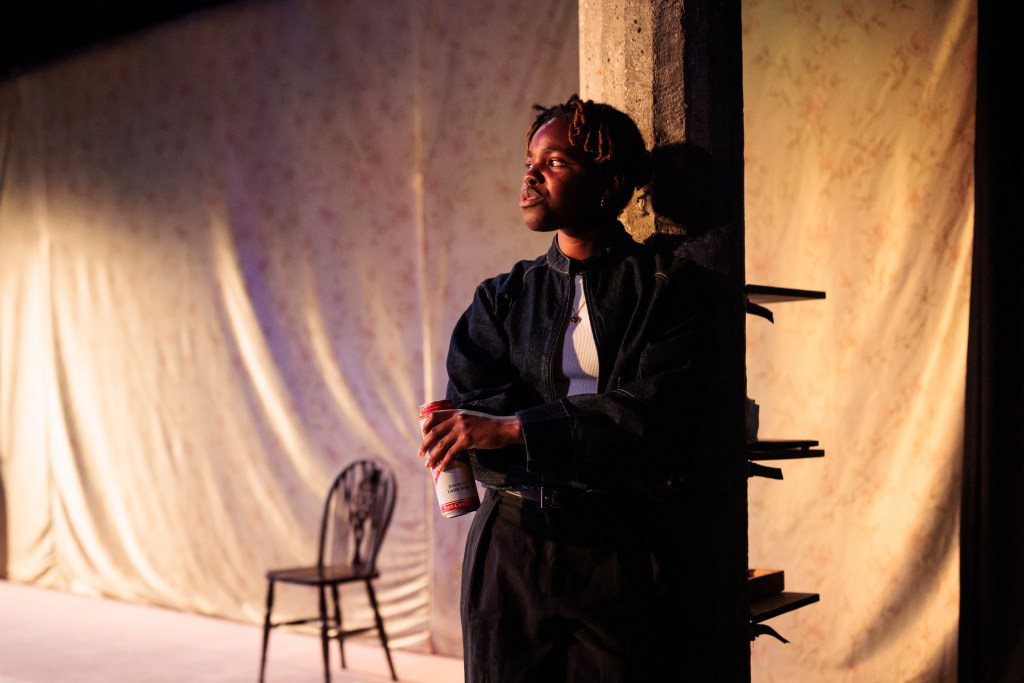
Tindall is skilled in showing not telling, allowing the story to unfold naturally, encouraging the viewers to draw their own conclusions. Max’s unwanted advances towards Ivy tell us about how men feel entitled to women’s bodies, Ash escaping her toxic relationship will speak to a group of women who have experienced the same, and although Ivy never explicitly says that she is struggling with her sexuality, we see it in her interactions with the other characters, Ash in particular.
Perhaps what has stayed with me the most, apart from the performances, is the movement, masterminded by not one but two intimacy coordinators. Ivy and Ash dance around each other, sometimes quite literally, simulating an intense, intimate connection that appears more powerful than physical touch. While some theatre productions use lighting primarily to highlight emotional peaks or intensity, David Doyle’s lighting is ever-present, moving with the characters throughout the production, adding warmth and vulnerability.
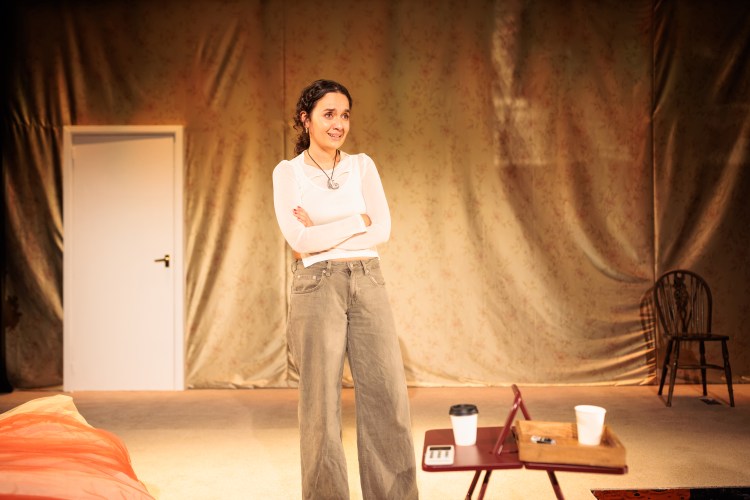
At the start of the play Alys Whitehead’s set appears simple, but it is as alive as the characters. At the centre of the stage is a hole that slowly fills with blood throughout. The characters step in it, spreading the blood throughout the stage. Now, I haven’t quite decided what I think this might say – perhaps a reference to the splitting of Ivy’s body into differing identities as her repressed sexuality begins to be freed? Whatever it is, let’s hope the Bush is stocked with carpet cleaner. Perhaps at times the symbolism feels quite far away from the anchoring performances of the leads, I was not always sure how it all ties together, but the hole and blood is visually striking, and keeps the viewer engaged. The pulsating back wall makes one first think of a poltergeist, but is used to mirror the quickly developing relationship of the characters, akin to a quickening heart rate. Again, I am not sure what it amounts to, but it seems that Ivy’s stepping through it brings her some sort of peace.
The heavy symbolism, surrealism and forays into cannibalism, may lose some people but for me, it kept an interesting thread running throughout what could’ve been a conventional rom-com. Speaking of running threads, it could be argued that Ivy’s self-harm and abortion could be discussed in greater depth, but I think this would detract from the heart of the story, Ash and Ivy themselves, and would not particularly add much to their dynamic. Although some ideas, and some of the symbolism, could be more explicitly explained and woven into the central narrative, I certainly enjoyed Ash and Ivy’s journey.
4/5
Thanks for reading!
Photography by Harry Elletson

