
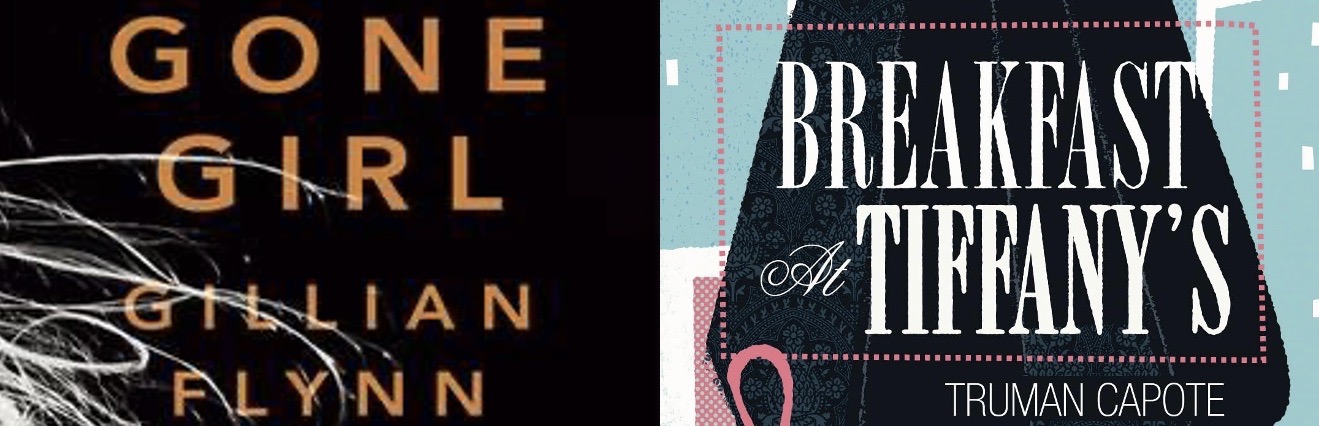
Now, I doubt many people would put Holly Golightly and Amy Elliott Dunne together – and I’ll admit, I came across the idea totally by chance. I recently read Gillian Flynn’s 2012 thriller Gone Girl, and afterwards chance upon Truman Capote’s 1958 novella Breakfast at Tiffany’s. Gone Girl tells the story of Nick’s search for his missing wife Amy Dunne, and it is through her narration later in the novel that we discover that she faked her death, and framed her husband as revenge for him having an affair with a younger woman. Holly Golightly in Breakfast at Tiffany’s is a nineteen-year-old socialite, whose story is told through the eyes of an unnamed narrator. Upon finishing the novella, I noticed that, although both women are different characters with different stories, there are common threads that tie them together, namely the archetypal ideas of gone girls and Cool Girls.
At the start of their respective stories, both Holly and Amy are gone girls. Amy is missing, the reader only learns of her through Nick or through her diary entries, and Holly has been missing for some time. They both enter shrouded in mystery, we are aware of their presence but never know who they truly are. Both become almost mythological, especially Holly after being sighted in Africa. The narrator is shown a photo of a ‘carving of a head’ that is the ‘spit-image of Holly.’[1] It is unclear what this carving is for, but it seems that Holly’s likeness is now associated with a different culture and mythology far away from America. She’s become an idol, and at this point for the narrator, a mere ‘memory.’[2] Even when Holly is present, she still never seems to be. Her name tag says that she is ‘travelling,’[3] and she always seems to ‘lose’[4] her keys – she never settles into one place or one personality.
Amy already has a pretty big influence on American culture because of the Amazing Amy novels. The series, partly inspired by Amy herself, is written by her parents, and it is what Amy herself is known for. The front of my edition of the novel bears the line the ‘search for Amazing Amy continues.’ The character is the ideal American child, something that extends to Amy herself. While she is missing, she is portrayed as the ideal, beautiful, blonde, pregnant wife. Everyone is so invested in finding her, and the romanticised idea of the reunion of the perfect couple that Amy knows that there is no way that people could believe she ever framed her husband for murder.
Even when we are properly introduced to these women, they maintain an ethereal, shape-shifting quality. Although it is Amy Dunne who establishes the idea of the ‘cool girl’ both women inhabit it.[5] Amy Dunne explains that Cool Girl is a type of woman that morphs herself to appeal to the male gaze and male fantasies. Cool Girl reflects what her man likes, is hot, never complains, remains thin and is what she believes men see as their ideal woman.[6] Since we are talking about Amy, lets stick with her. Her clearest confession about her shapeshifting ways comes in her statement that ‘some women change fashion regularly’ while she changes ‘personality.’[7] She is evidently very good at it, as at the close of the novel, she has the country in the palm of her hand, playing the doting, happy wife.
Holly also is in a constant state of change. Holly tells the narrator that she does not like older men, she ‘simply trained’ herself to.[8] Like Amy, she fashions herself to reflect what men want, and does so because she depends on their gifts of money and jewellery to survive. Obviously, with some men, this gets her into hot water, with Joe Bell naming her a ‘goddamn liar’ who ‘don’t know herself anymore.’[9] Bell believes that Holly has taken on so many personas and personalities that she does not even know who she is. This may be in part true, as Holly is still young, barely an adult at aged nineteen. Due to her youth, we could argue that she is not as assured as say, Amy is.
It is worth noting though, that although from the outside the intent of these women seem different, they both change their personalities to survive. Holly for financial survival, Amy for reputation, and to save herself from jail. There is still nuance here, as Holly appears fairly harmless, she does not actively seek to hurt others as Amy does. Holly herself appears as an early iteration of the Cool Girl.
I have noted that both characters change and shift personalities, but Holly has incidences where these characters are more defined. For a start, we learn that she was born ‘Lulamae Barnes’ and was raised in poverty.[10] She adopted the name Holiday ‘Holly’ Golightly when she started her new life in New York, her first name directly referencing the idea of fleeing, getting away and escaping. It speaks to the idea that to a degree Holly is untethered and unstable, fleeting from place to place and person to person.
Both characters change their preferences and personalities to exert control over those around them, both realising that femininity can be used as currency. Holly’s livelihood depends on her femininity, working as a socialite in 1940s New York. She spins a lot of people and a lot of plates, with the narrator recounting that she had a ‘tremendous many’ messages.[11] In an attempt to get Holly some acting work, she is modelled on the ‘Margaret Sullavan’ type, explaining how, for Holly, fitting an established, popular mould could have given her great fortune.[12] Holly’s situation is precarious though, as, if the men withdraw their affections and money, which is their prerogative, like José Ybarrar-Jaegar later on in the novel, Holly is left alone again.
While she has to have a degree of control to maintain her lifestyle, it is also hinted at throughout the novel that she does not wish to belong to anyone – she almost feels that people do not have the right to own her, nor she the right to own anything. It’s for this reason that her cat remains nameless, and why Holly classes everyone as ‘independents.’[13] While Holly treads a fine line on the control front, Amy goes full scorched earth.
Amy has Nick in a chokehold by the end of Gone Girl, knowing that she can ‘ruin’ him.[14] This is because, unlike Holly, Amy has poured all her energy into one pretty watertight plan. She has stacked the evidence against Nick, and also crafted a story to ensure that she is popular with the media. Amy becomes a commodity as far as the media is concerned, and within the novel, and outside it, speaks to ideas about marriage, gender, and violence against women. In the 2014 film version, Amy, played by Rosamund Pike, understands that ‘America loves pregnant women,’ hence, when she went missing, she added that to her narrative by faking a pregnancy, then realised it upon her return.[15] She knows that people will be sympathetic to her plight, even more so if Nick leaves her, because he will appear as the man who abandoned his traumatised wife and unborn child. While Holly’s control is essential to her survival, Amy’s calculating and controlling nature seems to be the foundation of her character.
Both characters speak to wider ideas about womanhood, and have become cultural symbols. Historically, both women’s abilities to shape shift is reminiscent of the feminine gothic – take Catherine Earnshaw from Wuthering Heights. Cathy’s personality changes depending on her romantic affections. Holly and Amy change their personalities in similar fashions. In the same vein, Amy is recognised as the embodiment of feminine evil, harking back to the literary archetype of the Victorian villainesses of the 1800s, such as Lydia Gwilt and Lady Audley. Or in contrast, some people see Amy as a beacon of feminism, exacting revenge on her cheating, inadequate husband and by extension mankind.
Holly Golightly, particularly Audrey Hepburn’s lauded portrayal in the 1961 film version has been hailed as a style icon, with her black dress being noted as one of the most iconic outfits in cinema. She is also recognised as a romantic heroine.
So although their stories are different, as are their outcomes, I do feel that both women do speak to each other and reflect evolving cultural ideas of gender and womanhood. And although Amy Dunne’s Cool Girl did not exist in the 1940s, in retrospect, I believe that Holly can be seen as an early, albeit accidental prototype.
Thanks for reading!
[1] Truman Capote, Breakfast at Tiffany’s (London: Penguin Essentials, 2011), p. 6.
[2] Ibid., p.3.
[3] Ibid., p. 10.
[4] Ibid., p. 11.
[5] Gillian Flynn, Gone Girl (London: W&N, 2014), p. 250
[6] Ibid., p. 251.
[7] Ibid., p. 250.
[8] Truman Capote, Breakfast at Tiffany’s (London: Penguin Essentials, 2011), p. 18.
[9] Ibid., p. 29.
[10] Ibid., p. 59.
[11] Ibid., p. 4.
[12] Ibid., p. 29.
[13] Ibid., p. 95.
[14] Gillian Flynn, Gone Girl (London: W&N, 2014), p. 439.
[15] Fincher, D. (Director) (2014) Gone Girl. [Film] 20th Century Fox.

