Bhangra: A Brief History

It is undisputed that Bhangra originates from the Panjab, a province in northern India. ‘Panjab’ means ‘the land of the five rivers.’ Bhangra itself has been around for over five hundred years. What is more disputed, and difficult to define, is the word ‘Bhangra’ itself. In general terms, Bhangra describes a traditional folk dance, usually performed around Baisakhi, April 13th, the festival of the harvest. It is widely asserted that the dance originates from Sialkot in the Majha area of Panjab, as the dance practised here is regarded to be the standard. Key components of the dance generally remain consistent, and include instruments, the most well known being the dhol, a double-sided barrel, and boliyan, rhyming couplets which form the majority of lyrics. Traditionally, social issues are focused on, like love, marriage and drinking. The combination of the dance and the dhol encourage rhythmic cohesion. The oldest literal mention of the term ‘Bhangra’ dates back to the late 1800s.

The term itself acts as an umbrella term, and encompasses folk dances such as, Sammi, Jhummar and Giddha. All are classed as Bhangra but have slight variations. It is argued that Jhummar, originating from Jhang-Sial, can be traced back to the Aryan period. This took place between 1750-500 BCE, where Indo-Aryans settled in Northern India. Sammi is a dance that centres around the story of a fabled girl. Sikh freedom fighters have also been the topic of lyrics and dances. Giddha is a dance that is performed by women, and the dances enact verses called bolis, representing a wide variety of subjects from familial conflict to political affairs. Along with the beat of the dhol, the handclaps of the dancer’s guide and control the rhythm of the dancing.

For men, Bhangra represented the epitome of strength and masculinity. The energetic dance movements paraded their strength and stamina. The dance’s association with the harvest also speaks to self-sufficiency in agriculture. Wider themes associated with Bhangra have included independence and bravery.

Another interpretation, associates Bhangra with Panjabi martial dances. This is evident in the performing of Gatka, a Sikh martial art in which people use swords, sticks, or daggers. It is believed that sixth Sikh Guru, Guru Hargobind, started this following the martyrdom of his predecessor, Guru Arjan Dev. Gatka is usually performed on special Panjabi holidays, a practice which upholds traditional ideas of bravery and masculinity.

Bhangra gradually began to spread and become more mainstream, beginning in the 1940s. Following Partition, displaced Panjabis took Bhangra to new places and countries, such as the UK, where many emigrated to. In the 1950s, Bhangra was patronised by the Maharaja of Patiala, who requested a stage performance of it in 1953. This marks a distinct change, as from then on, Bhangra was not just associated with the harvest, and was seen more widely as entertainment. Throughout the 80s and 90s, artists, such as Gurdaas Mann, helped Bhangra enter into mainstream music and reach a wider audience.

Clothing worn by performers is eye-catching and colourful. To ensure that their movement is not restricted, their clothes, the vardiyaan, are loose fitting. This accentuates their movement and also the rhythm of the dance, making the overall performance of Bhangra impressive and aesthetically pleasing.

Today, with the aid of artists such as Diljit Dosanjh, and the influence of Bollywood, Bhangra is massively popular. Bhangra has even been suggested as an exercise alternative. Sarina Jain was the first woman to create a Bhangra fitness workout. Bhangra societies and clubs have popped up all over the country and inspired national competitions. There is even a section dedicated to the dance as part of BBC Bitesize’s GCSE Music curriculum. It seems that Bhangra is still changing and reaching a wider audience, which is impressive considering the folk dance is over five hundred years old.[1]


[1] Information taken from:

https://hiteshsharma001.tripod.com/id2.html

https://learnbhangra.com/history

And my own knowledge.

Was there resentment towards the Roman Catholic Church in Germany in the early 16th century?

In the years 1500 to 1517, the vulnerability of Germany and the weakness of their government led to their over exploitation by the church, and by extension the Pope. Due to Germany’s feeble government, the Pope was able to instruct and send Princes, who governed individual states, to impose the laws and views of the Pope on the German people. This continued manipulation led to resentment, meaning growing disapproval and dislike. This ill feeling towards the way Germany was being exploited caused many individuals to become opposed to the church itself. The most important and apparent source of this disapproval was the corruption of the Roman Catholic Church itself, and the behaviour of those in authority, which led to the church being viewed in a negative light. Another fundamental reason for the growing dislike towards the church were the individuals who opposed the church, who named themselves ‘Humanists.’ This growing group ensured that new ideas and ways of living were spread, thus causing opposition towards the Catholic Church to grow. Despite these warring factions, it should be noted that up to and during this time, the Catholic Church still had great power and influence over Germany and also the entire Holy Roman Empire, which dominated the majority of central Europe. 

The most important and apparent reason for the growing disapproval towards the Roman Catholic Church was the corruption that took place within it. The behaviour of those in authority was condemned, and led to the eventual growth of opposition. This dislike stemmed from the behaviour of the priests themselves, and when examined, it was discovered that they themselves were not fulfilling their duties and were being unprofessional. Absenteeism was rife, and this angered locals, as they wanted to be able to consult a religious authority at all times to administer the seven sacraments when needed, which the church believed were the seven things a good Christian must carry out in their lives. If one died without confessing his sins, or the Last Rites, due to the absence of a priest a German Catholic would argue that their relatives’ time in Purgatory would be longer as they had not confessed. This could have had a profound affect on the members of the family left behind, and their mind would not be at ease, due to the absence of their local priest. Non-residency also angered the German people in the same way, as there was nobody to turn to if religious help was required. Some priests even lived with women, which was strictly prohibited, as the prospect of a woman and a family in the life of a priest would distract them from their devotion to God. Pluralism also was apparent in the church, and one person could hold several positions. Bishops could be in charge of many dioceses at a time, and this did not allow the Bishops to focus on one state alone. For example, Albert of Brandenburg was the Archbishop of Mainz (from 1514-1545) and the Archbishop of Magdeburg (1513-1545). These positions could also be sold to the highest bidder, insinuating that some people saw the church as a means to make money. During the Indulgency scandal of 1517, Jakob Fugger of Augsburg lent Albert of Brandenburg money so he could become the Archbishop of Mainz, proving that one needed money to climb the hierarchy in the Catholic Church. Many of these people were unqualified, which led to an ignorance of Latin and doctrine. This meant that the people of Germany were not getting the required spiritual consultation they were hoping for, and that those within the church did not take their position seriously and were not well informed enough to provide the public with help. As the ordinary lay person couldn’t understand Latin, it was imperative that they had someone they could approach to help them to decipher it, and due to their unprofessionalism and ignorance of the priests, there was know one to turn to. The practise of nepotism also took place, implying that when assigning a new role, the skills and knowledge of the candidate were not considered, and only his familial ties were. This is unsettling, as it shows how little care the Catholic Church showed for the ordinary people, as they were not prepared to provide them with the most knowledgeable people. There was also great instability within the church itself as many tried to promote reform within it. One of these people was Luther, who after being caught in a thunderstorm in 1505 became ordained. The civil war within the church itself demonstrates the extent of how corrupt it was, as the ways of the church had clearly created groups with differing ideas. Priests also behaved appalling outside of the church, and were regularly seen indulging in activities that were frowned upon, such as drinking, gambling and womanising. The church condemned gambling as it could lead to addiction, and the “enslavement” of the person taking part in gambling. Money was also a cause for the corruption of the Catholic Church, as priests without payment would not perform many religious acts. These included marriage and baptisms. Money was also extracted from those embarking on pilgrimages and those who wanted to see, what the church claimed were, ancient remains, or relics. Perhaps the greatest example of exploitation by the church is the selling of Indulgences. It was believed that the purchase of Indulgences was “a way to reduce the amount of punishment one has to undergo for sins” in purgatory. Whether they were dead or alive did not matter, as Indulgences could be bought for the previously deceased. Of course, their spiritual value could not be proven, but Pope Leo X used the money raised to fund projects such as the rebuilding of St Peters’ Basilica in 1517. This again displays how the clergy would exploit the people and their own position (as well as that of the church’s) to gain money. The overall unprofessionalism of the church, as well as their exploitation of the public, provides reason for the growing dislike and disapproval towards the Roman Catholic Church in the early 16th century.  

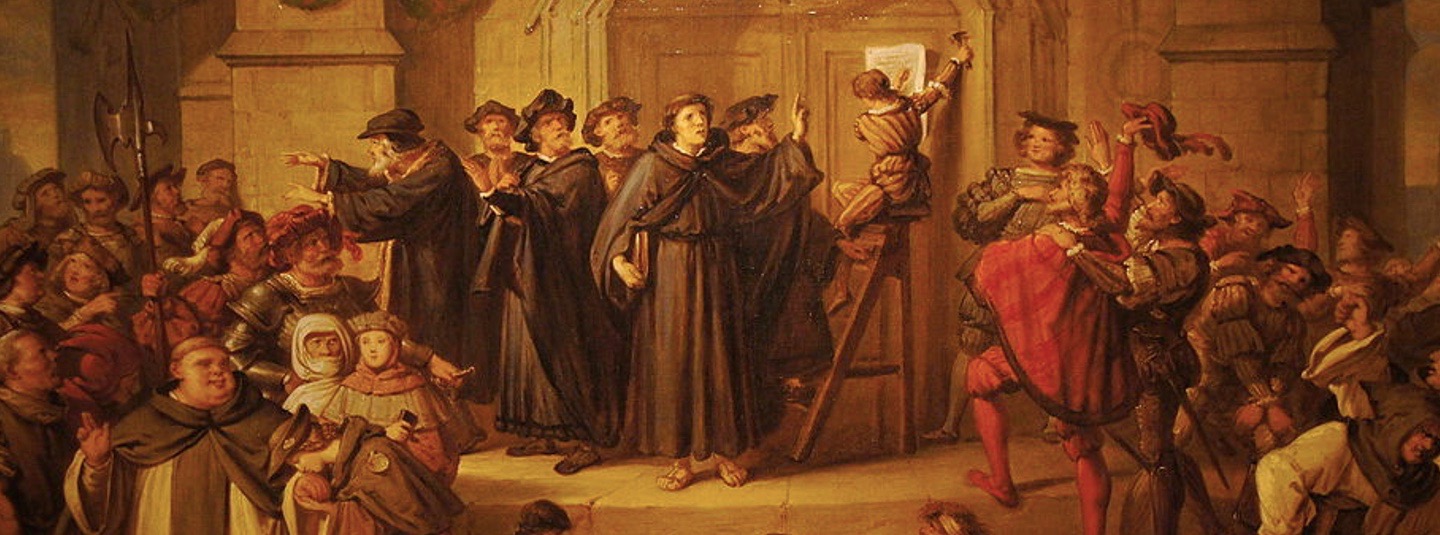
Another important reason that added to the strong disapproval towards the Catholic Church in the early 16th century was the activity of the Humanists. This group, led by Martin Luther and at times Phillip Melanchthon, voiced the problems within the church and ensured they were well known to the public. Their actions spread the news about the corruption of the church and also provided ways to combat it. It could be argued that their open criticism of the church was the most important reason for negative feelings, but it was fundamentally the church, and the acts that those inside it, that fuelled the reforming ideas of Luther and the Humanists as well as their criticism. For example, Ulrich Von Hutten was known to mock “clerical ignorance” within the church. This movement was primarily proposed and led by Luther, and came to a climax in 1516. It struck Luther at this time that “The righteous shall live by faith,” thus propelling him to nail his 95 Theses to the doors of the university church at Wittenburg. Before this action the Humanists were responsible for promoting the general feelings of anti-clericalism and anti-papalism in Germany. This opposition to the church based on its abuse of power spread through Germany, as well as a feeling of nationalism. Humanists defended Germany’s language, culture and outlook and regarded them as highly important. This gave the Humanists the right conditions for reform, as the people of Germany were beginning to value their culture and faith again. The Humanists used this to discuss new ideas about faith and how to be a good Christian, which involved the German people further. This nationalism led to arguments from the Humanists supporting the idea that the Bible should be in the vernacular; and this eventually happened in 1522, based on Erasmus’ Greek translation in 1516. The Humanists emphasised the importance of having a good understanding of the Bible, and how this was the key to faith. The idea of “sola scriptura” was highlighted, meaning the scripture, the Bible alone, is the way to full religious knowledge. This also contributed to the idea of “sola fide,” meaning faith alone. This phrase condemns the Church’s’ practise of extorting money, as only faith is needed to be a good Christian. By making the Bible easy to understand for the ordinary person, the Humanists and particularly Erasmus hoped that this would lead to debate about religious practises, and hoped that people would become emboldened by their views of the Church. Knowledgeable theologians also supported Luther in the build up to the reformation, including Philip Melanchthon, who was present at Luther’s’ first dispute with the church in 1519 in Leipzeig. The intelligence of the Humanists, as many studied theology at university, allowed them to understand the reforms taking place and were able to actively engage with the changes. The Humanists hoped that everyone would not accept the authority of the church so easily, and would be able to grapple with new ideas of reform. The Humanists also denounced the way the Church dealt with money, and condemned the selling of Indulgences because of it. Humanists condemned the idea of relics and pilgrimages, referring back to the key concepts of faith, which they believed was having a thorough understanding of doctrine. The Humanists were partly responsible for the growing disapproval towards the Catholic Church in the early 16th century, as it was them who voiced their personal resentment towards it, thus spreading the word about the Church’s corruption to the public.

However, it can be argued that there was no disapproval towards the church whatsoever during the early 16th century. The church provided a local authority for the German people, and was regularly consulted up to the reformation, as it had great ecclesiastical power. Despite the criticisms of the Humanists, local German people still valued the Church and regarded it with great importance. The church had great influence due to the structure of the Holy Roman Empire, which dominated much of central Europe. There were 46 ecclesiastical states in the Empire, compared to only 26 secular ones. Many people turned to the church and asked for sacraments to be administered. It was believed that if the Last Rites were not performed, the amount of time spent by the dead in purgatory would be longer than intended. This emphasised the importance of the church, and how much people depended and relied on them. They also trusted them greatly, to save the souls of their loved ones and to ensure that they got to heaven. The church was regularly consulted, as people believed that God and the Devil were responsible for the good or bad events. If there were a bad harvest, the people, after consulting those in the church, would believe that God was asking for good deeds to be delivered, in order for the good times to return. Priests were also seen as teacher in the local community, and were supposed to be available at all times for consultation. The Church also spread fear among the locals, as those who broke the rules of the Church were told that they would suffer eternal damnation in Hell. This increased the popularity of the church and the amount of people who went as they wished to know how to avoid this, and they could only find out this knowledge if they understood the Bible. The Church was the sole interpreter of the Bible, because know one understood Latin, and priests were the only people allowed to read it. This inspired great respect for the church, as many believed the priests within it to be learned and cultured. This was partly the reason why many respected the church, as they felt their divine knowledge and understanding of doctrine could not be disputed, especially their attitudes to saints and relics. The viewing of such relics was believed to aid individuals towards eternal salvation, and as this belief came from priests, many people obliged. This insinuates that there was actually no disapproval towards the Roman Catholic Church, as many people saw them as the only spiritually learned men in their state. As priests were the only people who could read the Bible they were well respected and had great status, thus diminishing the disapproval towards the Church.

There was not resentment towards the Catholic Church in Germany in the early 16th century but only strong dislike, mainly for the corruption within the Church. Their unprofessionalism and exploitation of the people for money are the actions that fuelled Humanist activity, and are therefore primarily responsible for the growing disapproval of the Catholic Church.[1]


[1] All information taken from:

A. Grundy, Religion and state in early modern Europe, (London, Pearson Education, 2015).

And my own knowledge.

Female Suffering in Shakespeare: Ophelia and Juliet

Female expressions of love lead to suffering, and this initial suffering comes in the form of exploitation. Ophelia suffers as she is exploited by Polonius and Claudius in Hamlet because of her love for the title character.  Although their love is debated, Ophelia confesses that she did ‘love’ Hamlet ‘once’ (3.1.1114).[1] AC Bradley concurs, declaring that Hamlet once ‘sincerely’ loved Ophelia, making her exploitation all the more upsetting as her genuine feelings for Hamlet are disregarded.[2] This love prompts Polonius to ‘loose’ (2.2.159) his daughter to Hamlet, in the hope of ascertaining the cause of his madness. Ophelia is traded by her father in aid of Claudius’ schemes, leading to her suffering. Emi Hamana recognises this scenario, noting that Ophelia suffers a series of ‘patriarchal oppressions.’[3] She suffers at the hands of the patriarchy as her interests are ignored and subverted in favour of the dominant males that surround her, notably Claudius and Polonius. Ophelia’s declaration of love for Hamlet leads to her suffering as she is considered a useful tool to be exploited.

This exploitation of Ophelia leads to a different form of suffering, as she is subjected to verbal abuse by her former lover. Hamlet ambiguously banishes Ophelia to a ‘nunnery,’ (3.1.120) which could be a reference to a brothel. This reference implies that Ophelia is sexually promiscuous and does not uphold traditional ideas of purity and chastity. Avi Erlich therefore defines Ophelia as ‘sexually treacherous,’ and theorises that she has had sex with Hamlet.[4] Upon her wedding, Hamlet threatens to give Ophelia a ‘plague for thy dowry,’ perhaps a reference to sexually transmitted diseases, thus confirming Ophelia’s sexual activities with Hamlet (3.1.135). Her demonstration of love towards Hamlet, having sex with him, has led him to shame her publicly, and therefore led to her suffering in the form of verbal abuse. Hamlet shames Ophelia and implies her sexual discordancy in the presence of Claudius and Polonius, leaving her feeling ‘most deject and wretched’ (3.1.154). Ophelia feels rejected by Hamlet as he has cast her aside and alluded to her sexual impurity through his verbal abuse directed at her. Hamlet’s verbal aggression towards Ophelia opens her up to ridicule and leaves her vulnerable, as he exposes their clandestine affair in front of her father and Claudius, resulting in her suffering.

Juliet’s expressions of love for Romeo lead to her suffering at the hands of Lord Capulet as she is also subjected to a tirade of verbal abuse. Lady Capulet tells Juliet that Paris seeks her for ‘his love,’ (1.3.75)[5] and Juliet opines that marriage was an ‘honour’ she did not ‘dream of’ (1.3.67). Juliet agrees to ‘look’ at Paris, as her mother wishes, like a dutiful daughter (1.3.98). However, upon marrying Romeo, Juliet dispenses with her daughterly duties, as she marries without her parents’ consent and does not consider their opinions on the matter. Her strength of love for Romeo has led her away from her familial duties demonstrating her newfound loyalty towards him. Cedric Watts notes that Juliet defies the will of her parents and opens herself up to ridicule by marrying for love and without her parents’ consent.[6] As a result, Lord Capulet is verbally aggressive towards Juliet, declaring that she is a ‘disobedient wretch!’ (3.5.166). The use of exclamation marks is rare in Shakespeare, and its inclusion emphasises the anger of Lord Capulet towards Juliet. Lord Capulet declares that having her has been a ‘curse,’ (3.5.166) implying that Lord Capulet now sees his daughter as a burden that he seeks to reject, as she has disobeyed him and refused to marry Paris. ‘Curse’ implies that Capulet believes Juliet will continually cause the family distress and harm. Juliet is rejected by her father during this tirade and risks being fully ejected from the family in her refusal to marry Paris, prompting her to beg for ‘pity’ (3.5.197). Her expressions of love towards Romeo and her agreeing to marry him, has led to her suffering as she is subjected to verbal abuse by her family. This occurs as she has compromised her duty and role within the family. Watts also notes that Lord Capulet’s response is symbolic of the feud due to its ‘intensity,’ which Juliet has concentrated into her own home through her marrying, and love of Romeo.[7] This cements the idea that female expressions of love lead to suffering, and in this instance suffering comes in the form of verbal abuse and aggression.

Female expressions of love lead to suffering, and for both women this also manifests in the form of grief, which is caused directly by their lovers. Upon hearing that Romeo has murdered Tybalt, Juliet acts with confusion, which is conveyed in her discussion with the Nurse, as she calls Romeo a ‘beautiful tyrant, fiend angelical’ (3.2.75). This juxtaposition shows her distress at the news, as she cannot reconcile Romeo’s beautiful appearance with his murderous actions. Romeo’s killing of Tybalt places Juliet in a precarious position, as she cannot condone the murder of Tybalt, but also finds that she cannot ‘speak ill of him that is my husband’ (3.2.125). Juliet suffers due to her love for Romeo, as it was Romeo who killed Tybalt offsetting her grief and all of the events that follow.

The ‘poison of deep grief’ (4.5.75) affects Ophelia differently, and prompts her descent into madness. She is distressed at the idea that Polonius should be laid in the ‘cold ground,’ (4.5.70) an action directly caused by Hamlet as he is the murderer of Polonius. Shakespeare’s use of prose here emphasises the madness of Ophelia, as she speaks and acts freely within her madness, expressing disdain towards Hamlet, highlighting the suffering that he has caused her. Ophelia sings about a man who ‘promised me to wed,’ (4.5.63) implying that Hamlet is the object of her hatred and disgust. She also states that this promise was made before he ‘tumbled’ (4.5.62) her, a reference to sexual intercourse. Despite her father’s murder, in her madness, caused by her intense grief, Ophelia still fixates upon her lover, imploring the audience to realise that Hamlet is the direct cause of her suffering, as her father’s murderer, and her suffering throughout the whole play.

Juliet’s suffering is sustained past the stages of grief, due to her continued loyalty to Romeo. Unlike Ophelia, Juliet remains loyal to her male lover, and retains her sanity. This prolongs her suffering, as she finds that she is further tested with the impending news of Romeo’s banishment. Juliet explains that ‘there is no end, no limit, measure’ in the word ‘banished’ (3.2.125). Juliet notes that the word itself has infinite powers to kill and destroy, and that the physical act of Romeo’s banishment kills her beyond infinity. As well as having to deal with her grief, and the prospect of Romeo’s banishment, Juliet finds that in allying with Romeo, she will make enemies of her family, who seek the ‘murderer’ (3.5.84) of Tybalt. She then tries to involve herself in the Capulet plot to avenge Tybalt, falsely claiming that she will not be satisfied until she sees Romeo ‘dead’ (3.5.94). Her loyalty towards Romeo means that she has to cope with the possibility of his banishment, as well as the grief and anger of the Capulet family, which exacerbates her suffering.

The final suffering of both heroines is death, which is used to discuss the wider position of women in society. Juliet greets death with the strength that she draws from her love for Romeo. Her loyalty to him, and the suffering she has endured, leads her to this moment, as she declares that she is the ‘sheath’ (5.3.170) of Romeo’s dagger. Juliet’s death is used by Shakespeare to discuss love more broadly, as in her final act, Juliet dispenses with the conventions and duties that have restrained her, personified by Lord Capulet.[8] Juliet has consistently resisted the societal pressures that have been placed on her, and rejected her duty as daughter in order to pursue Romeo. Juliet’s final sacrifice and suffering confirms the magnitude of her love for Romeo, as Shakespeare uses the character as a cipher to argue that love can be measured by the acts that lovers perform for each other.[9] Her reunion with Romeo in death advocates the idea of free choice, as Juliet is rewarded for her loyalty to her husband in death.[10]

Ophelia’s death is somewhat more peaceful as she is pulled ‘to muddy death’ (4.7.181). The ‘willow’ (4.7.164) is a symbol of unrequited love, again referencing the fact that her expressions of love for Hamlet have led to her suffering, and subsequent death.[11] Her lack of will to stop her drowning leads some critics to argue that Ophelia’s death was suicide, much like Juliet’s. In contrast to Juliet, Ophelia is not reuniting with any lover in death but instead seeks to escape the suffering that she has endured in her life, exacerbated by her love for Hamlet. Elaine Showalter opines that Ophelia’s madness and death is representative of women’s oppression within society, suggesting that, like Juliet, Shakespeare uses Ophelia to discuss the wider issues and treatment of women.[12]

Juliet and Ophelia’s love and loyalty for their male counterparts leads to their suffering and eventual deaths, which is preceded by suffering in the forms of exploitation, verbal abuse and grief. Although Shakespeare endorses free love in the character of Juliet, such emotions can be dangerous for young women. Love is portrayed as a destructive force that leads to multiple character deaths, and draws women away from their duties, thus imploring them to break free from societal restraints. Only Juliet succeeds in this, as her suicide subverts societal expectations and allows her to succeed in being with Romeo. Ophelia, in contrast, is destroyed by the men in the play, most specifically Hamlet, and is exploited by Polonius and Claudius because of her love for Hamlet. Her freedom comes in the form of her madness, suggesting that Ophelia is used to open discussions about female oppression. The sufferings and subsequent deaths of both heroines can be used to discuss issues that are still prominent today concerning the freedom and oppression of women.

Thanks for reading!


[1] William Shakespeare, Hamlet, ed. by Ann Thompson and Neil Taylor (London: Arden Shakespeare, 2016).

[2] AC Bradley, Shakespearean Tragedy, (London: Palgrave Macmillan, 1992) p. 129.

[3] Emi Hamana, ‘Whose Body Is It, Anyway? – A re-Reading of Ophelia’, in Hamlet and Japan, ed. by Yoshiko Uéno, (AMS Press: 1995) pp. 143-154. p. 145.

[4] Avi Erlick, Hamlet’s Absent Father, (Princeton: Princeton University Press, 2015) p. 171.

[5] William Shakespeare, Romeo and Juliet, ed. by René Weis (London: Arden Shakespeare, 2012).

[6] Cedric Watts, Romeo and Juliet, (Conneticut: Twayne Publishers, 1991) p. 92.

[7] Ibid., p. 72.

[8] Cedric Watts, Romeo and Juliet, (Conneticut: Twayne Publishers, 1991) p. 97

[9] Ibid., p. 115

[10] Ibid., p. 114

[11] William Shakespeare, Romeo and Juliet, ed. by René Weis (London: Arden Shakespeare, 2012).  p. 436.

[12] Elaine Showalter, ‘Representing Ophelia: Women, madness and the Responsibilities of Feminist Criticism’, in Shakespearean Tragedy, ed. by John Drakakis (London: Routledge, 1991) pp. 280-296. p. 281.

The Other in ‘Beloved’ and ‘Under the Skin’

The concept of the Other refers to something, or someone, that is dissimilar to the norm and outside of the realm of the familiar.[1] What is exclusively classed as the Other in both novels is not so clearly defined. This complexity prompts the reader to question what truly is the Other, and in turn, what this means for understanding its opposite, the familiar. This essay will explore how the Gothic novels ‘Beloved’ and ‘Under the Skin’, complicate the trope of Otherness through the use of physical forms, such as the home and the body, intangible concepts, such as language, the subconscious and the conflicting nature of characters’ thoughts and actions. The conflict that arises from attempting to identify the Other leads to attempts at self-destruction and suicide for both of the novels’ protagonists, Sethe and Isserley. 

The physical form of the home may be considered the ultimate familiar, but this is disrupted in Beloved, complicating the trope of Otherness. Anthony Vidler describes the home, as the seat of ‘domesticity, its residue of family and nostalgia.’[2] There is nothing abnormal about domesticity, and it appears as fairly banal. The presence of the family and memories make the home an ‘intimate shelter of private comfort.’[3] The privacy of the home enhances the security and familiarity of it, which Vidler attributes to the presence of loved ones. This safe space shields its inmates from harm, and by extension, from the Other. The first line of the novel subverts this conception of the home and personifies Sethe’s own home by stating that it was ‘spiteful. Full of baby’s venom.’[4] Sethe’s home harbours a malicious force which intends to poison its inmates. This contrasts with the readers’ preconceptions of the security and familiarity of the home, forcing them to realise that it may in fact be the opposite.[5] This blurs the line between familiarity and Otherness, which is further complicated by Beloved’s physical presence in the home.

Sethe allows Beloved into her home, believing Beloved to be the embodiment of her deceased daughter.[6] Beloved’s physical body is used to examine and complicate the trope of Otherness, as she initially appears as a ‘young woman’[7] who possesses ‘good skin, bright eyes.’[8] Paul D notes that she is ‘strong,’ portraying Beloved as a familiar image of beauty and health, prompting Sethe to accept her.[9] Despite Beloved’s youthful appearance, she moves like an ‘older’ person, demonstrating a conflict between Beloved’s physical appearance and physical capabilities.[10] Beloved grows in strength as the novel progresses, and physically weakens when she is deprived of Sethe’s attention, which is shown by Beloved’s loss of a tooth, and her own lamentation that next it would be her ‘arm, her hand, a toe.’[11] Beloved is revealed to be a parasitic figure, who must draw nourishment from Sethe in order to survive. This perhaps explains her lack of strength when she first appears. Such a being closely aligns with the concept of the Other, due to its lack of familiarity and similarity to a human being. Beloved’s physical body hides her true nature, again blurring the distinction between familiarity and Otherness.

Sethe’s scars are also tied to Otherness, as the presence of such scars are not the familiar for others within the novel. They represent the physical cruelty of slavery, and imply that Sethe’s body is still owned by the slave owners.[12] However, Sethe reclaims the scar, by seeing it as a metaphorical ‘sculpture’[13] of a ‘chokecherry tree.’[14] The beauty of the tree contrasts with the ugliness of slavery, and although the presence of such scars may not be the familiar for most people, Sethe’s reclaiming of them ensures that they become the familiar for her, in spite of the Otherness that they initially represented.

Isserley’s physical body in ‘Under the Skin’ too complicates the trope of Otherness. Like Beloved, Isserley is initially presented as a familiar representation of female ‘beauty,’[15] and is even described as ‘page three material.’[16] Isserley’s reflection of the highly sexualised females that appear in the media ascend the idea of familiarity, portraying her instead as the perfect example of female beauty, from the male perspective. She later reveals that, in modelling her body, a ‘magazine’ was used as a ‘guide.’[17] Her hyper familiarity is not natural but synthetic, highlighting the inherent Otherness of her deceptively familiar appearance.

The extent of Isserley’s Otherness is explored further when her true form is revealed, which contrasts with her initial familiarity. Her physical form is antithetical to that of a human being, as she resembles a ‘tripod style’[18] alien being, with a ‘prehensile tail,’[19] ‘vulpine snout’[20] and ‘soft fur.’[21] Isserley’s true nature fully embodies the Other, as she is an alien, which is unfamiliar to the humans in the novel and the reader. Her intense strength is hinted at through her ‘prehensile’ tail. Her ‘vulpine’ snout implies that she is fox-like and cunning. Like Beloved, Isserley embodies both the familiar and the Other simultaneously, complicating the readers’ perception of her, and her own perception of herself. While the reader would consider Isserley’s human form to be the perfect form of female beauty, she sees it as a physical mutilation of her natural form, and believes herself to be monstrous in the eyes of her colleagues.[22] This conflict raises questions about identity, as Isserley and the reader find it difficult to categorise her as human or alien, and by extension, heroine or anti-heroine.[23] The physical body is used to complicate the trope of Otherness, as it conceals the true nature of Isserley and Beloved.[24]

Aside from physical forms, intangible concepts are used to complicate the trope of Otherness. Isserley’s use of language forces Otherness upon humanity and asserts herself as the familiar. She dehumanises the physical bodies of the humans that she encounters. By naming humans as ‘vodsels’ Isserley forces Otherness upon them, as from her perspective, it is the humans, and by extension the reader, who are the aliens, and therefore the Other.[25] She describes one of her hitchhikers as ‘bristly, wrinkled and scarred, with a mottled snout of a nose.’[26] By likening his features to an animals’, Isserley removes his humanity. She goes further by describing humans as ‘specimens’[27] and ‘fleshy bipeds,’ portraying them as pieces of meat.[28] She later likens two human heads to the ‘polyps of an anemone.’[29] By comparing them to a plant, Isserley strips the humans of their ability to reason, reducing them to inanimate beings in contrast. This further complicates the relationship between Isserley and the reader, as even though her Otherness has already been explored, we are encouraged, from Isserley’s perspective, to view human beings as the Other, despite their familiarity to us.

Humans are deprived of their language while they are being processed, as their tongue is ‘carved’ out.[30] Jacques Derrida declares that animals are non-human because they do not possess the quality of ‘speech.’[31] Isserley’s race judges’ humanity on their ability to communicate, and the division between the two races is based on language.[32] This could be comparable to humanity’s attitude towards animals. In the eyes of Amliss Vess, the son of Isserley’s employer, the possession or non-possession of language informs him whether it is acceptable to kill humans or not, and because of his preconception that they do not have a language, he believes it is acceptable.[33] Without language, Isserley’s race renders human beings as mindless beasts, making them appear as the Other. This allows Isserley’s race to emotionally distance from the humans being slaughtered, minimising their guilt. This could also act as a wider critique of humanity’s treatment of animals outside of the novel.

Isserley criticises humanity’s lack of intellectual capability, aligning them with the Other from her perspective. Derrida notes that animals are unlike humans because they do not possess the quality of ‘reason.’[34] Isserley feels similarly about humans, as they cannot ‘siuwil, they couldn’t mesnishtil, they had no concept of slan.’[35] Isserley reprimands humanity as they do not possess the same intellectual capabilities that she does, which she believes is essential to any being. This is ironic as these are not human qualities, so it is unsurprising that humans do not possess them. Despite this, Isserley still tries to measure humanity by the intellectual capability of her own species, citing the former as the inferior.

Beloved’s use of language too brings into question her intellectual capabilities, further complicating the trope of Otherness. Beloved, presumably talking about Sethe, states that she is ‘not separate from her there is no place where I stop   her face is my own.’[36] Morrison’s use of free direct discourse allows for a stream of consciousness, and direct insight into Beloved’s mind. This mirrors Beloved’s belief that she does not ‘stop.’ The lack of punctuation implies Beloved’s infantile lack of coherency, highlighting the conflict between her physical appearance and intellectual capabilities. Beloved’s monologue merges with the monologues of Sethe and her sister Denver. All declare that ‘you are mine,’[37] and the lack of punctuation implies that there is no barrier or divide between the three characters.[38] Beloved wants to physically and psychologically merge with Sethe and Denver and wishes for them to do the same. In merging and becoming like Beloved, Sethe and Denver would too align with the concept of the Other as Beloved does.

It is through a lack of language, that Beloved is eventually expelled from the narrative.[39] She is ‘disremembered and unaccounted for,’ as Sethe and Denver do not give life to her, through their speech.[40] By not talking about her, Beloved is effectively removed from their lives. Luce Irigaray tries to explain this, by arguing that a mothers’ love is needed for a woman to ‘retain’ her identity.[41] Sethe’s decision to not speak about Beloved could imply her lack of love for her, causing Beloved to lose her place in Sethe’s heart and therefore the physical home. This again demonstrates Beloved’s Otherness, as she is destroyed by a lack of attention, something which cannot physically harm an ordinary being.

An exploration of Isserley’s subconscious is also used to complicate the trope of Otherness. After being sexually assaulted, Isserley realises that humans can inflict pain upon her, as she can on them.[42] This brings an unexpected, and unsettling, level of equality between Isserley and humanity.[43] Isserley then wishes to see a vodsel suffer and enjoys watching one being butchered.[44] This destabilises her, as her emotional response means that she cannot treat the vodsels as mere animals, and she begins to see them as living beings.[45] She later tries to ‘see herself as a vodsel might,’ in an attempt to accept her human form.[46] Isserley now finds herself identifying with humanity and their pain, complicating her own conception of the Other. This inner conflict gives voice to her own internal Other.[47] Isserley finds herself torn between her physical appearance and who she identifies with subconsciously. Her growing internal Otherness and rejection of herself, in favour of her humanity, marks a conflict that escalates throughout the remainder of the novel.

Sethe’s thoughts and actions provide a similar internal conflict in relation to her role as a mother. In anguish Sethe frequently mentions that her ‘nursing milk’ was stolen from her.[48] Her continual grief at this development emphasises her strong desire to be a mother, which also implies her suitability for the role, as her grief shows how much she cares, and how attentive she would be. Sethe believes that her primary function was to be a mother, and that this opportunity was partly stolen from her upon the death of Beloved. Sethe’s suitability as a mother is later reinforced by Sethe’s conviction that her ‘world’ was in her house, implying that her children, Beloved and Denver, are all that she needs to feel complete.[49]

This image however is disrupted when the reader learns that Sethe ‘meant’ to kill all of her children.[50] Carolyn Dever argues that mothers in the Gothic narrative are ‘constructed as an emblem of safety.’[51] Sethe however decapitates Beloved with a ‘handsaw,’ and this behaviour of a mother towards her child is antithetical to the familiar conceptions of motherhood.[52] The complication of the trope of Otherness is examined in the conflict between Sethe’s own thoughts and actions, as her desire to be a mother conflicts with her action of killing Beloved.

However, following on from Dever’s belief, that the mother represents ‘safety,’ perhaps Sethe’s actions maintain her status as a perfect mother, as she sought to shield her child from the horrors of slavery.[53] Out of context, her action of infanticide would likely be condemned, but some may be more sympathetic because Sethe’s intention was to shield her child from future harm, despite the pain that the act would cause to herself. This further shows how the conflicting thoughts and actions of characters complicate the trope of Otherness, and also lead to their self-destruction.

The escalating conflict of internal Otherness leads to attempts at self-destruction. Sethe wishes to care for Beloved as ‘no mother ever tended a child.’[54] Sethe’s willingness to let Beloved into her home is self-destructive, as Beloved ‘ate up her life.’[55] Sethe does not care for Beloved in the conventional sense, but instead metaphorically ‘yielded’ her life force to her, in her desperation to care for her.[56] This threatens Sethe’s own life, as physically evidenced by Sethe becoming ‘smaller,’ and Beloved becoming ‘bigger.’[57] Sethe’s internal guilt over personally Othering the familiar conception of motherhood, and her desire to be a mother, blinds her to the reality that, by letting Beloved remain in her home, she risks her own life.

In contrast, Isserley’s internal conflict with the Other results in her suicide. By this point in the novel, Isserley does not feel exclusively human or alien, due to the conflict between her subconscious mind and physical body, and therefore does not exclusively belong on Earth or her home world.[58] Isserley is more attracted to the idea of becoming ‘atoms,’ and a ‘part of the sky.’[59] The climax of Isserley’s internal conflict with the Other is suicide, as she ascends from her physical body to a realm where there is no exclusive identity that she must conform to. She frees her ‘soul’ from her physical body, and with it, the judgement of where she should belong.[60] Isserley’s suicide allows her to literally and metaphorically, rise above her internal conflict between her physical appearance and who she identifies with subconsciously.

The Gothic novel complicates the trope of Otherness, as it demonstrates that there can be no individual concept of the Other, as settings and people evolve throughout the narrative, and can embody established preconceptions, as well as the Other. Physical forms that the reader identifies with, such as the home, can be infiltrated and can embody the Other, as demonstrated by Beloved’s entrance. The human form also cannot be separated from the Other as Isserley and Beloved embody the familiar and the Other simultaneously, complicating the trope of Otherness in general. Otherness can also be forced upon concepts and characters through language. This makes the concept of the Other difficult to follow, and the conflict between such ideas can be straining for the characters involved within the genre, leading to attempts at self-destruction and suicide.

Thanks for reading!


[1] Stephen Frosh, ‘The Other,’ Discourses of the Other, Vol. 59, No. 4 (2002) p. 395.

[2] Anthony Vidler, The Architectural Uncanny: Essays in the Modern Unhomely, (London: MIT Press, 1994), p. 17.

[3] Peter Hutchings, The Horror Film, (Oxford: Routledge, 2004), p. 74.

[4] Toni Morrison, Beloved (New York: Vintage Classics, 2007), p. 3.

[5] Hutchings, The Horror Film, p. 74.

[6] Morrison, Beloved, p. 236.

[7] Ibid., p. 66.

[8] Ibid., p. 67.

[9] Ibid., p. 67.

[10] Ibid., p. 67.

[11] Ibid., p. 157.

[12] Jean Wyatt, ‘Giving Body to the Word: The Maternal Symbolic in Toni Morrison’s Beloved’, PMLA, Vol. 108, No. 3 (1993), p. 478.

[13] Morrison, Beloved, p. 21.

[14] Ibid., p. 18.

[15] Michel Faber, Under the Skin (London: Canongate Canons, 2017), p. 2.

[16] Ibid., p. 181.

[17] Ibid., p. 178.

[18] Ibid., p. 110.

[19] Ibid., p. 110.

[20] Ibid., p. 110.

[21] Ibid., p. 110.

[22] Virginia Harger-Grinling and Chantal Jordaan, ‘Fifty Years On: “Animal Farm” Gets Under the Skin,’ Journal of the Fantastic in the Arts, Vol. 14, No. 2 (2003), p. 249.

[23] Ibid., p. 253.

[24] Ibid., p. 252.

[25] Sarah Dillon, ‘“It’s a Question of Words, Therefore”: Becoming-Animal in Michel Faber’s Under the Skin’, Science Fiction Studies, Vol. 38, No. 1 (2011), p. 140.

[26] Faber, Under the Skin, p. 77.

[27] Ibid., p. 1.

[28] Ibid., p. 3.

[29] Ibid., p. 169.

[30] Faber, Under the Skin, p. 214.

[31] Derrida, The Animal That Therefore I Am, p. 135.

[32] Dillon, ‘“It’s a Question of Words, Therefore”: Becoming-Animal in Michel Faber’s Under the Skin’, p. 135.

[33] Ibid., p. 138.

[34] Jacques Derrida, The Animal That Therefore I Am. Translated by David Wills, notes by Marie-Louise Mallet, (New York: Fordham University Press, 2008), p. 135.

[35] Faber, Under the Skin, p. 174.

[36] Morrison, Beloved, p. 248.

[37] Ibid., p. 256.

[38] Wyatt, ‘Giving Body to the Word: The Maternal Symbolic in Toni Morrison’s Beloved’, p. 481.

[39] Ibid., p. 479.

[40] Morrison, Beloved, p. 323.

[41] Diana Wallace, Female Gothic Histories: Gender, History and the Gothic (Wales, University of Wales Press, 2013), p. 184.

[42] Dillon, ‘“It’s a Question of Words, Therefore”: Becoming-Animal in Michel Faber’s Under the Skin’, p. 147.

[43] Ibid., p. 147

[44] Faber, Under the Skin, p. 219.

[45] Dillon, ‘“It’s a Question of Words, Therefore”: Becoming-Animal in Michel Faber’s Under the Skin’, p. 147

[46] Faber, Under the Skin, p. 250.

[47] Frosh, ‘The Other,’ p. 394.

[48] Morrison, Beloved, p. 236.

[49] Ibid., p. 215.

[50] Ibid., p. 179.

[51] Ruth Bienstock Anolik, ‘The Missing Mother: The Meanings of Maternal Absence in the Gothic Mode’, Modern Language Studies, Vol. 33, No. ½, (2003), p. 27.

[52] Morrison, Beloved, p. 295.

[53] Bienstock Anolik, ‘The Missing Mother: The Meanings of Maternal Absence in the Gothic Mode’, p. 27.

[54] Morrison, Beloved, p. 237.

[55] Ibid., p. 295.

[56] Ibid., p. 295.

[57] Ibid., p. 294.

[58] Harger-Grinling and Jordaan, ‘Fifty Years On: “Animal Farm” Gets Under the Skin,’ p. 250.

[59] Faber, Under the Skin, p. 296.

[60] Ibid., p. 292.

Dickens and the classic Victorian Christmas

Dickens and the classic Victorian image of Christmas are inextricably linked, mostly because of ‘A Christmas Carol.’ Published in 1843, the book sold 6000 copies in five days, and became massively popular. First editions today sell for ten to fifteen thousand pounds. Dickens is often credited with creating Christmas, but it is more accurate to say that he revived it.

Christmas had fallen out of fashion by the 1810s, and its classic traditions were researched and revived by a group of upcoming antiquarians. The Victorians themselves loved history and enjoyed classical literature and the romance of the past. Researching the origins of Christmas would not doubt have been enjoyable. Christmas had taken a hit under Oliver Cromwell, and it was banned. It was revived under Charles I, but never to the same degree of revelry as had gone before. The antiquarians pictured the ideal Christmas in the court of Elizabeth I, and through research, the Victorians cherry picked the traditions that they wanted to keep, replicate, and revive.

The frivolity is ever-present. Games were traditionally played on Christmas day, such as Bindman’s buff by Dickens himself. There were dinners, games, and Dickens himself loved to dance. He even prepared magic tricks for his children and party guest, emphasising the fun nature of Christmas. Santa himself went through many different forms and was originally based on a pagan figure that encouraged drinking and frivolity. He only too on the traditional Santa we know today when he married with the American version of Santa.

Trees became popular throughout the Victorian period, as did tree decorations in the 1850s. The image of Victoria and Albert, as the ideal Victorian family, encouraged others to copy them and too get their own Christmas trees. In the decade before, crackers began to take shape, as well as the idea of the traditional Christmas card, as put forward by Henry Cole. Shops also tapped into this, and would decorate their shop windows elaborately, which encouraged the act of gift giving and also led to the commercialisation of the Christmas period. Christmas food is relevant here too, with the rich eating beef on Christmas Day. Dickens himself had a Turkey in 1843, which became the more common choice. Henry VIII was the first person in Britain to eat a Turkey. Geese were also popular, as per the ending of ‘A Christmas Carol.’ Charles Dickens himself tapped into the commercial side of Christmas, and took a great deal of time in designing ‘A Christmas Carol.’ The images were coloured by hand, and the book itself looked like a sophisticated Christmas gift. Dickens capitalised on this further, and towards the end of his life would tour the country reading his famous works. He profited a great deal from this, and on Christmas day 1867, he was touring around America.

At the heart of Christmas for the Victorians was also the Church. The Victorians prided themselves on tradition and morality, which is also explored in Dickens’ novel. It is wrong that Scrooge is a cruel miser, and it is right that he is given the opportunity the change. It reinforces the idea that everybody can change, and that people should always be charitable and do good deeds at Christmas time. The alternative is to embody the children, named Ignorance and Want. Dickens skilfully weaves together several genres and themes, thriller, ghost story, gothic… and also manages to ensure his novel carries a strong, social message about child poverty, cruelty and hardship. All of these things should be tackled at Christmas and extinguished with festive charity.

The Christmas zeitgeist took off in the Victorian era, and Dickens certainly helped the traditions get off the ground. His novel and Victorian attitudes melded perfectly and allowed the popular image of the family Christmas to enter into popular culture. It feels as relevant now as ever, as in times of hardship, especially at Christmas, the novel tells us to be caring towards others, and to have faith and have hope. God bless us, everyone![1]

Merry Christmas, thanks for reading!


[1] Charles Dickens and the Invention of Christmas (television programme) London: BBC, December 23 2020).

Diana in ‘The Crown’ Season Four: An Analysis

TW: Eating disorders

The fourth season of the ‘The Crown’ on Netflix has caused quite a stir, with royal biographers and insiders criticising the depiction of the royal family. Both Lady Diana Spencer and Margaret Thatcher made their entrance in its most recent season, to rave reviews. In particular, the spotlight was placed on the well-known marriage of Charles and Diana. The series covers their relationship from their first meeting, up until the late 80s. Over ten episodes we watch Charles and Diana’s marriage falter, while the rest of the royal family, and Camilla, stand by and watch.

We first meet Diana, played by Emma Corrin, along with Charles in episode one. She is 16 and dressed as a ‘mad tree.’ She is preparing for her school’s production of ‘A Midsummer Night’s Dream.’ The choice of play is obviously deliberate, as is her costume, and writer Peter Morgan should be commended for the allusion. It evokes the idea of the magical fairytale, a theme that runs throughout the series in tandem with the Wales marriage. The play itself revolves around two sets of lovers, who through, the intervention of magic, switch couples. A lot of this action takes place in an enchanted forest, hence Diana’s costume. In the play, Hermia herself runs away from home as her father does not approve of her choice of groom, Lysander. She is instead supposed to be married to, and is loved, by Demetrius. In this immediate situation we could place Charles as Hermia, Lysander as Camilla and Demetrius as Diana. The obvious couple swapping foreshadows the adultery that occurred within the royal marriage, with Charles, Diana, Camilla and James Hewitt taking on the role of the four lovers, and the confusion that ensues within the play speaks to the general confusion felt by Charles and Diana and… well everyone else as to what is going on. The fact that the action takes place away from the city and in the forest also speaks to the dichotomy of public and private. The action between the four lovers in the play is not seen by anyone else other than those directly involved. The public were not fully aware about the specific difficulties in the Wales marriage until the 90s, following Andrew Morton’s book and interviews given by the couple. The fact that Charles does not see Diana’s face throughout the scene, as she wears a mask shows that, from the off, he cannot see her or understand her properly. Later on, in the episode, Diana randomly appears in front of Charles at a fair to offer her condolences following the death of Lord Mountbatten. After their brief conversation she floats away into the background as fairground music plays, giving her an almost fairy-like, ethereal quality.

The second episode revolves around the royal family’s trip to Balmoral, and their obsession with shooting a stag. When invited to Balmoral, Diana is told that this would be the ‘most important weekend’ of her life. At the end of the episode, the stag is caught and mounted on the wall. Following Diana’s debut, she is described as ‘perfection’ and ‘a triumph’ by members of the family, putting the pressure on Charles to marry her. By the end of the episode she is the prize, and the new addition to the family. Much like the stag. The stag is immortalised on the wall, as Diana is in history. There is the obvious fact that at this point, the stag is dead, having been shot down and caught by the royal family.

The third episode heavily focuses on the engagement of the couple and the wedding. The aptly titled ‘Fairytale’ is well established throughout the episode, beginning with the excitement of Diana’s friends. The perfect vision of princess happiness, tiaras and tea is quickly subverted when she joins the royal family for drinks. They stand in a circle, and Diana walks into the centre. She curtseys and calls the wrong people by the wrong titles in the wrong order. The camera places us in the circle, with the royal family. It circles around her, invoking the image of vultures swarming around their prey. Charles later leaves Diana to go on a royal tour, telling her to contact Camilla, who is the ‘best company.’ The use of the word ‘best’ literally places Camilla above Diana in Charles’ affections. As part of her Princess training later, in order to stop her hands from flapping, Diana’s grandmother ties rope around her arms. This metaphor shows how the royal family are constraining and trapping Diana in the palace and in their rigid, traditional ways. Throughout the season we see Diana trying to break free of these rules and conventions. Diana’s lunch with Camilla is also an interesting scene to dissect. Dressed head to toe in yellow, a colour that usually denotes happiness, Diana discovers that she knows nothing about her intended. Although she may not intend to do it, Camilla patronises and belittles the young Diana by knowing everything about Charles. This is probably more the fault of Charles, and the conventions of courtship, but it is at this point that Diana realises her and Charles are mismatched. The power dynamics in the conversation shift however, as after Diana finishes dessert, she leans back in her chair, and answers all of Camilla’s questions with confidence and aplomb. The occasional squint emphasises how much Camilla is irritating her. Diana also dishes out her own knowledge about Charles, and how he plans to renovate Highgrove. This is partly new information to Camilla, which puts Diana back into the spotlight. Diana also flatly asks Camilla why she asks all of these questions, which takes Camilla aback, prompting her eyes to drop to the floor. It descends into tragedy however, as Diana is seen throwing up her food following lunch. Diana becomes increasingly isolated in the palace and is seen failing to get through to Charles or the Queen on the phone. Directly after the lunch she asserts that the marriage will be a ‘disaster.’ Despite this, the episode ends with the family preparing for the wedding, with some fairly ominous music playing in the background, like an ill foreboding. We see Diana from behind, followed by her long train. She appears to be walking into a dimly lit room, quite literally signalling her entrance into a dark period of her life.

Diana at the close of episode three

Diana comes under scrutiny in episode four, as Charles berates her interests and Anne expresses jealousy over Diana’s growing popularity. Episode six focuses on the Wales’ tour of Australia. Diana causes controversy by insisting on taking William on the tour. Diana is used throughout the series to subtly critique the royal family, as in this instance, her devotion to her child is not directly mirrored by the queen, who saw no issue with leaving her children at home for five months, when her and Philip toured Australia in 1954. In a heated argument about taking William on the trip, Charles’ secretary notes that Diana’s wishes are irrelevant, as she ‘married the Prince of Wales,’ which is an ‘act of service.’ The use of the word ‘service’ essentially affirms that Diana now has no life outside the royal family, and that she has entered into a life of servitude to the monarchy. She does not have independence or freedom. Diana’s main concern is that William will have no ‘vestige of humanity in him’ and asserts that the ‘greatest’ act of service she can perform as Princess is being a hands-on mother to her son. Charles later complains about Diana to Camilla, as she faltered in the Australian heat, asking for water. He moans about her weakness and fragility, even though for any normal person it is perfectly permissible to feel dehydrated. Diana appears to be much more human and relatable throughout the entire season, and little moments like this emphasise this. In a heated row, Diana tells Charles that she knows about Camilla, asks to be ‘heard, understood, appreciated’ and questions where she fits in. In a poor attempt to resolve the situation, Charles tells Diana that he loves her. This lie feeds Diana exactly what she has been craving, which only heightens her tragedy further, as she is effectively being manipulated by her once handsome Prince. This brief period of happiness quickly descends into jealousy, as Charles cannot handle the attention that Diana gets. When leaving Australia, Diana steps into the plane, which inside is pitch black, implying her unhappiness.

In a desperate conversation with the queen, Diana explains that Charles ‘resents’ her and points out that the public understand that she has ‘suffered.’ Diana hugs the queen, calling her ‘mama’ like a lost child. She is rejected by the queen, leaving Diana as the archetypical fragile, abandoned child. The Queen Mother later labels Diana as ‘immature,’ and asserts that she will ‘bend’ to the ways of the royal family. When questioning if she does not, Margaret chips in saying that Diana will ‘break’ if she refuses. At this point in the series, she is breaking, if not already broken, as her bulimia demonstrates.

Episode nine sees Anne describe the Wales marriage beginning with the phrase ‘once upon a time.’ The obvious references to the fairytale scenario only emphasises the irony and tragedy of Diana’s situation. Diana’s adultery is a large plot point in the episode, and Anne even says that she has a ‘revolving door’ of men. Charles in this episode is not questioned about his infidelity, and Diana takes the flack. This again shows how the family are firmly against Diana and blame her for the failure of her marriage. Her bulimia is discussed by other members of the family, yet no one is seen reaching out in an attempt to help her. After vowing to save the marriage, Charles grows ever distant and so Diana resumes her affair with James Hewitt.

Episode ten centres largely around the couple, and is aptly titled ‘War.’ Diana notes that she is treated as if she is ‘mad’ by the family, and inspires greater fury in Charles when she is seen hugging a child with AIDS on her New York trip. This again only draws the line between the unemotional royals, and the raw, human Diana. After yet another row, Charles informs Diana that, if she is unhappy in the marriage, she should take it up with the ‘people who arranged it.’ It appears that Diana had no power from the very beginning, and that her entire life has been controlled and managed by other people. She was merely a puppet and it is now that she finally realises it. Charles tells her here that he only wants Camilla. At Christmas, Diana awkwardly stands on the periphery during the family celebrations. In one scene, Diana catches the Queen coming inside from a walk, while the lyric, ‘baby it’s cold outside,’ plays. This may be a reference to the Queen’s icy behaviour and attitude towards Diana. She later describes the family as a ‘cold, frozen tundra’ to Prince Philip. He tells her that all people in the family are outsiders bar the queen, and that Diana needs to realise that she is not the centre of the family. Diana threatens to divorce Charles here, completing her arc in the season, from innocent, timid girl, to strong, powerful and nearly independent woman. She is only nearly independent as Philip warns her that a divorce would not ‘end well’ for her. Diana is then seen walking down the stairs to take the Christmas family photo. She walks past some decorative antlers, perhaps emphasising the aggressive and harsh world she inhabits. She also wears black, a colour that directly contrasts with the joy of Christmas, and is more linked to death. She does not smile in the photo, nor at the close of the series. She is expressionless, as if she is devoid of personality, and what we see before us is merely a husk of the once joyful young Princess. Perhaps the title of this episode, ‘War,’ foreshadows the ‘War of the Wales’s’ that will no doubt dominate season five.

Thanks for reading!

What was the significance of policing inter-racial sexual liaisons in late eighteenth century India?

The significance of the policing of interracial sexual liaisons in the 1790s cannot be realised without understanding Britain’s previous activities in India. Since its conception in the seventeenth century, the East India Trading Company’s primary function was the building and maintaining of trade links with India as a whole.[1] This holistic focus began to narrow under the administration of Warren Hastings, who intended to better understand India by interrogating the country’s customs and languages. This resulted in a degree of cultural assimilation and hybridity, which although it was not fully accepted, was not explicitly discouraged. This led to an increase in interracial sexual liaisons.  Such liaisons did not totally discriminate against Indian women, which is demonstrated by the degree of power that they exercised within these relationships. Hastings’ administration marked the beginning of colonial rule in India. It was during the era of Hastings’ successor, Charles Cornwallis, that the focus of British colonial rule narrowed further and began the process of racialisation, as Cornwallis sought to distance the people of India from the British. ‘Racialisation’ refers to the process in which social practices are defined by race, the practices of which were previously racially unclassified.[2] Cornwallis’ 1793 policies and attitudes towards Eurasians, those of mixed race, indicated this and encouraged the perpetuation of racist stereotypes throughout India which caused Britons to view all Indians with increasing anxiety. The racialisation of the British colonial state had lasting effects following Cornwallis’ departure. Cornwallis’ reforms had encouraged the British to view Indians as the inferior race, as demonstrated from the absence of Indian women from birth records in India and the establishment of Haileybury college. Later, the British desire to abolish Sati showed the highly racialised nature of the colonial state, as the British believed that the people of India needed to be helped in order to save themselves. In this essay I will argue that the policing of interracial sexual liaisons in late eighteenth century India was significant as it marked the increasingly narrowing focus of British colonial rule on race, which led to the racialisation of British colonial India.

Hastings’ administration must be understood in order to appreciate the significance of the policing of interracial sexual liaisons later on in the eighteenth century. Hastings was appointed Governor-General of Bengal in 1773, and sought to adhere to India’s ‘ancient uses and Institutions.’[3] To accomplish this, William Jones established the Asiatic Society of Bengal in 1784, which prioritised the study of ancient Indian texts.[4] This demonstrates that, in Hastings’ quest to better understand India, he placed the peoples of India and their views first and wished to adapt British concepts of rule in order to suit them. In Hastings’ mind, this would increase British interest in the culture of India and make Indians feel less subjected to British rule, as the British would have made an effort to understand them.[5] In Hastings’ view, this would lead to a harmonious colonial state. This, to an extent, did occur, as the education and proximity of British officials with the people and culture of India resulted in a degree of cultural assimilation and hybridity.

Many British men adopted Indian customs. Dalrymple’s work illustrates this, and speaks of British men who established harems and adopted Mughal ways of governance, such as James Kirkpatrick.[6] This occurred so frequently that contemporaries remarked that the British in India represented a fictionalised, outdated replica of Britain, because they were not attuned to the ongoing developments occurring in their homeland.[7] Under Hastings, the British immersed themselves into Indian culture, turning away from aspects of their native British culture, which resulted in an increase of cultural assimilation and hybridity. The growing proximity between the people of Britain and India resulted in an increase in interracial sexual liaisons.

Captain Thomas Williamson advocated the idea of interracial sexual liaisons and concubinage under Hastings, as it was ‘more practical and economic’ than marriage to a European woman.[8] Williamson justified such liaisons further merely as the result of the ‘disparity in numbers’ between British men and women in India.[9] It is worth noting that, these Indian mistresses too adopted European customs, and even went so far as converting to Christianity, thus encouraging further cultural assimilation.[10] Williamson did not discourage such unions and instead appears to dismiss them as unimportant, as did Hastings’ administration by extension.

These early interracial liaisons are significant as the Indian women involved fashioned themselves into colonial subjects and became involved with colonial governance and finances.[11] Although this power should not be overstated, Indian women did take the opportunity to use their advantageous connections with European men, which allowed for a degree of social mobility.[12]

It was under Hastings that the focus of the British began to narrow increasingly on the language and culture of India and how this could be used for administrative purposes. Although Hastings did respect Indian culture and tradition, it should not be forgotten that the British learned about India in order to rule the country more efficiently and legitimise British colonial rule.[13] Correctly, historians, such as Kopf, identify Hastings’ administration as the beginning of the establishment of colonial rule in India.[14] Although in Hastings’ eyes the resulting cultural assimilation and hybridity of his administration could be seen as examples of tolerance and cosmopolitanism, as Gosh argues, the advent of cultural assimilation and interracial sexual liaisons also led to an increase in anxiety,[15] which was acknowledged and acted upon during Cornwallis’ tenure as Governor-General, beginning in 1786.[16]

It was during the administration of Cornwallis that the focus of the British narrowed further and focused specifically on race, marking the beginning of the increasing racialisation of the British colonial state. The Cornwallis Codes of 1793 barred Indians from taking posts in the British colonial administration.[17] This reform directly contradicted the work of Hastings, who based his administration on the ancient texts and word of India. Cornwallis’ measures ensured that only Britons could be appointed to positions of power in the administration, which Stokes described as ‘a defensive form of Anglicization.’[18] Cornwallis felt that he was defending the British by limiting their contact with the Indians, as he believed them all to be ‘corrupt.’[19] Cornwallis’ anxieties directed the developing ideas of the colonial state, and encouraged him to abolish interracial sexual liaisons through the deployment of legal reforms. Through said reforms Cornwallis clearly marked the distinction between British and Indians and discouraged cultural assimilation, as he saw interracial liaisons and cultural assimilation to be destabilising and threatening to the British colonial order. Both this action and belief represents a radical change in the direction of colonial policy and the beginnings of racialisation in British colonial India. Cornwallis found that such cultural assimilation and hybridity would result in the birth of Eurasians, whose presence he also found problematic.

Eurasians were viewed as a direct threat to the increasing racialisation of British colonial rule as their mixed heritage bridged the divide between the coloniser and the colonised.[20] As part of the Cornwallis codes, Eurasians were also barred from taking positions of power within the colonial administration.[21] Their existence, as part of the ‘colonial family’ threatened British ideals of domesticity and the conventional definition of family.[22] Carton explains that British anxieties were bolstered further by confusion over shifting Eurasian political affiliations, and their lack of a unified voice.[23]  This linked to broader, conflicting ideas of national identification, as Eurasians were not fully identifiable with the Britons or Indians, and therefore represented a dangerous, third party.[24] For the British, the existence of Eurasians and the difficulties that they posed clearly demonstrated the dangers of interracial sexual liaisons, and in Cornwallis’ eyes, called for the policing of them. This demonstrates the narrowing focus and increasing racialisation of British colonial rule, as Cornwallis primarily sought to reduce all forms of contact between the people of Britain and India. Such ideas encouraged the perpetuation of racist stereotypes within the empire.

The perpetuation of racist stereotypes heightened the anxieties that Britons felt towards Indians, which can be examined when looking at the figure of the Indian prostitute. This image epitomised the attractive yet dangerous nature of India, as well as its degradation because of what the British called ‘temple prostitution.’[25] This referred to the devadasis, women who lived out their days in a temple in dedicated worship of a chosen God.[26] The British believed that such a position shamefully married eroticism and religious worship, which only heightened their fears of the Indian woman further.[27] The moral degradation of the Indian woman was vocalised by Lord Kitchener, who declared that all women in India had Syphilis in its most ‘fatal form.’[28] This strengthened the view that India was a diseased country that needed to be contained. This view was supported by British contemporaries, such as Mary Sherwood, who lamented that young British men in India were ‘sacrificing themselves to drinking, smoking, want of rest, and the witcheries of the unhappy daughters of heathens.’[29] Sherwood referred specifically to the Indian nautch girls.[30] The perpetuation of the racist stereotype of the ‘degraded Indian woman’ implied that Indian women were not suitable sexual partners for elite British men and should therefore be shunned. This marks a change in attitudes from Hastings’ administration, which allowed the development of interracial relations and even afforded Indian women a degree of power. The policing of interracial sexual liaisons is therefore significant, as it reflects Britain’s narrowing focus and increasing racialisation of British colonial India.

Despite Cornwallis’ departure, in 1793, his active racialisation of the British colonial state had lasting effects. The racist stereotypes perpetuated about Indian women and men cemented Cornwallis’ belief that the people of India needed to be helped to save themselves. This view was epitomised by the act of Sati, which saw a widowed woman throw herself on her husbands’ funeral pyre.[31] Seen by the British as a barbaric act, Sati legitimised the superiority of Britain’s domestic ideology and Christian values.[32] Britons declared that, as Indian men lacked these, they were devoid of authority and masculinity, and therefore could not govern their household properly, let alone their country.[33] As Indian men were unfit to protect their women from the horrors of their own tradition, the British decided that they must.[34] In response, the British legally abolished Sati in 1829.[35] This perpetuated the idea that the people of India were so morally degraded and incompetent that they needed to be saved from themselves by the British. This marks the point at which the British colonial state can be seen as highly racialised, as the British not only decided that the people of India were inferior, but that they had to involve themselves with, and alter the traditions of India.

The erasing of Indian women from birth records also supports the idea that the British colonial state had become highly racialised. Dalrymple’s research indicates that from 1805 to 1810, bibis appeared in only one in four wills; by 1830, this decreased to one in six, and by the middle of the nineteenth century, bibis were no longer present.[36] The anonymity of Indian women speaks to their position outside of the traditional British meaning of ‘family.’[37] This communicates the extreme lengths at which the British were willing to go to sever ties, and associations, between British men and Indian women, and in turn, the racialised colonial state that Cornwallis had aided.

The British also felt the need to discourage such relations even before British men took up post in India, beginning with their education in Britain. Haileybury college was established in 1806 to educate young Britons about Christian values, morality and self-restraint.[38] The temptations of India appeared to be so dangerous to the British that they assumed officials would need to be trained specifically in order to resist, and that this would require the establishment of an entire college. This demonstrates the profound impact of the stereotypes and anxieties that were embedded in British minds during Cornwallis’ administration. This shows the significance and results of, the policing of interracial sexual liaisons in India, as such extreme provisions, like the establishment of an entire college, were taken to ensure the separation of the people of Britain and India.

By examining the administrations of Hastings and Cornwallis, as well as the aftermath, I have demonstrated that the policing of interracial sexual liaisons in the 1790s was significant as it led to the racialisation of British colonial rule. I have discussed how Hastings was concerned with the culture of India and did not explicitly discourage cultural hybridity. Cornwallis’ conception of the British colonial state was examined to illustrate that social groups and practices of the Indians were negatively attributed to race. The British were styled as the superior through the perpetuation of racist stereotypes, a gulf which, as established in the 1790s through the policing of interracial sexual liaisons, only widened further throughout the nineteenth century.

Thanks for reading!


[1] T. Metcalf, Ideologies of the Raj¸ vol. III.4, New Cambridge History of India (Cambridge, 2007), p. 57.

[2] H. J. Gans, ‘Racialisation and racialisation research’, Ethnic and Racial Studies, 40 (2017), pp. 341-352, p. 342.

[3] B. D Metcalf, A Concise History of Modern India (Cambridge 2006), p. 57.

[4] Ibid., p. 62.

[5] Ibid., p. 62.

[6] W. Dalrymple, ‘Assimilation and Transculturation in Eighteenth-Century India: A Response to Pankaj Mishra’, Common Knowledge, 11 (2005), pp. 445-485, p. 449.

[7] D. Ghosh, Sex and Family in Colonial India: The Making of Empire (Cambridge, 2006), p. 47.

[8] Ibid., p. 35.

[9] Ibid., p. 35.

[10] Dalrymple, ‘Assimilation and Transculturation in Eighteenth-Century India,’ Common Knowledge, 11 (2005), pp. 445-485, p. 448.

[11] Ghosh, Sex and Family in Colonial India, p. 15.

[12] Ibid., p. 16.

[13] M. S. Dodson, Orientalism, Empire, and National Culture: India, 1770-1880 (New York, 2007), p. 5.

[14] D. Kopf, British Orientalism and the Bengal Renaissance: The Dynamics of Indian Modernization, 1773-1835 (Princeton, 1969), p. 13.

[15] Ghosh, Sex and Family in Colonial India, p. 33.

[16] Ibid., p. 14.

[17] J. Sramek, Gender, Morality, and Race in Company India, 1765-1858, (Basingstoke, 2011), p. 40.

[18] Ibid., p. 40.

[19] Metcalf, Ideologies of the Raj, p. 24.

[20] K. Ballhatchet, Race, Sex and Class under the Raj: Imperial Attitudes and Policies and Their Critics, 1793-1905 (London, 1980), p. 4.

[21] Sramek, Gender, Morality, and Race in Company India, 1765-1858, p. 40.

[22] Ghosh, Sex and Family in Colonial India,p. 3.

[23] A. Carton, Mixed-Race and Modernity in Colonial India: Changing Concepts of Hybridity across Empires (London, 2012), p. 38.

[24] Ibid., p. 32.

[25] Metcalf, Ideologies of the Raj, p. 102.

[26] Ibid., p. 102.

[27] Ibid., p. 102.

[28] Ibid., p. 102.

[29] S. Sen, ‘Colonial Aversions and Domestic Desires: Blood, Race, Sex and the Decline of Intimacy in Early British India’ South Asia, 24 (2001), pp. 25-45, p. 31.

[30] Ibid., p. 31.

[31] Metcalf, A Concise History of Modern India, p. 82.

[32] Metcalf, Ideologies of the Raj, p. 96.

[33] Ibid., p. 94.

[34] Ibid., p. 94.

[35] Metcalf, A Concise History of Modern India, p. 82.

[36] Dalrymple, ‘Assimilation and Transculturation in Eighteenth-Century India,’ Common Knowledge, 11 (2005), pp. 445-485, p. 447.

[37] Ghosh, Sex and Family in Colonial India, p. 18.

[38] Sramek, Gender, Morality, and Race in Company India, p. 48.

The Gothic in ‘A Christmas Carol’

harpalkhambay's avatarKhambay's Words, Words, Words

Searching for the Gothic in Dickens’ Christmas classic!

‘A Christmas Carol’ is a classic Christmas story, as it encompasses all that should be at the heart of Christmas. Love, joy, family… and a prize turkey that can feed the five thousand. It also gives us the lesson that people can change and that sometimes they should, in a quick hit of one hundred and seventeen pages… depending on your edition.

This happiness however doesn’t come about on its own, and is only really facilitated by Scrooge’s conversion, which in turn is only facilitated by the appearance of the three Ghosts… four if you count Marley.

If we want to find the Gothic in the novel, we should start with Dickens’ finest creation. Scrooge! He kind of fits into the archetypal Gothic patriarch mould, a figure that is tyrannical, uncompromising and relentless. We get this from Manfred, in ‘The Castle of…

View original post 915 more words

Why is Princess Diana still remembered today?

Diana, Princess of Wales is a figure that seems to be ever-present. She comes back into the public imagination on the advent of any royal ceremony, be that the wedding of her former husband or both of her children. It is difficult to think of a royal that has had a similar impact, one that is continually, universally popular. Perhaps it is fitting that her own children, the next generation of royals, seem to be on the path of gaining similar levels of popularity from the public. But why is she so popular, and why was she dubbed the People’s Princess?

Diana married Charles when she was a 19-year-old kindergarten teacher, and was seen as the young, pure woman who managed to snag bachelor Prince Charles. Friends noted her keen sense of fun, and quick wit. One particularly funny story recounts her riding her bike around Buckingham Palace the night before her wedding. Their wedding came at a time of national upheaval, following the rise of Margaret Thatcher in 1979. Riots were breaking out in Brixton also, and so the impending royal wedding was an easy way to unite the country in revelry and festivity. Diana’s advancement to become the Princess of Wales immediately styled her as the young woman entering into the dream fairy-tale. At the wedding, held on the 29th of July 1981, the Archbishop of Canterbury himself declared that the vision before him was the ‘stuff of which fairy-tales are made.’ The wedding was watched by 750 million.

Their romance had been slightly strange up until this point. Charles had first met Diana while dating her sister, Lady Sarah Spencer. Richard Kay, a friend of Diana and journalist, noted that Diana and Charles’ romance was incredibly formal, and that she had to call him Sir. Essentially, they never got to fully know each other, at least not enough to realise that they were massively incompatible. In retrospect, former BBC royal correspondent Jennie Bond argues that, as Charles could not marry long term girlfriend Camilla Parker Bowles, he went for the next best option.

Diana was stalked by the media very early on, and was dubbed by Kevin Mackenzie, former editor of the Sun, as ‘The Princess of Sales.’ He noted that she changed the way in which the royals were reported, and that Diana herself pushed the royals forward into the 80s.

However, problems in the relationship of Charles and Diana started early on. Following their engagement, Charles flew to Australia on tour. Diana was caught crying on camera, not because she feared missing him, but because she had caught him on the phone with Camilla shortly before his departure. Diana recounted on several occasions, that she suffered from bulimia, and was violently sick the night before the wedding. Reportedly, on this night, Charles told Diana that he did not love her. Her waist shrunk prompting several refits of her dress, emphasising the delicate state of her mental health. She described this as a ‘symptom’ of what was happening in her relationship, which only worsened when she became Princess of Wales. Diana’s former Personal Protection Officer, Ken Wharfe recently said that Camilla was always on the scene. Kevin Mackenzie, claimed that Diana’s young age and naivete made the situation ‘even more deceitful by Charles.’

Their 1983 tour of Australia bought further trouble, as Charles became increasingly jealous of Diana’s popularity. This sparked a growing resentment between the couple. Former photographer Ken Lennox saw that, when Diana was weeping on tour, Charles did not give her a second glance. After Prince Harry’s birth in 1984, Diana told author Andrew Morton that ‘the shutters came down.’ Baroness Rosie Boycott, a former newspaper editor, believes that Charles emotionally abused her. Former butler Paul Burrell asserts that, as Diana had provided ‘the heir and a spare,’ it left Charles free to go back to Camilla. Morton asserts that Diana was ‘being lied to by everyone,’ and that everyone knew and supported Charles’ clandestine relationship with Camilla. The couple began to lead separate private lives.

At this point, we see Diana as a young woman trapped and essentially tricked into a loveless, deceitful marriage. Her descent from the fairy-tale princess into the prisoner is incredibly tragic and is in part why she is remembered. The sheer sympathy that the public felt for Diana is quite overwhelming, and still stands today. It is even more remarkable what Diana did with her elevated position.

Diana is remembered for her empathy and charity work. In 1987, Diana opened a ward in Middlesex hospital, specially built to treat AIDS/HIV patients. At the time, there was a great fear of the disease. People did not know how it was transmitted. Diana shook hands with nurses and patients, without wearing gloves. This event displayed Diana’s endless empathy towards those in need, and she singlehandedly debunked the theory that HIV can be transmitted through touch. This was, and is incredibly powerful, and caused Diana’s popularity to soar. It is difficult to match another royal act to this, that had such an impact on AID’s sufferers, the public as well as scientific studies about the disease.

Diana in 1987

Following, Morton’s 1991 book, which Diana secretly helped with, the Squidgygate and Camillagate tapes and revelations that both parties had been adulterous… the couples’ separation was announced in 1992, although they had no plans to divorce. This meant that Diana would still one day be queen. On the 20th June 1994, Charles tried to hit back at Diana’s popularity by giving an interview with ITV. He stated that he was only unfaithful to Diana after their marriage had ‘irretrievably broken down.’ Here, her confirmed his adulterous affair. Both Charles and Camilla were vilified in the media. Cue Diana’s 1995 Panorama interview.

Diana was approached by Martin Bashir, who stated that he had ‘proof’ that her friends were spying on her. At the time Diana was paranoid about the secret service, and was concerned she was being watched. The interview was certainly dubiously obtained, but it is more remembered for its shocking content. In the space of half an hour, Diana lifted the lid on her marriage, which confirmed details present in Morton’s book. She also criticised members of the royal family, including Charles and the Queen Mother. Paul Burrell termed the interview as ‘unprecedented,’ and all recordings and tapes were under constant guard. Diana told the palace about the interview moments before the BBC announced it. The whole affair was shrouded in secrecy. Diana was swayed, partly because of the bank statements Bashir presented her with, but also because she feared that an impending divorce meant an impending gagging order.

Seen as ‘earth shattering,’ ‘explosive television’ and one of the most important interviews given in the 20th century, the interview was watched by 23 million people. Diana’s description of her bulimia, in graphic detail, helped people better understand a previously misunderstood illness. She stated that she was blamed for the failure of her marriage, as she was frequently referred to as ‘unstable.’ Baroness Boycott saw this as a message to all people in the world, telling them that it was ok to be vulnerable. In Boycott’s eyes, Diana unbuttoned a fairly ‘buttoned up society,’ with her frankness. She validated the feelings and fears of everybody. She famously stated that there were ‘three of us in this marriage,’ and also confirmed her own infidelity with James Hewitt, stating ‘yes I adored him, yes I was in love with him.’ Mackenzie and his team were shocked, as all stories that they had run on the royals, which had previously been denied, were confirmed by Diana in the space of half an hour.

As a result, the Queen asked the couple to divorce, and the Queen’s Christmas broadcast was also shown on ITV. The interview itself greatly affected the relationship between the monarchy and the BBC. Diana, in the interview, wished for a monarchy that had a more ‘in depth understanding’ of its people, and wished this for William and Harry. Following her death in 1997, Charles took up some of Diana’s AIDS work, and it is Morton’s belief that Diana paved the way for Meghan Markle’s entrance into the royal family.

So, why is Diana still remembered today? With her 1995 interview, Baroness Boycott felt that Diana ‘blew the lid off the world,’ and in a way, she did this during her lifetime. Her beginnings as a young naïve woman made the public fall in love with her, a feeling that only strengthened upon seeing her compassion and empathy towards AIDS sufferers. Her honesty in her 1995 interview was shocking, as viewers saw their future queen admit her vulnerability, validate the vulnerability of others and share her own hopes for the future of the British monarchy.[1]

Thanks for reading!


[1] Information taken from:

The Diana Interview, Revenge of a Princess (television programme) (London: ITV Television, November 24 2020).

To what extent did women exercise political power within the Ottoman, Safavid, and Mughal Dynasties?

Within the Ottoman, Safavid and Mughal empires, it is a common belief that women were subject to ‘widespread oppression and subordination.’[1] However, this view can be deemed reductive It is within the dynastic setting that women were able to exercise a degree of political power even if they did not always have full autonomy. By examining the harem, their relationship with the sultan, marriage, rare examples of queenship, patronage and education, it can be ascertained that women within the Ottoman, Safavid and Mughal dynasties wielded political power to a moderate extent. Their degree of political power was only moderate as it rarely allowed them to affect political policy directly, and even when they had the chance to do so, their political power was limited by their gender and established role at court, which was usually tied to the family.

The royal harem was an area in which women could exercise political power within the Ottoman, Safavid and Mughal dynasties. During the Ottoman empire, the sultan’s mother was at the ‘apex’ of the harem and had considerable influence within it.[2] As she was close to the ruler of the Ottoman empire, she could still indirectly influence the goings on within the empire. This was aided by her strong influence within the harem, and her high status as the mother of the sultan.[3] Women would partake in ‘harem intrigue,’ the goal of which was to elevate the position of their husbands.[4] This involved making connections with men of high status, to increase the status of their own family. This demonstrates that women did exercise a moderate degree of political power within the Ottoman empire, albeit behind closed doors. Fanny Blunt supports this, and observes that many viziers gained influence within the Ottoman court due to the influence of their wives within the harem.[5]

Similarly, within the Safavid empire the harem was seen as an ‘internal power structure,’ in which women could exert political power.[6]

It appears that with the advent of the Mughal empire, the harem began to directly exert political power. Akbar left his mother, Hamida Banu Begum, in charge of the empire when he had to deal with unrest in the north, placing political power directly into the heart of the harem.[7]  However, when looking at the harem across all three dynasties it is clear that women were only able to exercise a moderate degree of political power. The fact that their influence mainly occurred behind closed doors emphasises the fact that, despite this influence, they did not have the means to enter into mainstream political decisions.

Through analysis of the women’s’ relationship with the ruling sultan, it can be learned that women wielded a moderate degree of political power. Lisa Balabanlilar recounts that within the Ottoman court, females were removed from power and that the purpose of women within the court centred around the family.[8] After giving birth, women were supposed to educate and protect their sons, which would have given them the opportunity to forge a strong relationship with their child, and perhaps influence them at a young age in political matters.[9] Despite this influence, it is still clear that their relationship to the sultan was one that depended on their ability to produce children, which took precedent over their political agency.

The Mughal ruling dynasties emphasised the importance of the female role within the family and household. Elderly women would intervene in familial and political crisis’ which is demonstrated in Jahangir’s use of female diplomats.[10] Shah Jahan, the fifth Mughal emperor, relied heavily on his daughter Jahanara to run the household,[11] and even left her in control of finances.[12] Audrey Truschke, noted that royal women were involved in succession struggles.[13] This is true of Jahanara, who failed to quell the war of succession between her two brothers, Aurangzeb and Dara Shukoh, despite her attempts via letters.[14] The fact that she was not a competitor for the throne herself demonstrates that she only had a moderate degree of political power. This emphasises that a women’s primary role within court was one that was allied with the family and the household.

Within the Safavid dynasties, marriage was used to consolidate power.[15] This would have allowed women to further the political course of the empire through an advantageous marriage. By intermarrying with military and civil dignitaries of Turkic and Iranian origin, more local states were incorporated into the Safavid empire.[16] Women were therefore instrumental, and were frequently married more than once.[17] It would be through their mother that the children of Safavid princesses would inherit, giving the latter a degree of political power as through marriage they could secure their place within the Safavid court through their son’s inheritance.[18] An example of this is Shah Abbas I’s incorporation of Mazandaran into the Safavid state, due to familial connections from his mother’s side at the end of the 16th century.[19] This provided women with a moderate degree of political power. Although they were not able to directly wield it, they were still able to secure their place, and the place of their children, through an advantageous marriage.

There are rare examples of queenship across all three empires. Within the Ottoman dynasties, female sultans were privileged not with political power but with freedom.[20] Within the Safavid empire, Khayr al-Nisa Begum governed the Safavid state from February 1578 to July 1579.[21] She was the wife of Shah Mohammed Khodabanda, and it is recorded that ‘no affair was conducted without her advice.’[22] She had a considerable influence within the Safavid court, and held administrative roles, made military decisions and approved royal decrees.[23] However her constant quarrelling with the Qizilbash amirs prompted the comment that the Shah should ‘rule by himself and not delegate his power to a woman.’[24] This power struggle climaxed in July 1579, when Khayr al-Nisa Begum and her mother were strangled in the royal harem by the Qizilbash.[25] Judging by the Qizilbash’s response, it appears that it was the gender of the Shah’s wife that should have halted her ability to wield political power. This gives the impression that in society, female rulers were not accepted. Despite her high political influence, her power could not be maintained and was thwarted by other men within the Safavid empire. This leads to the conclusion that across the dynasties, women only wielded a moderate degree of political power.

Women wielded power through their patronage, and although this cannot be considered as a direct political influence, it would have enhanced the legitimacy of their ruling families. Within the Ottoman empire, status would be conveyed by the number, location and the designs of buildings that were commissioned by patrons.[26] Princess Mihrimah had two mosque complexes built in Üsküdar and Edirnekapi, the inscriptions of which proclaimed her privileged status.[27] She was also the first princess to commission a monumental mosque complex in Istanbul, in memory of her deceased brother.[28] Building mosques styled the ruling dynasty as Islamic, increasing its legitimacy to rule. Within the Safavid empire, princess Gawhar-Shad Begum was recognised as the largest patron of charities and the arts.[29] She also was a recognisable figure on the political scene in the first half of the 15th century, demonstrating that her political power was tied to her patronage. Many Mughal women acted as the patrons of shrines, such as Nur Jahan, who was married to Jahanghir.[30] She built several ships and independent palaces, using her political influence to impact the culture of the Mughal empire.[31] She was seen as an ‘exceptionally powerful woman,’ and considered to be a co-regent to her husband.[32] Patronage can be seen as an example of indirect political influence, as through her status in the Mughal Court Nur Jahan was able to affect the culture and appearance of the Mughal empire. This cements the idea that women possessed political power to a moderate extent, as although they could use this power to influence patronage there were still limits as to how they could influence political policy directly.

Mehmet II established a Palace School in order to educate young women of the Ottoman empire.[33] They were taught feminine arts, such as sewing and embroidering.[34] This tells us that women were educated in the domestic sphere and were not intended to exercise political power within the Ottoman empire.

In contrast, during the Safavid empire, young women were subject to the same curriculum as young boys, and were encouraged to study the Qu’ran and principles of the Shari’a.[35] Both sexes were taught about rules of civility and social behaviour.[36] Judging by this curriculum it could be argued that children within the Safavid ruling families were subject to greater gender equality than in the Ottoman empire.

The Mughal’s ensured that royal women were educated in many subjects including Maths and astrology, with some learning the Qur’an.[37] Emperor Akbar styled himself as the moral centre and exemplar in the empire, and it is conceivable to think that both men and women were answerable to his high standards.[38] If one were to take this as true, both men and women were supposed to follow the example and rules of Akbar, creating an empire which encouraged equal education. Despite this equality, it appears that this did not impact the female ability to wield political power in their adult life, as women only wielded political power to a moderate extent, as outlined above.

This leads one to the conclusion that women of the ruling dynasties of the Ottoman, Safavid and Mughal empires only wielded political power to a moderate extent, as their attempts at exercising power were not enough to secure their direct political influence at the royal courts. Their main function within court was rooted in the production of children and the family, which, although this would give them a degree of power, it still would not allow them to direct political policy themselves.

Thanks for reading!


[1] N. R. Keddie, B. Baron, Women in Middle Eastern History: Shifting Boundaries in Sex and Gender (Yale, 2008), p. 13.

[2] F. Davis, The Ottoman Lady: A Social History, 1718-1918 (Contributions in Women’s Studies) (Conneticut, 1986), p. 1.

[3] Ibid., p. 9.

[4] Ibid., p. 171.

[5] Ibid., p. 171.

[6] M. Szuppe, ‘Status, Knowledge and Politics in Sixteenth-Century Safavid Iran’, in Guity Nashat and Lois Beck (eds.) Women in Iran from the Rise of Islam to 1800 (Urbana 2003), pp. 140-169, p. 142.

[7] L. Balabanlilar, ‘The Begims of the Mystic Feast: Turco-Mongol Tradition in the Mughal Harem’, Journal of Asian Studies 69, 1 (2010), pp. 123-147, p. 135.

[8] Ibid., p. 137.

[9] Ibid., p. 137.

[10] Ibid., p. 140.

[11] Ibid., p. 140.

[12] Ibid., p. 141.

[13] A. Truschke, Aurangzeb: The Life and Legacy of India’s Most Controversial King (Stanford, 2017), p. 25.

[14] J. Mikkelson, “The Way of Tradition and the Path of Innovation: Aurangzeb and Dara Shukuh’s Struggle for the Mughal Throne,” in Hani Khafipour (ed.), The Three Empires of the Near East (New York, 2019), pp. 240-263, p. 243.

[15] Szuppe, ‘Status, Knowledge and Politics in Sixteenth-Century Safavid Iran’, p. 144.

[16] Ibid., p. 144.

[17] Ibid., p. 144.

[18] Ibid., p. 148.

[19] Ibid., p. 148.

[20] Davis, The Ottoman Lady, p. 14.

[21] Szuppe, ‘Status, Knowledge and Politics in Sixteenth-Century Safavid Iran’, p. 158.

[22] Ibid., p. 159.

[23] Ibid., p. 159.

[24] Ibid., p. 160.

[25] Ibid., p. 160.

[26] C. Isom-Verhaaren, ‘Mihrimah Sultan: A Princess Constructs Ottoman Dynastic Identity’, in Christine Isom Verhaaren and Kent Schull (eds.) Living in the Ottoman Realm: Empire and Identity, 13th to 20th Centuries (Bloomington, 2016) pp. 150-165, p. 157.

[27] Ibid., p. 157.

[28] Ibid., p. 157

[29] Szuppe, ‘Status, Knowledge and Politics in Sixteenth-Century Safavid Iran’, p. 142.

[30] Ibid., p. 142.

[31] Ibid., p. 143.

[32] Ibid., p. 143.

[33] Davis, The Ottoman Lady, p. 47.

[34] Ibid., p. 47.

[35] Szuppe, ‘Status, Knowledge and Politics in Sixteenth-Century Safavid Iran’, p. 149.

[36] Ibid., p. 149.

[37] Balabanlilar, ‘The Begims of the Mystic Feast: Turco-Mongol Tradition in the Mughal Harem’, p. 142

[38] R. O’Hanlon, ‘Kingdom, household and body: history, gender and imperial service under Akbar’, Modern Asian Studies, 41 5 (2007), pp. 889-923, p. 898.