The Pencil Case: A Brief History

One of my favourite parts of going back to school was buying some brand new stationary… I’m a humanities graduate, what can I say?

Pencils

Back in ancient Rome, the equivalent of a pencil was called a stylus, which was a thin metal rod. This was used to leave marks on papyrus, or wax tablets. Pieces of wood were also used. As early as the 8th century, lead was used to write and draw images. The monk who wrote the Lindisfarne Gospels, who is believed to be called Eadfrith, used lead paint to illustrate and create the work. This took approximately ten years. Although there is some debate about what ink was used, if it was lead based, then Eadfrith’s work would predate the modern pencil by several centuries. It was not until the mid 1500s that graphite was discovered, and due to the properties of the material, it was easily applicable to paper and left much darker marks. However, graphite is also delicate and brittle, so in order to fashion the pencil, it was encased in wood. Germany began mass producing pencils in the 17th century. In the 18th century, Nicolas-Jacques Conté began to blend graphite and clay into pencil lead, and with that the modern day pencil was born. The word ‘pencil’ itself comes from the Old French pincel, meaning little tail. This referred to camel hair, which artists originally used for their paint brushes. It should also be noted that, until the mid 20th century, paint used to cover the wood of the pencil contained a high amount of lead, which could have become dangerous when the pencil was chewed, as lead is poisonous. 

Pencil Sharpener

Of course, you could not have a pencil without a sharpener. Before these came about, pencils were sharpened by whittling with a knife. The development of pencil sharpeners began in France, when Mr C. A. Boucher reported in an 1822 book that he had created a device that sharpened pencils. Inventors in Germany also recognised his ideas. Boucher however did not patent his sharpener, perhaps explaining why many people have been linked to its invention. 

French mathematician Bernard Lassimonne patented the sharpener in 1828, and these sharpeners were sold at a shop in Paris. A version of the sharpener was patented by Cooper and Eckstein in 1833, and was called the Styloxynon. The device consisted of two blades set at right angles to each other, in a block of rosewood. Another person linked to the invention of the sharpener is African American inventor John Lee Love. He was a carpenter in Massachusetts where he developed a version of the pencil sharpener, which he operated with a hand crank. He gained a patent in 1897. Electric sharpeners came onto the scene in the 1900s, with the oldest recorded one being introduced in 1936.

Rubbers

Old school rubbers included wax, which was used to remove spelling errors. Pumice stones were used to make corrections on papyrus, and crustless bread was also used rub away pencil markings. It was not until Edward Nairne began experimenting with rubber in 1770 that the rubbers we have today began to come into fashion. Nairne accidentally picked up a piece of India gum, which was rubber but not called it at the time, and realised how effective it was by accident. He had intended to pick up some breadcrumbs. Raw rubber though, was perishable. Philosopher Joseph Priestly also knew that India gum was effective, and it was he that named the material as ‘rubber’ because of its skill at ‘rubbing out.’ We have Charles Goodyear to thank for the modern rubber, as he developed the process of vulcanisation in 1839. This made rubber harder and more durable. This process also aided the creation of rubber tubing. 

The Biro

Ideas about the biro began to surface in 1888, and came from American man John J Loud. Although his ball point design worked, his design was not compatible with paper. In the 1930s,  Hungarian journalist László Bíró and his brother György did further work on the idea, and developed a quick drying ink that could be used for it. Their plans for the pen were disrupted by World War Two, and after fleeing to Argentina from the Nazi threat, the brothers were Jewish, they released the ‘birome’ pen in 1943. The USA based company Reynolds International Pen Company released their own version of the pen, and tweaked it enough so that it would not integer with the Bíró’s biro. All of these versions required frequent refills however, and it was not until Marcel Bic from France began manufacturing Bic pens that cheap biros came onto the market.

Thanks for reading!

Religious Allegory in ‘Harry Potter’

The ‘Harry Potter’ series has been subjected to much critical analysis over the years, and many critics have noted the religious allusions present in the books.

Harry himself can be likened to Jesus, especially going off from his death in the seventh book. Critic Ernie Rea notes that Harry sacrifices himself for the sake of all those that are threatened by Voldermort. In a similar fashion, Jesus sacrifices himself for humanity. Both reject the help of others, and both feel betrayed by their superiors. Jesus tries to reason with God in the Garden of Gethsemane, Harry feels betrayed by the late Albus Dumbledore. In the last novel Harry realises that Snape had always been protecting him on Dumbledore’s orders, so that Voldermort himself could kill him. The idea of Harry being ‘The Chosen One’ also echoes the role of Christ, as the one saviour of humanity. 

If we rewind to the ‘Chamber of Secrets,’ the Basilisk itself as a snake has strong allusions to Satan, and the form He took in the Garden of Eden. Harry goes down to the Chamber of Secrets to rescue Ginny from Tom Riddle, an equally Satanic figure. Harry is aided by a Phoenix, who can be compared to Christ. The Phoenix is sent by Dumbledore, who takes the role of God, as it was God who sent Jesus amongst mankind to save them. This links to the general theme of good triumphing over evil, which really features in all of the series. 

Vanessa Zoltan even goes so far as comparing Hagrid to the Virgin Mary. Hagrid provides a maternal influence to Harry throughout the series, and literally carries him at the start of the series to Privet Drive, and out of the Forbidden Forest at the end. This image of unadulterated love and protection is similar to that of Michelangelo’s Pietà, which depicts the Virgin Mary carrying the dead Jesus Christ.

In an issue of the Vatican newspaper in 2008, the Harry Potter series was praised, as they taught the audience lessons about loving, and selflessness. The paper argued that the line between good and evil is clearly defined, and that this is communicated strongly to the audience. 

As well as this, the series has been met with strong opposition by religious scholars. Former official exorcist of Rome, Gabriele Amorth, declared that the novels were the work of the Devil… extreme I know. This probably stems from some peoples’ belief that the novel encourages people to believe in witchcraft and the supernatural, ideas which are generally condemned within scripture. Some critics, such as Professor Edoardo Rialti have gone so far as to say that the series itself praises witchcraft and the occult. He explained that, just because the protagonists have possession of these powers, and they use them for good, it does not actually make the characters good people. 

The series has also been publicly burned, as recently as 2019. In Poland, priests from the northern city of Koszalin set fire to the novel series, as well as the ‘Twilight’ series, in fear that the novels promoted magic and sorcery. The ‘Harry Potter’ books were also banned in a school in Tennessee, as Reverend Dan Reehil argued that the spells used in the series were real ones, that could be used to conjure up ‘evil spirits.’

Thanks for reading!

D. H. Lawrence: A Brief Biography

On D. H. Lawrence’s birthday week, I take a quick look at his eventful life. David Herbert Lawrence is most well known for his erotic novel, ‘Lady Chatterley’s Lover’ but people often forget that he was also a poet and painter. ‘Lady Chatterley’s Lover’ probably gets the most attention because of the 1960 obscenity trial that it precipitated. Penguin Books were taken to court over the publication of the novel and won the case. The novel then promptly sold three million copies. But what led Lawrence to write this novel, and how did his life and upbringing affect its subject matter?

Lawrence was born on September 11th 1885 into the mining community of Nottingham. He had three older siblings. He was deeply close to his mother, Lydia Beardsall, but had a tempestuous relationship with his father, Arthur John Lawrence. It is through his father however that Lawrence developed a deep love of nature. His mother hailed from a higher class than his father, who was known in the local area for his drinking.

Throughout his life Lawrence had poor health, and a bout of pneumonia aged nineteen plagued him for the rest of his life. Lawrence never properly settled in one place either, and for several years after school, he worked as a clerk, and then as a teacher. He developed a close bond with fellow bookworm Jessie Chambers, and their bond became so close that his family encouraged him to marry her, or break contact with her completely. He chose the latter in 1910. It was that year that his mother also died from abdominal cancer.

After his brief teaching career, Lawrence decided to become a lecturer in Germany. He enlisted the help of a former professor, Ernest Weekley to help him do this. When arriving to discuss the matter with Weekley at his home, Lawrence instead was welcome by his wife Frieda. Frieda had just engaged in a love affair with Otto Grosse, a Freudian analyst. It was here that Lawrence and Frieda discussed the love and sex, deciding that all desires should be freely expressed and enjoyed. Frieda was to have a profound impact on Lawrence, as he persuaded her to leave her husband and three children and elope with him.

Lawrence published ‘Sons and Lovers’ in 1913. The book is almost semi autobiographical, and chronicles the life and losses of Paul Morel. The novel focuses on his relationship with his mother, and his relationships with two women, Miriam Levers and Clara Dawes. The novel almost tries to analyse what went wrong with Jessie Chambers. In the novel, Paul has sex with Miriam, and then sex with Clara. He notes that sex with Clara is physical, not spiritual, whereas sex with Miriam is the reverse. Paul cannot integrate a sexual relationship with a spiritual one, and it would appear that this is what Lawrence was seeking in his life. Frieda helped him write the novel, and told him how it would be seen through Freudian eyes. Her notes are present in his manuscripts. It is conceivable to think that Freud would have picked up on Paul’s closeness with his mother, and would have made further comment on this. Her death in the novel marks a major turning point for Paul.

Lawrence’s next novel ‘The Rainbow’ was much broader than ‘Sons and Lovers,’ and covered several generations of the same family. The material again was controversial, and as was his reputation. Ezra Pound even described Lawrence as a ‘detestable person.’ Frieda and Lawrence married in 1914, and their neighbours noted that, although they would literally tear each other’s hair out in rage, they were deeply attached to each other. Lawrence once recounted to a friend that he wanted a woman who challenged him. During this time, as Lawrence struggled to get his work published, Frieda and Lawrence were so poor that they relied on charity to live.

Lawrence finally decided to leave England after the war. Although not a pacifist, he detested the war so much that he became alienated from his own homeland. For the rest of his life, he would continue to travel.

Lawrence began his ‘savage pilgrimage’ in 1919, and his travels took him to Sri Lanka and America. He eventually settled in New Mexico. It was in 1925 that Lawrence received his tuberculosis diagnosis. His rapidly declining health affected his ability to work, and wit much effort, ‘Lady Chatterley’s Lover’ was published privately in 1928. While Frieda had several affairs during their marriage, Lawrence only had one with Rosalyn Banes. Scholars think that this one night of passion in 1920 partly inspired the novel, as did Frieda’s liberal feelings about sexuality. Rosalyn herself may have been a model for Constance, as both had similar upbringings. The novel may have also been inspired by Frieda’s affair with Angelo Ravagli, the couple’s landlord. ‘Lady Chatterley’s Lover’ might have been Lawrence’s way of telling Frieda that she needed to explore her sexuality.

In 1929, an exhibition of Lawrence’s paintings ended in a police raid, and thirteen of his paintings were confiscated for obscenity. Lawrence succumbed to his tuberculosis on 2nd March 1930, and he died in France in the presence of Frieda and novelist Aldous Huxley. Frieda would go on to marry Angelo in 1950. Angelo was tasked with bringing Lawrence’s ashes to be interred at Lawrence’s former ranch in New Mexico, at a shrine Frieda had built for him. However, on discovering that Angelo had to pay a tax to take Lawrence’s ashes on the boat, he decided that the Mediterranean sea would be a better resting place for him. The urn was then filled with dust and dirt, and interred in a concrete block in the chapel in New Mexico that Frieda had erected.

Thanks for reading!

‘Bates Motel’ TV Series: An Analysis

‘Bates Motel’ ran for five seasons from 2013 to 2017, and centred around the trials and tribulations of Norma and Norman Bates. Both characters appear in Robert Bloch’s 1959 novel ‘Psycho,’ and Hitchock’s acclaimed horror film of the same name the following year. The series starts with Norma and Norman moving to White Pine Bay, and buying their infamous hotel. Throughout the fifty episodes the two become embroiled in the politics of the Bay, and leave a string of corpses behind them.

It is clear from the beginning of the show that Norma (Vera Farmiga) and Norman (Freddie Highmore) are very close. His name is literally an extension of hers, as he is a physical extension of her, as her son. She does not act like a mature woman in the opening scenes, as she runs around the new motel, and jumps on the bed. She wears pretty clothes, mainly dresses with floral prints. The flowers emphasise her femininity, as does her girlish behaviour. Her blonde bob and pretty face, which is usually done up, make her appear more like a pretty dolly than a human woman. This of course foreshadows Norman’s cross dressing as his mother, and his digging up of her corpse in the fourth season. His preservation of her body is also flagged by his unnerving interest in taxidermy.

In the first episode, he witnesses her being raped by an intruder. After breaking free, Norma straddles him and repeatedly stabs him. This scenario already creates an unhealthy relationship between sex, violence and death, a trio that Norman carries with him. Bodies with multiple stab wounds are usually suggestive of a ‘crime of passion,’ and it is this passion that is simulated when Norma kills her assailant. Her repeated stabbing, and the spurting of blood, acts as some kind of release and carries sexual undertones. Although Norman is not physically involved in this act, seeing his mother kill somebody, and witnessing the act of sex for the first time in this way effectively ends his innocent childhood, and forces him into the reality of adulthood… suffice to say, this is no normal adulthood. It is here where he enters Norma’s world – she had to cover up Norman’s father’s death, and also suffered abuse at his hand. This is Norman’s first glimpse into his mother’s world and it is this world, specifically his mother’s persona, that he will totally adopt.

Throughout the series, the lines between sex and authority are regularly blurred. Although Norma tries to stop Norman having sex with other girls, and describes other women as whores, she has several sexual relationships throughout the series. One of these is with Sheriff Romero, which blurs the lines between sex and authority. Blaire Watson only complicates Norma and Norman’s relationship. She acts as a pseudo-mother to him, but also tries to seduce him. This blurs the relationship between sex and authority, and only intensifies Norman’s attraction to his mother. Norman adopts the mother personality and kills the women that Norman is sexually attracted to. Because of this, Norman is continually abandoned by women who he likes and who he thinks care for him, like teacher Blaire Watson and schoolmates Bradley Martin and Emma Decody. Norma is the only woman that does not reject Norman, which only intensifies their bond.

Norma and Norman also act like a couple. They share intimate moments, he zips up her dress, they sleep in the same bed. They have numerous shared experiences. In the fourth season, Norman remembers Norma being raped as a child. Norman hides under the bed, and takes Norma’s hand. He jolts as she does, making her rape by her husband an almost shared experience. This idea of shared experience goes further, as Norman later becomes Norma and dresses up in her clothes.

On the night of Norma’s death, weirdly their roles switch. Norman sings Norma a lullaby as she drifts to sleep, which ultimately infantilises her. She is infantilised just like she has infantilised Norman, and it is this that kills her. Norma’s death has a tragic element, as Norman is now alone in the world. His plan has massively backfired. Norma had to die in season four, to ensure that season five could sufficiently delve deep into Norman’s downward spiral.

The following events have a ‘Wuthering Heights’ vibe, as he begs his mother not to stay in ‘the abyss where I cannot find you.’ Heathcliff says a similar thing when Cathy dies, and at one point digs up her corpse just to feel close to her. Norman does this same, meaning that the writers are intentionally, or unintentionally, comparing the mother and son to Heathcliff and Catherine. Both couples have a doomed, destructive love, and both couples never enter into a sexual relationship. It is more a relationship of the mind. Heathcliff and Catherine speak as if they are two halves of the same soul, and Norman and Norma are the same. Like Norman, Heathcliff dreams that Catherine is still alive.

When Norman dreams about Norma, he dreams that she stays at home and does the housework, while he goes out as the breadwinner. The two sound like a traditional 50s couple. Norman seeks to recreate his mother by dressing up as her, and then by having Madeleine Loomis dress up on her. It saddens him that her dresses will go ‘unanimated.’ The use of the term is strange. He does not say that he does not want the dresses to be wasted, he is saying that he does not want them to be stationary. He wants to see them inhabited and moving, and wants the dresses to be inhabited in front of him – by Madeleine. He wants the dresses to come alive again, because he wants his mother to be alive again.

One of the bigger shocks of the series is seeing Rihanna rock up to the motel as Marion Crane. Her characterization, and survival, allows the show to remake Hitchcock’s ‘Psycho’ with a feminist lens. Marion is trying to survive in a male dominated world, and finds herself belittled by her male peers at work and manipulated by Sam Loomis, who has not told her that he is married. Norma manipulates Norman into killing Sam Loomis in the shower, instead of Marion. Norma tells Norman that Sam was like his father, blaming him for their misfortune.

Norman and Marion’s story converges at this point, as in killing Sam, Norman is killing someone who is representative of his own father, who was abusive to his mother, Norma. It is from his father that Norma and Norman’s problems both started, as he was abusive towards Norma. Norman was subjected to the effects of this trauma. Sam dies for the sins of man, and effectively, Norman is taking a stab at the corrupt patriarchy that abused his mother and abused Marion. Sam’s death is Norman’s attempt to retcon his previous trauma, and undo his and Norma’s crimes. Unfortunately, it is too late for that.

It is here that Norman finally realises what HE has done. The killing of Sam Loomis is the first killing committed by Norman, not Norma. While Norman is questioned about the death of Sam, in place of Norman we see Norma. Several shots show Norman staring at his reflection, that reflection being his mother. Norman has now stopped dressing up as his mother, or in other words, stopped pretending to be her. He now IS her. By having them both in shot as the same person, the idea is reinforced that they are two halves of the same person, like Heathcliff and Cathy. They both are fully amalgamated, and therefore cannot escape each other. It is here that the five year story arc reaches its completion. Norman and Norma cannot be separated. If you put their two names together it is ‘Norman’ they both converge inside Norman’s physical body, where Norman and Norma both reside. This is why Norman has to die, as he cannot survive any longer without Norma. Norman’s death affords him some sort of redemption, as he realises that what he has done is wrong.

Thanks for reading!

Raksha Bandhan: A Brief History

Raksha Bandhan is a Hindu festival that takes place every year. Although the date changes each year, traditionally the festival falls in August. This is because the festival occurs on the last day of the Hindu lunar calendar month of Shraavana. Although traditionally Hindu, the festival has been absorbed in the culture of India and is celebrated by many different faiths of the country, including Sikhism. On this day, sisters tie a decorative thread around their brother’s wrist, which is supposed to protect them. These threads are called ‘rakhis.’ The thread itself literally represents ‘the bond of protection, obligation, or care’ which actually is the meaning of the Sanksrit phrase ‘Raksha Bandhan.’ In return, brothers would give a gift to their sisters, sometimes in the form of money. The ceremony does not take place only for direct brothers and sisters, but cousin-brothers and cousin-sisters also. Some people take this one step further, and form voluntary kin relations by partaking in the festival along with those who are not blood relatives.

The relationship between brother and sister is at the heart of the festival. This is integral to the culture of India, as, for example, when young women get married and move out of the family home, the brother is supposed to act as the intermediary between their family and the in laws.

The festival itself is inspired by many different stories in Hindu scripture, but a popular one revolves around the god Vishnu. Vishnu had left his wife Lakshmi to live with King Bali. She travelled to King Bali to tie a rakhi on him, and when asked what she wanted in return, she asked for her husband to come home. This is meant to communicate the generosity of Hindus.

Another potential source for the festival is the Mahabharata. In the ancient Hindu epic, heroine Draupadi tears her sari and ties it around Krishna’s wrists to stop them bleeding. Krishna was so touched by this that in return, he vowed to protect her. Although this story is an example, there are many other religious myths that surround the festival, which causes debate amongst historians.

Another important moment in the history of Raksha Bandhan happened in the 1500s. Widowed queen Rani Karnavati sent a rakhi to the Mughal emperor asking for help defending her city. Although not explicitly brother and sister, the idea of asking for protection is still an important part of the festival.

In 1905, Rabindranath Tagore started a mass Raksha Bandhan festival to combat the Partition of Bengal. He encouraged Hindu and Muslim women to tie rakhis on Hindu and Muslim men, and take them as brothers. This was supposed to heal the divide between Hindus and Muslims that the British were encouraging. Different regions in India celebrate Raksha Bandhan in different ways. In North India, kites are often flown. Some puja and prayers are also performed. While rituals vary, the core focus of the festival remains the same: the bond between brother and sister.

Happy Raksha Bandhan!

Thanks for reading!

‘Ophelia’ 2018: An Analysis

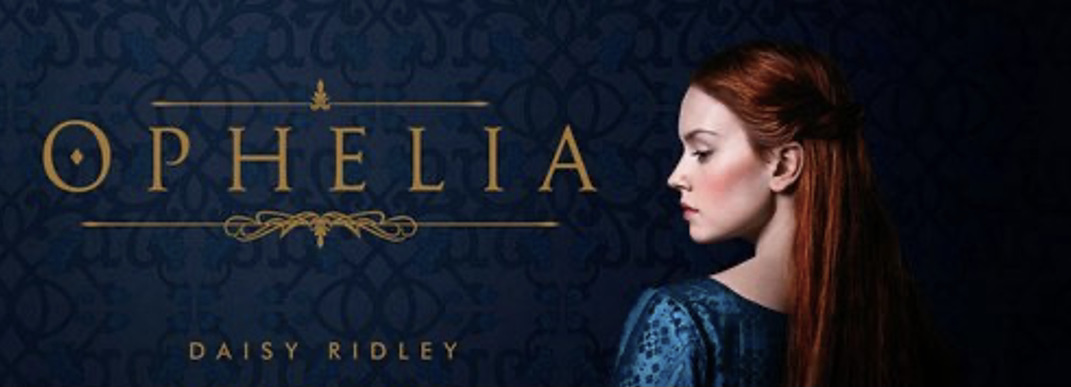
The 2018 film ‘Ophelia’ is based on the original ‘Hamlet’ character who was the protagonist of Lisa Klein’s novel. The film tells the story of ‘Hamlet’ but from Ophelia’s perspective. The film follows Ophelia’s life from when she was a child, who first entered court, to her whereabouts at the end of the play. While remaining faithful to the source material, the film deviates from it significantly. Ophelia is generally considered to be a side character in the original play, one that exudes excessive femininity. Being a woman of the Elizabethan age the plot lines and themes that surround her focus on her sexuality, honour and madness.

The film opens with Ophelia floating in a lake. This is probably Ophelia’s most iconic scene in the play, even though it is only referenced by Gertrude and not actually seen. Gertrude’s speech, recounting Ophelia’s death, has been the subject of many paintings, by the likes of John Everett Millais and John William Waterhouse. Much like these paintings, Daisy Ridley dons red hair throughout the film. This immediately makes her standout at court, and as a child, she is forced to be washed and wear fine clothes. The court domesticates her, implying that, before entering court, Ophelia was not the feminine beauty that is depicted in the play. Her dancing is also likened to a ‘goat’… which does not paint the most feminine picture.

Ophelia is regularly seen with her hair open, perhaps a reference to her infamous mad scene in Act 4 scene 5. In Elizabethan theatre, open, messy hair was associated with madness and acted as a sign of sexual discordancy.

From the get go, Ophelia’s affiliations with nature are made explicit. She is frequently seen swimming in a lake, and runs to nature for solace. This is where she meets Hamlet as an adult, when he returns from his studies at the University of Wittenberg. She is mocked for wearing flowers in her hair. Ophelia’s later use of flowers in her mad scene are referenced here. Ophelia’s identification with nature emphasise her untameable and free spirit, as well as her child-like innocence. This innocence is further emphasised by her reading of romantic texts. It appears that she dreams about romance and love, and its only upon Hamlet’s return that these wishes are fulfilled.

In the play, Ophelia is more of a pawn used by men for their own gain. For example, Claudius uses her to assess Hamlet’s feigned madness. However in the film, she has more agency and witnesses key plot developments. She witnesses an adulterous kiss between Gertrude and is sent by Gertrude to collect tonic from a local witch named Mechtild. It is Ophelia that also sees the Ghost first – even though it is just Claudius in disguise. She becomes embroiled within the politics of Denmark from the beginning of the film, and is probably more aware of this than her original counterpart.

Ophelia also has a subtle feminist edge. While rejecting Hamlet’s advances, as she recognises that he is a Prince, Hamlet references her frailty. In response she notes that it is more likely that the trait of frailty runs within families, not exclusively womankind. Hamlet’s winning over of Ophelia in the film proves that he genuinely cares for her, something that is questioned in the original play.

The film diverts from the play with Hamlet and Ophelia’s marriage. They marry outside in a field, again referencing how comfortable Ophelia is within nature. The film also tackles the infamous ‘get thee to a nunnery’ scene, 3.1. Ophelia is aware that she is being used by Claudius to assess Hamlet’s sanity, and she is aware that Hamlet is playing up to it. He is concerned for her welfare, and advises her to flee Denmark. In the play he is unsympathetic towards her, and even though Hamlet might be faking his assault of Ophelia, there is no apology or repentance afterwards.

Hamlet puts his plan in motion when he engineers the Dumb Show, a play that re-enacts the murder of his father by Claudius. It is here that he catches ‘the conscience of the King,’ meaning that effectively, he confirms Claudius’ guilt. Hamlet lunges to kill Claudius, but it is Ophelia that stops him – again, she is central to the action. In the play, Hamlet stops himself from killing Claudius when he hears Claudius praying for forgiveness, and absolving his sins.

The next chain of events occurs quickly. Hamlet is carted off to England, and is thought to be killed by Rosencrantz and Guildenstern. Ophelia is forced to wed another, and when she refuses she is thrown in jail. Ophelia here pretends to be mad, to elicit sympathy from Gertrude, which proves effective. This again emphasises Ophelia’s agency and ingenuity. When she hands out her flowers, she dishes out rue, which is for remembrance. Whereas in the play her choice of flowers are thought to be the results of madness, the film makes it clear that Ophelia is being strategic, as she subtly insults the King and Queen through her use of foliage.

Ophelia then fakes her death, by taking a strong sleeping draught. There is no mention of the ‘willow’ and Ophelia’s fall from it, but like in the original play, it is through Gertrude that we discover that Ophelia has died in a lake. Horatio then digs up Ophelia’s grave, finding her alive. After learning the truth from Mechtild, she returns to Hamlet to tell him that Claudius is indeed guilty of killing King Hamlet. Ophelia resolves this instrumental plot thread, which heightens her importance in the film.

The portrayal of Gertrude also impacts Ophelia. Naomi Watts plays Gertrude and Mechtild, and the two characters are sisters. Mechtild was considered a witch because she had a miscarriage. The death of her baby was thought to be the work of the devil, and so she was to be burned at the stake. Interestingly, the child was Claudius’. However, she faked her death and escaped. What does this mean, that both characters are played by Watts? Perhaps it is two different extremes of womanhood, the outcast and the queen. Ophelia inhabits some sort of space between the two, as the future king of Denmark’s wife, and the fleeing outcast. Unlike in the play, where Gertrude accidentally drinks the poisoned wine, she kills Claudius. She stabs him with a sword which pushes through the back of his throne. The white throne and spurt of blood may be a reference to penetration. This reverse act of penetration, as female penetrates the male, is dangerous and deadly to Claudius. Gertrude reclaims her narrative, in an act that appears to reclaim her sexuality. It is only after this that Gertrude poisons herself. She dies in control of her story, as does Ophelia. The difference is, Ophelia lives.

Ophelia notes that she ‘did not lose my way to vengeance.’ By the end of the film, and play, someone is baying for the blood of someone else. Throughout the play, Ophelia was never vengeful, and the film retains this key character trait. It is her inherent goodness that saves her. Ophelia gives birth to a daughter, and lives with her in a convent. Ophelia is safe in a female-dominated environment, and it is here that she is able to flourish. Gertrude is starved of this. The film is suggesting that it is men who use and corrupt women, it is their fault that women fall.

Thanks for reading!

Christian Allegory in ‘The Lion, the Witch and the Wardrobe’

C. S. Lewis’ 1950 children’s classic has been adapted multiple times for stage and screen. While the novel is consistently cited as a fan favourite, what is less obviously cited is the Christian allusions within it. Some adaptations play this up more than others, and after re-reading the book, I would say that they do have an ambiguous quality. Such allusions would probably only be recognised by those who understand and have knowledge of Christianity. Lewis himself stated that such allusions were not intentional, but modern critics have nonetheless identified that they are there.

An obvious reference to Genesis is the Pevensie children’s statuses as Daughters of Eve, and Sons of Adam. I was never entirely sure what this meant, but perhaps the use of Adam and Eve was meant to emphasise the humanity, and therefore purity, of the four children when in comparison to figures such as the White Witch. The children’s status as descendants of the first men and women seem fitting, as it is they who take seat at Cair Paravel and restore harmony to the kingdom of Narnia.

However, it is also Adam and Eve that bring sin into the world. Perhaps Lucy brings sin to Mr Tumnus, by placing herself in his way and tempting him to betray her to the White Witch. Susan and Lucy fit the image of the subservient Eve, as majority of the arduous physical activities are left to the men. What they lack in physical action they do make up for in kindness and compassion and serve as council to their brothers.

When looking at Milton’s depiction of Eve in ‘Paradise Lost,’ one may draw some similarities between her and Susan. Jumping forward to ‘The Last Battle,’ the last book in the series, Susan comes under fire for her growing obsession with ‘nylons and lipstick and invitations.’[1] She is no longer deemed a friend of Narnia. It appears that Susan has grown up, and has essentially become a stereotypical, teenage girl. It is implied that she is particularly materialistic and selfish. Perhaps her obsession with looking pretty and attracting invitations, maybe a reference to the attention of boys, might imply her growing promiscuity? This may be a bit of a jump, but in the way that Milton sees Eve as a sinner, Lewis appears to imply that Susan has become a sinner. She has fallen from grace much like Eve. It is unclear whether she makes it to Aslan’s country in the end, and her barring from heaven may be a result of a combination of materialism, hedonism, immaturity, and promiscuity.

Both Susan and Lucy are side-lined slightly by Peter and Edmund. Peter fills the role of the apostle, much like his biblical namesake. St. Peter is given his name by Christ, as Peter is given the name Sir Peter Wolfsbane by Aslan.

When talking about sinners, Edmund is the obvious contender. While he does not commit any form of fratricide, his feud with brother Peter, and betrayal of all the Pevensies can be likened to the conflict between Cain and Abel. A more obvious allusion is to that of Judas, who betrays Christ with a kiss. Edmund’s betrayal is more unceremonious, as he just sneaks out of the Beavers dam. Allusions between Edmund and Eve can also be drawn, as he is tempted by a food product, Turkish Delight. It is his indulgence in this food that acts as a metaphor for the betrayal of his siblings.

Speaking of Judas, the main contender for the role of Christ is Aslan. This allusion is brought to the fore when he sacrifices himself for the sins of mankind, as represented by Edmund, and is promptly resurrected. It is he who is supposed to save Narnia, and does so by guiding the children in the right direction to do so. It also makes sense for Aslan’s country to be heaven, the children’s final destination. Lucy and Susan’s witnessing of Aslan’s death places them in the role of the Virgin Mary and Mary Magdalen, who watched Jesus die on the Cross.

It also Aslan who also defeats the Witch, who is evil personified. While the novel notes that the two of them ‘rolled around’ on the battlefield, it does not explicitly say how the Witch dies.[2] In the 2005 film adaptation, Aslan explicitly bites her head off. While not very Christ-like, it is finite and it does hammer the point home that good has triumphed over evil. The Witch’s status as ice, and Aslan’s orange mane as fire also adds to the image of evil being extinguished.

The White Witch’s origins are touched on briefly in the text, and she is described to be a daughter of Lillith, Adam’s first wife, and descended from giants. Lilith is traditionally portrayed as some sort of she-demon, so it is obvious that Lewis is trying to explain where the Witch gets her nefariousness from. The Beavers recount that there is no ‘Human blood in the Witch.’[3] This again asserts the superiority and purity of the Pevensie children.

Her backstory of further elaborated upon in ‘The Magicians Nephew.’ While her family ruled as the kings and queens of Charn, the Witch’s uttering of the ‘Deplorable World’ wiped out all life in Charn except her own. After being resurrected by Polly and Digory, she attempt to conquer the human world, and then is transported to Narnia at the moment of its creation by Aslan. Here she tries to battle Aslan with a fragment of a London lamp post… yes this is true. After the lam post is fairly ineffective, no surprises there, she flees to a garden on a mountain west of Narnia and eats an apple that she believes will grant her immortality. It does, but as a result, her skin is bleached white and the evil in her heart causes her eternal misery. One thousand Narnian years later, Lucy stumbles upon the same fragment of the lamppost, which has grown into a fully working one. The garden conjures up thoughts about the Garden of Eden, and Adam and Eve’s fall from grace. It could also allude to the Jesus’ time in the Garden of Gethsemane, where Jesus suffered emotional turmoil before his arrest. I could not tell you if the Witch goes through some existential crisis in the garden, as I have not read ‘The Magicians Nephew’ in a while, but surely some thought must have led to her decision to eat the fruit?

Thanks for reading!


[1] C. S. Lewis The Last Battle (London: HarperCollins, 2009).

[2] C. S. Lewis The Lion, the Witch and the Wardrobe (London: HarperCollins, 1998) p. 185.

[3] Ibid., p. 88.

Colonialism and the Crusades: Evaluating Joshua Prawer’s and Lucy Anne Hunt’s interpretations

This essay will critically evaluate two historiographical approaches to the nature of the crusades. An examination of these approaches will focus particularly on the concept of colonialism. Prawer’s 1973 work on the subject identified the Crusades as the ‘first European colonial society,’ due to the crusaders policy of non-integration with the natives.[1] Hans Mayer’s ‘Latins, Muslims and Greeks in the Latin Kingdom of Jerusalem,’ published six years after Prawer’s work, largely agrees with Prawer’s views, that the Kingdom of Jerusalem was a colonial state, as proved through the examination of social and legal divides.[2] However Lucy Anne Hunts 1991 work on ‘the Problem of ‘Crusader’ art’ argues that artistic development during the Crusades demonstrates a degree of cultural hybridity which would negate the idea of colonialist separatism. This essay will examine the respective arguments, methodologies and limitations of Mayer and Hunt with respect to their contribution to the existing arguments concerning the nature of colonialism at the time of the Crusades.

Mayer and Hunt have distinctly different arguments concerning the nature of the crusader states. Mayer asserts that the crusader states were colonialist states, like Prawer. Although the word ‘colonialist’ is not used, Mayer paints a picture of a world in which the native Muslims were ‘devoid of political rights,’ and that there were many divisions within the crusader societies.[3] His assertion that Muslims were perceived to be simply ‘objects of taxation’ by the crusaders reinforces the perception of native inferiority, and does not illustrate a harmonious picture between conqueror and conquered.[4] Mayer explores the exploitation of the natives by looking at the law. When assessing property, throughout the crusader states, if a family had ten gold pieces worth of property, they were forced to pay one percent of this money as tax. However, the rich manipulated this rule, and by declaring that they had been overcharged, and swearing the value of their property under oath, their property could not be extorted. The rich would therefore swear that their property was worth less than what was originally judged, allowing them to keep their money. The native Muslims were not afforded this loophole and were therefore exploited by the crusaders.[5] Mayer appears to select appropriate evidence when making his argument, as it is clear that the rich were willing to manipulate and exploit the poor native Muslims for their own financial gain. This would naturally create an imbalance of social and legal equality, as the Muslims were treated as inferiors by the colonisers.

Hunt’s article concerning artistic developments in contrast argues that cultural mixing occurred within the crusader states. She argues that art can tell us about local traditions and change in taste, proposing that religion is the cause for cultural change.[6] Hunt uses the Church of the nativity to epitomize this, which was completed in 1169.[7] The Church demonstrates the collaboration between the king of Jerusalem and the Byzantine emperor, and from this Hunt argues that crusader art can be termed neither exclusively western or Byzantine.[8] She uses S. Bochner to support her view, who argued that different cultures ‘mutually exert influence on each other’s ethnicity.’[9] Hunt and Bochner both agree that the colonialists and Byzantinists were influenced by each other, and therefore adopted each other’s artistic styles. The arguments of both historians concerning the crusades are radically different, as Mayer asserts the view that the crusader states maintained legal and social divides, much like the colonial states, whereas Hunt argues that through art, the crusader states were places of cultural mixing and hybridity.

The methodologies and evidence of both interpreters also differ. Mayer primarily uses written and eyewitness accounts to support his view. Mayer cites the account of Fulcher of Chartres, who notes that the Saracens mourned the death of King Baldwin I in 1118, along with the Franks and Syrians.[10] Chartres was a chronicler of Baldwin I, and by citing this account Mayer affirms his belief that there were social divides within the crusader states, as he notes that Muslims could only participate in public life upon the death of a king.[11] Another written source comes from William of Tyre, who reported that Muslims also attended the funeral of King Baldwin III.[12] Prawer too had mentioned this six years previously in his work, arguing that the only function of the indigenous Muslim population was to mourn the deaths of Frankish kings.[13] Mayer’s methodology, and information about the social and legal standing of the natives, comes purely from first-hand accounts and written texts, which differs greatly from Hunt’s evidence, who prioritises that of physical buildings.

Hunt uses the inscriptions in the Church of the Nativity in Jerusalem to further her argument. Inscribed in the nave is the name Basil, and Ephraim in the south side of the apse.[14] Ephraim was a monk and artist, who completed his work in the Church in 1169.[15] Cutler describes Ephraim as a byzantine mosaicist who was called from Constantinople by the Byzantine Emperor Manuel.[16] This western influence can be seen in the Church. Western saints, such as the Virgin, are heavily featured and represented, as is St John the Baptist, whose Jordan monastery was also restored by Manuel.[17] The abundance of Christian iconography, Hunt believes, demonstrates that there was not one distinct culture in the crusader states that influenced the building of the Church of the Nativity.[18] Basil’s own inscription appeared twenty years after Ephraim’s, in Syriac, an unspoken language affiliated with the orthodox church.[19] Hunt asserts that Basil was a Syrian Melkite, who could have been a deacon controlled by the Latin clergy, as Orthodox Syrians were favoured by the Latins over the Greeks.[20] The differing heritage of the artists demonstrates, in Hunt’s eyes, that the crusaders adopted different cultural and artistic techniques in the crusader states, proving them to be areas of cultural mixing and hybridity. She described the Church of the Nativity to be the epitome of such ideas, as both native and western artists worked on the Church, as inferred from the artists’ inscriptions and the western art itself. This appears logical, as one can visually understand and see the artists’ difference in heritage and design, which clearly demonstrates the amalgamation of western and Byzantine ideas within the crusader states.

However, when critically assessing the articles, both present limitations. Mayer focuses on an account from a Spanish traveller, Ibn Jubayr, who travelled to Acre, in 1184.[21] The account reinforces the idea that there was separation between different groups of people in the Kingdom of Jerusalem at the time of the crusades, but paints an idyllic view of their life, particularly in the coastal regions.[22] One can criticise Mayer’s selection of evidence here, as there is conflict between maximalist and minimalist interpretations. When taking the maximalist approach, one could argue that the source has worth as there are accurate descriptions of the ruling class within it, and it supports the colonialist argument, much like Prawer. However, one could downplay the value of the source as Jubayr takes a minimalist view, as he makes generic assumptions about the entire kingdom based on one village that he very briefly visited. He was an elite Muslim himself, and it is unlikely that he was shown areas of squalor and suffering on his tour, proving that Jubayr only provides a snapshot of life within Jerusalem. Written accounts are also open to interpretation, as proved by Jubayr’s mentioning of a functioning Mosque in Acre.[23] From this one can ascertain that Mosques were allowed by the Latin settlers in major urban settlements such as Acre, but this begs the question as to whether they were permitted in other places. Jubayr’s account does not provide an explicit answer, as he did not travel enough of the kingdom to ascertain this knowledge. The source therefore is open to interpretation and cannot reliably be used to learn about the crusader states as a whole.

Hunts use of physical evidence too presents problems, as well as her own background. Dumbarton Oaks is an American research institute, focussing on Byzantine studies. Hunt herself is a Byzantinist, and therefore may be biased and willing to over highlight the importance of the Byzantine images within the Church of the Nativity. Her main problem is that art is subjective, and that Hunt cannot categorically confirm how the art was received at the time. Like some of Mayer’s chosen texts, she provides a snapshot of the conditions and excludes other communities in the process, such as religious ones. Her article would be further improved if she looked at artistic developments over an extended period of time, and widened her sources. The Church of the Nativity is a special case, as it is an important site, its presence does not mean that all artwork in the Kingdom of Jerusalem displayed such cultural integration. It is also worth noting that such huge artistic works would have been designed by the elite, and perhaps used for political gain, as it was the elite groups in society that decided how cultural integration was perceived and represented.[24] Response art and graffiti would have also been helpful to Hunt. The presence of such in art in churches, like the Church of the Holy Sepulchre, could demonstrate the presence of other cultures and strengthen her argument.

Despite these limitations, there is a brief crossover between the two sources, as Mayer notes the different figures that contributed to the repairing of the Church of the Nativity. Emperor Manuel I was the protector of the Greek church by office and extended this protection to the crusader states.[25] The merging of the kingdom of Jerusalem with the Byzantine was influenced by the marriage of King Amaury of Jerusalem to Byzantine princess Maria Komnene, sparking an alliance with Emperor Manuel.[26] Following the couples’ state visit to Constantinople, Emperor Manuel repaired parts of the Church of the Holy Sepulchre, and in 1169, ordered the building of new mosaics in the Church of the Nativity. The Latin inscriptions mention the ‘payments of the Emperor,’ and the Greek inscriptions mention the ‘overlordship of the Emperor.’[27] This demonstrates that there was collaboration between the Latins and the Byzantinists in repairing the Church, advocating the presence of hybridity in the crusader states. Manuel himself too was painted in various places around the church as a reward from the Bishop of Bethlehem for his work.[28] Although the arguments of Hunt and Mayer differ, the evidence cited by Mayer can be used to support the idea of cultural hybridity within the crusader states.

Both articles appear to contribute to the already existing arguments about the crusader states. As noted previously, although Mayer’s article does not include the word ‘colonial’ it appears to be heavily influenced by the work of Prawer. Speaking in 1984 at a symposium, Prawer maintained that the crusader states were forged with a ‘colonial attitude,’ and that invaders did not accept local cultures and would not integrate with the Muslims, resulting in an ‘apartheid.’[29] Mayer’s findings about the legal and social divides within the crusader states harks back to Prawer’s idea, and contributes to it. Art was not explicitly mentioned at the symposium, but Hunt’s advocation of cultural hybridity within the crusader states, was reflected in the words of Professor Moses Finley, who criticised Prawer and noted that the rulers of the Kingdom of Jerusalem asked the west for help, and maintained many links with Europe which could have led to cultural mixing between the two.[30] Finley rejects the idea that the aim of the crusader states was independence, and although he does not discuss art as explicitly as Hunt does, her idea that the crusader states were not devoid of Byzantine influence can be linked back to Finley’s ideas.

The work of both Mayer and Hunt are indirectly cited in a 2017 book by Andrew Jotischky, demonstrating their continued relevance. Again, Mayer’s ideas are explored through the work of Prawer, as Jotischky discusses the legal and social institutions in place in crusader states. His assertion, based on Prawer’s, that the indigenous population were marginalised by the crusaders, too echoes back to the work and argument of Mayer, even though Mayer is not explicitly mentioned.[31] Jotischky also mentions the artistic culture within the crusader states, implying that the work of Hunt may have been present in his mind. Jotischky uses the example of the Church of the Nativity like Hunt, and notes that, due to the amalgamation of eastern and western artistry, the Church displays ‘cultural synthesis.’[32] The presence of western artistry is confirmed by the presence of western saints, perhaps showing Hunt’s influence on Jotischky’s work. Jotischky also cites the background of the artists Ephraim and Basil as Hunt does, to illustrate the hybridity of culture within the church. The similarities in the works of Hunt and Jotischky imply that the latter was directly influenced by the former, demonstrating the relevance of Hunt’s work and its impact upon the wider critical debate.

The works of both Mayer and Hunt differ greatly in their arguments and methodology. They both sit at opposite ends of the spectrum when discussing whether the crusader states can be seen as colonial states or states that allowed cultural mixing. Both works are well researched and argued, but are also both flawed. Written texts appear to lack credibility upon interpretation, and the subjectivity of art should not be ignored, but also should not dampen the significance of Meyer and Hunt’s work. Such flaws can perhaps explain why the debate about the true nature of the crusader states continues. Despite their differences and flaws, the work and arguments of Mayer and Hunt are clearly still relevant to the crusader debate, as they can be seen to, indirectly and directly, influence Jotischky’s recent work on the topic.


[1] B.Z Kedar (ed.), ‘The Crusading Kingdom of Jerusalem – The First European Colonial Society? A Symposium’, in The Horns of Hattin (Jerusalem, 1992), p. 341.

[2] H.E. Mayer, ‘Latins, Muslims and Greeks in the Latin Kingdom of Jerusalem’, History, Vol.63 (1978), p. 175.

[3] Ibid., p. 175.

[4] Ibid., p. 177.

[5] Ibid., p. 178

[6] L-A Hunt, ‘Art and Colonialism: The Mosaics of the Church of the Nativity in Bethlehem (1169) and the Problem of ‘Crusader’ Art’, Dumbarton Oaks Papers, Vol. 45 (1991), p. 71.

[7] Ibid., p. 71.

[8] Ibid., p. 69.

[9] Ibid., p. 71.

[10] Mayer, ‘Latins, Muslims and Greeks in the Latin Kingdom of Jerusalem’, p. 180.

[11] Ibid., p. 180

[12] Ibid., p. 180

[13] A. Jotischky, Crusading and the Crusader States, (London, 2017), p. 17.

[14] Hunt, ‘Art and Colonialism: The Mosaics of the Church of the Nativity in Bethlehem (1169) and the Problem of ‘Crusader’ Art’, p. 74.

[15] Ibid., p. 74.

[16] Ibid., p. 75.

[17] Ibid., p. 76.

[18] Ibid., p. 77.

[19] Ibid., p. 75.

[20] Ibid., p. 76.

[21] Mayer, ‘Latins, Muslims and Greeks in the Latin Kingdom of Jerusalem’, p. 181.

[22] Ibid., p. 181.

[23] Ibid., p. 186, n. 41.

[24] Hunt, ‘Art and Colonialism: The Mosaics of the Church of the Nativity in Bethlehem (1169) and the Problem of ‘Crusader’ Art’, p. 70.

[25] Ibid., p. 190.

[26] Ibid., p. 190.

[27] Ibid., p. 190.

[28] Ibid., p. 190.

[29] B.Z. Kedar (ed.), The Horns of Hattin, p. 364.

[30] Ibid., p. 345.

[31] Jotischky, Crusading and the Crusader States, p. 18.

[32] Ibid., p. 158.

Queer coded villains in children’s films

Every film, especially children’s ones, have a good villain. It is a key part of the plot. While these characters are feared, respected and enjoyed, it is modern criticism that has now pointed out that majority of these villains have been ‘queerly coded.’ But what does this mean? Effectively, queer coding a character means that said character is implied to be queer, perhaps through their speech of mannerisms. Their homosexuality is not explicitly confirmed, but implied in the subtext. In children’s films, it is common for these characters to be portrayed as villains, creating an unhealthy, and unnerving link between queerness and villainy.

Why might characters be queer coded? Well, in 1934, Will H. Hays produced the ‘Motion Picture Production Code.’ These contained guidelines for self-censorship of content, and warned against depicting, what was then classed as, the ‘perversion’ of homosexuality. Homosexuality was banned from being explicitly depicted, and therefore it was implied. Homosexuality was implied through stereotypical and at times, derogatory mannerisms. Although the Hays Code, as it was colloquially known, was officially abandoned in the late 60s, these stereotypical traits and characters continued to bleed through. These films do not imply that certain villains are evil because of their queerness, but it does create an unethical relationship between queerness and villainy, a relationship which is regularly seen in children’s films.

While more of a family film, the Child Catcher in ‘Chitty Chitty Bang Bang,’ is queer coded. The Child Catcher was played by Robert Helpmann, an openly gay ballet. It is undeniable that the character has camp mannerisms, and because of this some commentators have argued that the character fills the stereotypical role of the ‘gay paedophile.’ It is this that makes the character even more scary, and dangerous, towards children. This stereotype does seem to imply a relationship between queerness and villainy. Interestingly, The Child Catcher does not appear in Fleming’s original novel, and instead was fully fleshed out by the director, Ken Hughes. Perhaps the Child Catcher was played this way to act as a foil to Dick Van Dyke’s character, Caractacus Potts.

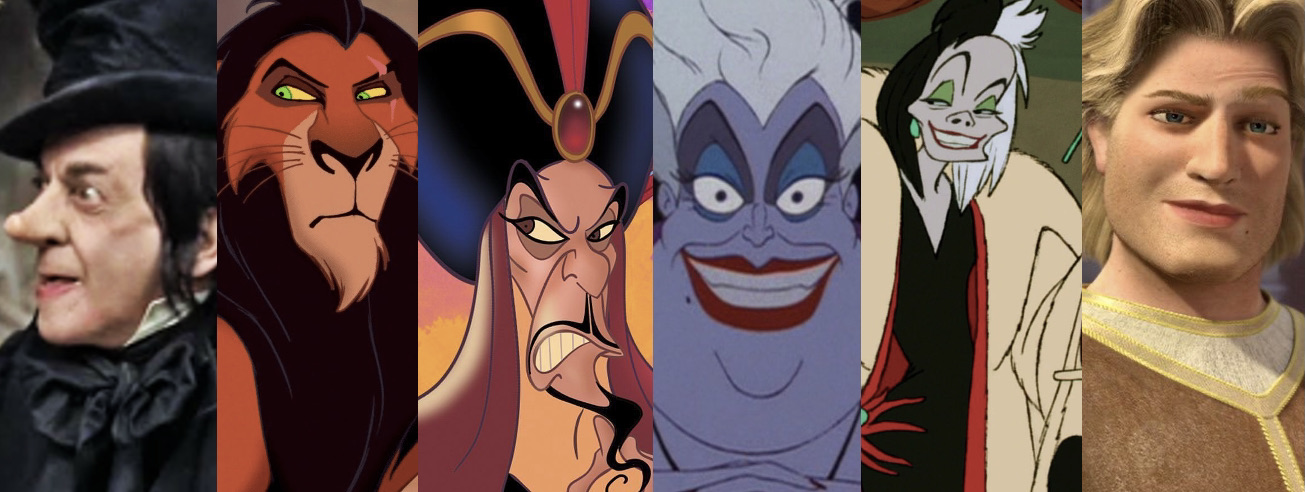
Turning our attention to Disney now, two notable, queerly-coded villains include Jafar and Scar. Both were animated by Andreas Deja, who himself was gay. This led many to believe that Jafar and Scar were based on him, something that Deja himself has denied. Deja claimed that Jafar’s appearance was based on Conrad Veidt. Jafar’s voice actor, Jonathan Freeman, also claimed that his work was inspired by Vincent Price and Boris Karloff. Both latter actors were famous for their villainous roles. Although Jafar does possess stereotypical camp mannerisms, throughout the film he is motivated by a potential marriage to Jasmine. This might complicate things, and based on Deja’s comments, perhaps means that Jafar has not been queer coded. Maybe it is our perception that has foisted this upon him.

In terms of Scar, again, Dejas said that he based the character on Jeremy Irons. Scar’s limp paw, and melodramatic tendencies, is what probably leads people to suggest that he may be queer, but again, like Jafar, he pursues a heterosexual relationship with Simba’s mother. Perhaps motivations and characteristics are not related… and if they are not related, then maybe queerness is not related to villainy? Again, perhaps it is just our outdated perceptions. Deja did also animate Gaston, whose villainy is based on his toxic masculinity, so perhaps Deja is truthful when he says that Scar and Jafar were unintentionally queer. Scar and Jafar also tap into ideas about colourism, as in their respective films, their skin colour is darker than the other characters in their respective films.

Maleficent and Ursula also join the line-up. Ursula appears as the stereotypical butch lesbian, and was based upon drag queen Divine, who regularly appeared in film. Due to this, Ursula herself has become a gay icon. Given Ursula’s movements and voice, and her appearance as Vanessa, it is clear that the production team wanted Ursula to have some sort of seductive, alluring quality. Maleficent possesses the same quality, and although is villainous, is not exactly ugly. It has long suggested that her appearance was based on Maila Nurmi’s turn as Vampira, a camp icon of the 1950s. While Maleficent is not as animated, and camp as Ursula, both are portrayed as much paler and sallower than their opposites, Ariel and Aurora. Both are outcasts, witches and determined to thwart romantic, specifically heterosexual, relationships. Perhaps this is implying some sort of queer-jealousy? A hatred of heterosexual relationships due to their own queerness?

I would also like to throw Miss Trunchbull into the mix. Again, she matches Ursula and fulfils the butch lesbian stereotype, but her behaviour pushes this trope a bit further. She appears obsessed with the feminine Matilda and Miss Honey, and berates Amanda for her excessive femininity, symbolised by her pretty pigtails. She is slightly Child Catcher-esque, as the film appears to suggest that queer people cannot be trusted around children. Again though, she does enter into a heterosexual relationship with Miss Honey’s uncle, as Jafar and Scar sought to do. Although Pam Ferris played her in the film, a man, Bertie Carvel, played her in the musical adaptation, perhaps in an attempt to push the butch lesbian trope further.

One character that appears devoid of sexuality, and is not involved in any sort of relationship is Cruella de Vil. Perhaps this is supposed to suggest her asexuality, but as other critics noted, it appeared that in Disney, characters were either explicitly heterosexual, or nothing. Again, she has a greyer complexion than characters such as Anita and Roger. In fact, all Disney villains I have commented on have a much more different complexion than the heroes of their films. Perhaps this is meant to show that they are devoid of heterosexual feeling and/or love? Or was it purely to point out that they were the films big bad, marked through their physical difference? Either option is probably just as bad as the other.

Perhaps Shrek can save us… or maybe not. While some critics identify Prince Charming as a metrosexual, others have argued that he is queer coded due to his dubious motivations. Does he really want Fiona, or does he just want his mother’s approval? Or does he just want glory? If he is actually attracted to Fiona, then fair enough, perhaps we can put his queer coded-ness to bed, but if not, does it leave him more open to interpretation, as the stereotypical ‘mummy’s boy.’

So… what conclusions do we draw from this? Would it be worth asking why these villains have all been portrayed in this way? Perhaps it is simply because producers wanted to create a foil between the virile, masculine hero and his villainous counterpart. In terms of female villains this also applies, they are not nearly as beautiful and feminine as the heroines of the film. Although this clearly does mark a divide, and flag up who is ‘bad’ and who is not, it does not make it right. Perhaps the audience is at fault, for still adhering to age-old stereotypes. Whether intentional or not, it does create an unhealthy link between queerness and villainy, something that does need to be addressed.

Thanks for reading!

How was individual identity expressed materially in Tudor England?

This essay will argue that different forms of material culture allowed the people of Tudor England to express different aspects of their individual identity. A persons ‘identity’ is influenced by several different affiliations. The people of Tudor England were associated with concepts such as heraldry and social standing, religion, and gender. Each of these different concepts were expressed through different material means. Firstly, this essay will examine how architecture allowed the Tudors to express their social identity. Secondly, the essay will discuss how books allows the Tudors to express their religious identity. Thirdly, the essay will recognise that activities, such as needlework, allowed people to assert their gender identity. By studying material culture, historians can understand the individual identities of the people of Tudor England.

It was the inclusion of heraldic imagery within architecture that allowed the Tudors to express their social identity.  ‘Social identity’ refers to how people relate to different social groups within society. Examples of heraldic images can be seen in what Sir John Summerson calls ‘prodigy houses.’ This describes large houses that were built to house, and impress, Elizabeth I and her entourage when she toured the country on progresses. John Guy notes that, courtiers competed to build more impressive houses, with the aim of winning the favour of the queen. This is demonstrated by Hardwick Hall in Derbyshire, which was designed by Robert Smythson for Bess Hardwick, and was built between 1590 and 1597. The chimney piece boasts Bess of Hardwick’s coat of arms, which appears several times throughout the building. They also appear on the house’s exterior in stone. By including this image throughout the hall, Hardwick expresses her social identity, as she is clearly pointing out her familial heritage using visual imagery. Those who recognised the crest would have ascertained that Hardwick came from a rich and respected family. Due to this, Hardwick’s inclusion of her family crest allows her to express her social superiority to her contemporaries.

In the High Great Chamber, Hardwick included the royal coat of arms of Elizabeth I. The High Great Chamber was used to receive important guests, and the presence of the arms would have indicated to them that Hardwick herself was affiliated with the crown. This connection to the crown would have enhanced Hardwick’s social status further. As well as asserting her own authority amongst her peers through this royal connection, Hardwick’s inclusion of the royal arms also demonstrates her loyalty to Elizabeth I. Tara Hamling notes that displays of the royal coat of arms were common in urban areas, especially in gentry houses. This allowed members of the gentry to assert their higher social standing in contrast to others within the locality. The use of heraldic devices allowed Hardwick and members of the gentry to enhance their social authority within the community, as this was elevated by their connections to the crown.

A stained-glass window at Montacute House in Somerset also demonstrates that architecture was used to express social identity. The house was owned by Edward Phelips, designed by William Arnold and built in 1598. The window depicts the coats of arms of fourteen local families. This visual imagery allowed Phelips to demonstrate his multiple social connections, which he had acquired through numerous familial marriages. As well as displaying his connections, this window would have encouraged people to recognise the authority and influence that Phelips held within the community. The placing of the shields on a window meant that they were clearly visible to all who walked past, meaning that Phelip showcased his social identity. To understand which arms represented which families, people would have needed a book of heraldry. Inclusion in such a book would only enhance one’s social status within the community, as it would only validate the families’ respectability.

Books were used to express religious identity. An example of this is a Book of Hours, which was popular before the Henrician reformation. These decorative books would contain prayers and psalms, as well as instructions as to when these prayers should be recited during the day. Books of Hours were created for the purpose of private religious practises. They were usually owned by members of the elite, who would have them personalised. An example is Anne Boleyn’s Book of Hours, which was made in Paris in 1500 and is currently held in the British Library. The pages are parchment and are particularly notable due to the personal messages inscribed inside. On a page depicting Christ suffering from the wounds of his crucifixion, Henry VIII wrote in French ‘If you remember my love in your prayers as strongly as I adore you, I shall hardly be forgotten, for I am yours. Henry R forever.’ Henry implies that his yearning for Anne is of a similar pain to Christ’s afflictions. Anne Boleyn replies with ‘by daily proof you shall me find, To be to you both loving and kind.’ This is inscribed on an image of the angel Gabriel telling the Virgin Mary that she will birth the son of God. Anne is using this religious imagery to tell Henry VIII that she is loyal and faithful to him, and that she will deliver him a son. As well as facilitating her romance with Henry, this book allowed Anne to privately express her religious identity and piety.

Following the reformation, Puritans, such as Nehemiah Wallington used notebooks to express their religious identity. Wallington filled fifty notebooks from 1618 to 1684, and detailed sermon notes to divine judgements. ‘A Record of Gods Marcys, or a Thankfull Remembrance’ was written by Wallington during the 1620s and 1630s, and was part diary and part commonplace book. In it, Wallington writes that he has ‘lived in sinne all my childhood heitherto. Likwise I knew that these sinnes were against the expres commandment of God in Exodus 20.’ Jonathan Willis recognises that Wallington’s focus on the Decalogue speaks to the Puritan desire to follow the word of God, which Puritans believed should be considered in all aspects of life. Wallington’s writings uphold the Puritan belief that they should be introspective about the word of God and their own lives. Andrew Cambers recognises that keeping notebooks was a ‘key component’ of Puritanism, as notebooks facilitated their deep contemplation of faith, as they provided Puritans with a space to write their feelings down. Wallington’s activities validate this idea, and prove that material objects were essential to the construction of religious identity. Books facilitated the expression of peoples’ religious identity by allowing them to engage in private devotion.

Susan Frye recognises that undertaking of activities allowed individuals to express their gender identity. This is supported by a linen needlework sampler, sewn in 1598 by Jane Bostocke. It is held in the V&A, and measures 42.6cm by 36.2 cm. It was made to commemorate the birth of her cousin, Alice Lee, two years earlier, and contains imagery relating to the Lee and Bostocke family crests. There are also demonstrations of different stitches. The V&A recognises that originally, samplers were used as reference pieces, but during the seventeenth century, they were used as a way of recording the maker’s skill. Embroidery was an encouraged occupation for young girls in gentry families. They would begin with samplers, then progress to caskets and embroidered pictures. Frye notes that needlework was seen as an exclusively domestic pursuit, which allowed young women to express agency and identity. Such an activity inculcates gender roles, as the domesticity that this activity encouraged informed girls of their place within the home: as the housewife. Susan Dwyer Amussen recognises the family as the basis for political and social order, suggesting that this was the reason women were encouraged to undertake tasks that educated them in domesticity from a young age. Matthew Johnson argues that gender roles were performed through action, and this sampler examples this.

Johnson provides another example of how performative action allowed people to express their gender identity. Johnson describes a folk custom from the Yorkshire Dales in which women would clean the flagged stone floor of their threshold with sand. Wives would lay out the sand in different patterns, which would remain until they were cleared in the afternoon. Johnson argues that the preservation of these patterns establishes the integrity of the household and wife, which is made visible to the community. Even though these patterns do not survive, Johnson’s recounting of this activity provides an example in which women expressed their gender identity, and drew authority from their role as housewife.

I have demonstrated that different forms of material culture were essential to expressing different aspects of individual identity. Architecture, specifically heraldic imagery, was used to express peoples’ social identity and peoples’ authority within the community. Books, in facilitating people’s worship and contemplation, allowed people to express their religious identity. Certain activities, such as needlework allowed people to express their gender identity. This proves value of studying material culture, and how it can be used to improve current historians’ understanding of the people living within Tudor England.